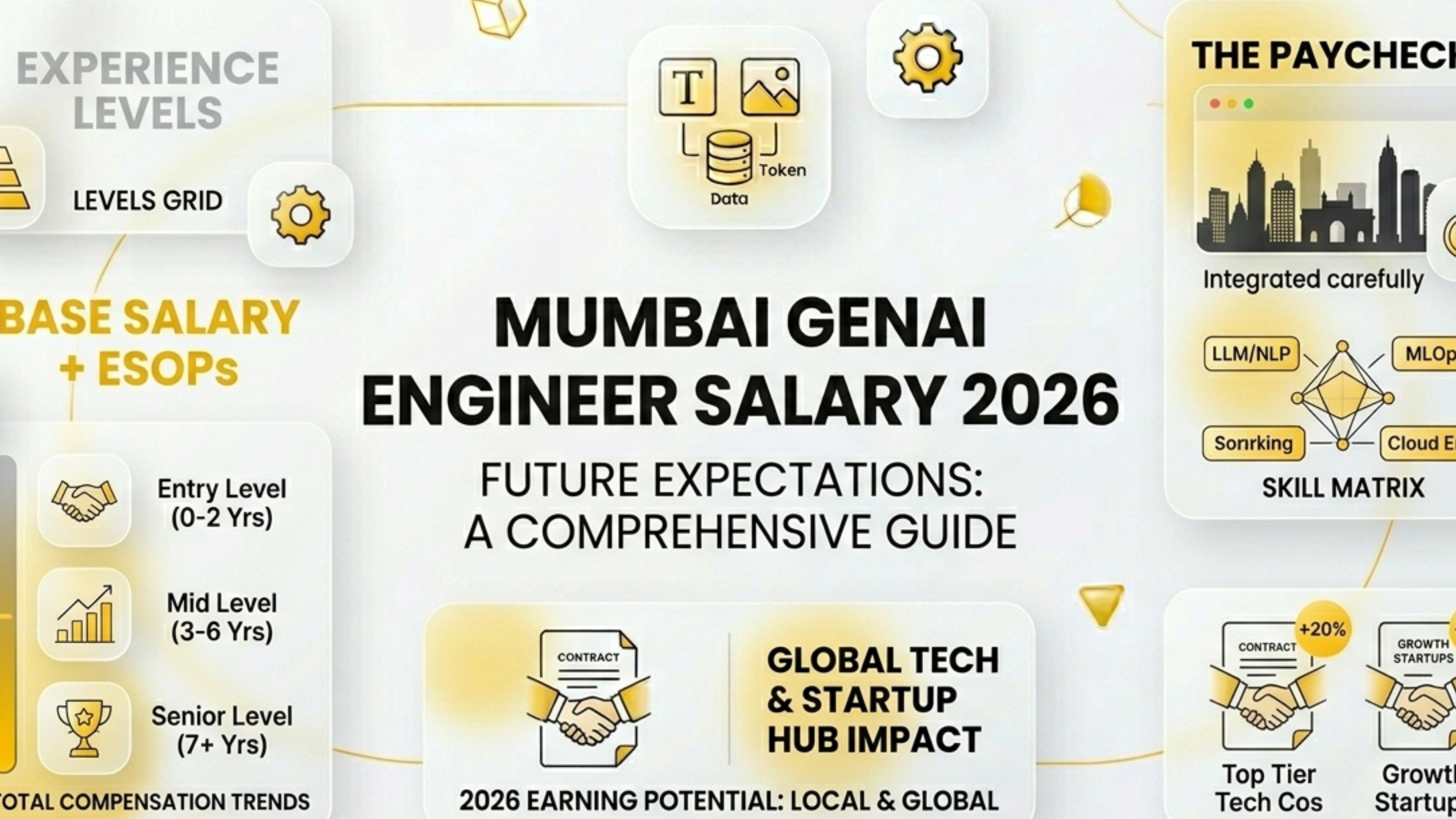
GenAI Engineer Salary in Mumbai 2026 — What to Expect
Contents
- GenAI Engineer Salary Mumbai 2025: The Complete Experience-Based Breakdown
- Tier 1 — Freshers and Junior Engineers (0–2 Years Experience): ₹7L – ₹15L
- Tier 2 — Mid-Level Engineers (3–6 Years Experience): ₹18L – ₹35L
- Tier 3 — Senior Engineers and Architects (7+ Years): ₹40L – ₹75L+
- GenAI Engineer Salary Mumbai 2025: The Mumbai Premium Hubs
- BKC (Bandra Kurla Complex): The Highest Compensation Tier
- Powai: The Startup and SaaS Premium
- Vikhroli and Eastern Suburbs: The Emerging GCC Corridor
- The "Money Skills" of 2026: What Commands the Biggest Premiums in Mumbai
- Money Skill 1: Building Autonomous AI Agents (LangGraph, CrewAI)
- Money Skill 2: Multimodal AI — Video, Audio, and Image Processing
- Money Skill 3: AI Security and Compliance for Mumbai Banks
- Mumbai-Specific GenAI Employers: Who Is Paying What
- Don't Let Your Salary Stagnate in 2026
The most important number in Mumbai's tech salary conversation right now is not a percentage — it is a multiplier. GenAI engineers in Mumbai are earning 2–3x more than their peers in traditional IT and software development roles at equivalent experience levels. That is not a projected future premium. It is the current, documented, market-rate reality.
The genai engineer salary Mumbai 2025 conversation has matured from speculation to data. Mid-level Full Stack or Java developers in Mumbai's IT services corridor typically earn ₹12–22 LPA at the 3–5 year mark. Their counterparts who pivoted to GenAI — building RAG pipelines, agentic systems, and LLM-powered applications — are earning ₹18–35 LPA for the same experience level. At the senior end, traditional software architects cap out at ₹35–50 LPA in Mumbai's enterprise market. GenAI architects and AI platform leads are clearing ₹50–75 LPA, with top-tier roles at Jio Platforms, Reliance's AI initiatives, and Mumbai-headquartered Global Capability Centres (GCCs) exceeding ₹90 LPA for AI strategy and infrastructure leadership.
This is a compensation premium built on structural scarcity. Every bank in BKC, every Fintech startup in Powai, and every multinational running a GCC in Mumbai needs GenAI engineers right now. Very few exist. The market is pricing that scarcity correctly and generously.
This guide tells you exactly where in that range you fall, what gets you to the higher end, and which Mumbai employers are paying the most for which specific skills.
GenAI Engineer Salary Mumbai 2025: The Complete Experience-Based Breakdown
Tier 1 — Freshers and Junior Engineers (0–2 Years Experience): ₹7L – ₹15L
Who sits in this tier: Final-year CS or engineering students, recent graduates, and developers from adjacent roles (Full Stack, data analysis, QA) who have upskilled into GenAI with a demonstrable portfolio.
What the market pays, specifically:
- ₹7L – ₹10L: Entry-level roles at IT services companies in Navi Mumbai (TCS, Infosys, LTIMindtree AI practices), digital agencies, and early-stage startups. These roles typically involve prompt engineering, basic RAG implementation, and LLM API integration within a larger team.
- ₹10L – ₹13L: Product companies and mid-size Fintechs in Powai and Andheri with active AI feature development. Requires a portfolio demonstrating at least one deployed RAG system or AI-assisted application with documented evaluation metrics.
- ₹13L – ₹15L: The upper end of the fresher range is available at Series B+ AI-first startups, Mumbai GCCs, and financial technology companies where domain context (payments, lending, insurance) is valued alongside the technical skills. Getting to ₹15L+ as a fresher requires: a strong portfolio with 2–3 deployed projects, demonstrated RAGAS evaluation familiarity, and ideally a working knowledge of the hiring company's domain.
The skills that push freshers from ₹7L to ₹15L:
- A deployed RAG system (not a notebook — a production-like application with a public demo URL)
- Documented evaluation metrics (RAGAS faithfulness, answer relevancy scores) in the portfolio
- Python proficiency with FastAPI — the ability to build an API around an AI feature, not just run a script
- At least one structured output / tool use implementation demonstrating understanding of function calling
- Any domain knowledge that maps to Mumbai's Fintech or BFSI sector
Tier 2 — Mid-Level Engineers (3–6 Years Experience): ₹18L – ₹35L
This is the most active hiring tier in Mumbai's GenAI market in 2025–2026. Companies that have already experimented with AI features are now building production systems and scaling teams. They need engineers who can own a GenAI feature end-to-end — not just write a RAG pipeline in isolation, but design the architecture, implement it, evaluate it, deploy it, and maintain it in production.
What the market pays, specifically:
- ₹18L – ₹24L: LLM Application Developers and RAG Engineers at product companies, Fintech startups, and IT services firms' AI practices. Deep RAG competency, LangChain or LlamaIndex fluency, and production deployment experience are the core requirements.
- ₹24L – ₹28L: AI Product Engineers who own a complete AI feature stack — from vector database configuration through API design through React or Next.js frontend. These roles are concentrated at Powai's SaaS companies and early-to-mid stage Fintechs. The Full Stack + AI combination is a premium profile.
- ₹28L – ₹35L: Agentic AI Engineers and AI Architects (mid-level) who have built and deployed multi-agent systems, understand LangGraph or CrewAI at production depth, and can make architectural decisions about AI infrastructure. These are the fastest-growing roles in Mumbai's GenAI market. Companies like Jio's AI division, Paytm's AI engineering team, and large banking technology arms are actively competing for these profiles.
The skills that drive the biggest jumps within this tier:
- Agentic workflow implementation (LangGraph, CrewAI): Moving from RAG to agents is the single biggest salary lever at the mid-level. The pay gap between a mid-level RAG engineer (₹22L) and a mid-level agent engineer (₹30L+) reflects the scarcity of this skill.
- LLM fine-tuning basics: Understanding LoRA, QLoRA, and PEFT-based fine-tuning of open-source models. Not a requirement for most roles, but a premium differentiator at companies building custom domain-specific models.
- Production evaluation frameworks: RAGAS, LangSmith, and the ability to set up monitoring pipelines that track AI output quality over time. Companies that have shipped AI features are discovering quality degradation issues; engineers who can solve them are immediately valuable.
- Cloud AI infrastructure: AWS Bedrock, Azure OpenAI Service, or Google Cloud Vertex AI — managed cloud LLM platforms that enterprise clients mandate. GCC roles in Mumbai almost always require cloud platform familiarity.
Tier 3 — Senior Engineers and Architects (7+ Years): ₹40L – ₹75L+
The senior GenAI engineering market in Mumbai is characterised by two distinct profiles with overlapping but distinct salary ranges.
The Technical Architecture Profile (₹40L – ₹65L):
Senior engineers who can design and lead the implementation of production-scale GenAI systems — multi-agent architectures, enterprise RAG platforms, AI infrastructure for high-throughput financial applications. These engineers combine deep LLM application engineering expertise with software architecture skills: system design, scalability planning, infrastructure cost management, and the ability to mentor and lead junior GenAI engineers.
Companies hiring at this level: Jio Platforms (AI and Digital Services), Reliance Retail's tech teams, HDFC Bank's AI CoE, Kotak Mahindra's technology division, and the largest GCCs operating AI initiatives in Mumbai — JP Morgan's Bengaluru/Mumbai AI teams, Goldman Sachs, Deutsche Bank's India operations.
The AI Strategy and Platform Profile (₹55L – ₹90L+):
The rarest and highest-compensated profile in Mumbai's GenAI market: engineers who combine deep technical expertise with the business acumen to drive AI strategy, build AI governance frameworks, lead the evaluation and adoption of new models and platforms, and communicate AI capabilities and risks to executive stakeholders. These roles are CHief AI Officer-adjacent in smaller companies and Head of AI Platform in larger ones.
The companies competing most actively for this profile in Mumbai are the financial services GCCs in BKC, where the combination of regulatory complexity, data sensitivity, and competitive pressure to deploy AI creates demand for leaders who understand both the technology and the compliance landscape.
What pushes compensation to ₹75L+:
- AI compliance and governance expertise — specifically for Mumbai's SEBI-regulated entities and RBI-supervised banks. Engineers who understand how to build explainable AI systems, maintain audit trails for AI decisions, and navigate model governance requirements are in a category of their own.
- Multimodal AI expertise — building systems that process and generate not just text but images, audio, and video. The multimodal frontier (speech-to-text financial advice, document intelligence with image processing, video-based KYC) is where Mumbai's financial sector is investing most heavily.
- Enterprise AI infrastructure — building the platform that a large organisation's AI applications run on: model serving infrastructure, prompt management systems, AI observability, cost management, and the developer tooling that enables teams to build AI features safely and consistently.
GenAI Engineer Salary Mumbai 2025: The Mumbai Premium Hubs
| Experience Level | Role Type | India (Annual ₹ LPA) | USA (Annual USD $) |
| Fresher (0–2 yrs) | Traditional Dev (Full Stack/Backend) | ₹4.5L – ₹8L | $85k – $115k |
| GenAI / LLM Engineer | ₹8L – ₹15L | $110k – $145k | |
| Mid-Level (3–6 yrs) | Traditional Dev (Senior SWE) | ₹15L – ₹28L | $130k – $175k |
| GenAI / Agent Architect | ₹25L – ₹48L | $170k – $230k | |
| Senior/Lead (7+ yrs) | Engineering Manager / Architect | ₹35L – ₹60L | $190k – $260k |
| Principal GenAI Engineer / AI Lead | ₹55L – ₹1Cr+ | $250k – $400k+ |
Not all Mumbai addresses pay equally for GenAI talent. Understanding the geographic salary landscape helps you target your job search for maximum compensation leverage.
BKC (Bandra Kurla Complex): The Highest Compensation Tier
BKC is where Mumbai's financial concentration translates directly into GenAI salary premiums. The companies operating here — HDFC Bank, ICICI Bank, Kotak Mahindra, Axis Bank, and the India operations of JP Morgan, Goldman Sachs, Deutsche Bank, and every major global financial institution with an India presence — pay a BKC premium for several compounding reasons.
Why BKC pays more:
The work is more complex. Deploying AI in a banking environment requires navigating RBI's technology governance guidelines, SEBI's algorithmic trading regulations, and each institution's own risk management frameworks. Engineers who can build GenAI systems that are explainable, auditable, and compliant are rarer than engineers who can build ones that are merely functional.
The stakes are higher. A hallucinating AI system at a consumer app causes a bad user experience. A hallucinating AI system at a bank processing loan applications or investment recommendations causes regulatory exposure, financial loss, and reputational damage measured in crores. Companies in this environment pay for engineers who understand this and build accordingly.
The competition is fierce. BKC employers are competing for a small pool of engineers who have both GenAI technical skills and financial domain knowledge. The scarcity premium compounds.
BKC salary premium over Mumbai average: Typically 15–25% above market rate for equivalent experience and skills.
Powai: The Startup and SaaS Premium
Powai's tech ecosystem — anchored by IIT Bombay and populated by funded startups, SaaS companies, and early-stage AI-first companies — offers a different kind of premium: equity + competitive base rather than the pure cash premium of BKC.
Companies in Powai hire GenAI engineers who can move fast and own large problem spaces. The base salaries are competitive with BKC (slightly lower at the senior end, comparable at the mid-level), but the equity component — ESOP grants that vest over 3–4 years — can significantly exceed the cash-only compensation of a banking tech firm for companies with credible growth trajectories.
The roles at Powai startups tend to be broader: a GenAI engineer here may own the RAG architecture, the evaluation framework, the API layer, and the frontend integration — full ownership that accelerates learning and career growth faster than a more specialised role at a large institution.
Vikhroli and Eastern Suburbs: The Emerging GCC Corridor
Godrej's Vikhroli campus and the broader eastern suburban corridor are emerging as Mumbai's newest premium tech address, driven by the GCC (Global Capability Centre) expansion of multinational corporations. Companies like Aditya Birla Group's tech arm, the GCC of several European and American financial institutions, and the emerging AI centres of India's largest conglomerates are building GenAI capabilities in this corridor.
GCCs offer GenAI engineers a combination that is increasingly attractive: compensation closer to the BKC premium, work that is often more architecturally interesting than IT services work, exposure to global AI initiatives, and job stability that pure startups do not offer. The Vikhroli corridor is an underrated job-search target for GenAI engineers who want enterprise compensation with product-like working conditions.
The "Money Skills" of 2026: What Commands the Biggest Premiums in Mumbai
Beyond the experience tier, specific technical skills command consistent salary premiums in Mumbai's GenAI market that are independent of years of experience. Developing one of these while building your base RAG and agentic skills can accelerate your compensation significantly.
Money Skill 1: Building Autonomous AI Agents (LangGraph, CrewAI)
The premium: ₹5L–₹8L above market rate at the mid-level, independently of other factors.
The agentic AI frontier — building systems where LLMs plan, act with tools, observe results, and iterate toward a goal — is the fastest-evolving and highest-demand specialisation in India's GenAI market in 2025–2026. LangGraph (stateful agent workflows with cycles) and CrewAI (multi-agent orchestration with role-based specialists) are the dominant frameworks.
Engineers who have built production agent systems — not tutorial agents, but deployed agents handling real user requests at a defined quality standard — are consistently the most competed-for GenAI profiles at Mumbai's Fintechs and AI-first companies.
How to build this skill: The AI Agent developer guide in this series walks through a complete from-scratch agent build. The portfolio project recommendation: build a multi-agent financial research system using CrewAI, deploy it as a live demo, and make the RAGAS evaluation scores visible on the demo page.
Money Skill 2: Multimodal AI — Video, Audio, and Image Processing
The premium: ₹6L–₹12L above market rate at mid-to-senior levels, due to extreme scarcity.
Multimodal AI — systems that process and generate not just text but images, audio, and video — is the frontier that Mumbai's financial sector is investing in most aggressively in 2025–2026.
The use cases are specific and high-value: AI-powered video KYC (Know Your Customer) verification for banking onboarding that reduces compliance cost by 60–70%; speech-to-text financial advice recording and summarisation for wealth management firms; document intelligence systems that extract data from scanned forms, handwritten notes, and complex PDFs with mixed text and image content; fraud detection systems that analyse behavioural patterns in transaction video evidence.
The multimodal models to know:
- GPT-4o and GPT-4 Vision: OpenAI's multimodal APIs for image understanding, OCR, and visual question answering
- Whisper: OpenAI's speech-to-text model — the standard for audio transcription in Indian financial applications
- Google Gemini 1.5 Pro: Native multimodal with 1M token context window — particularly capable for long video processing and mixed-media document analysis
- ElevenLabs and PlayHT: AI voice generation — for building voice interfaces and automated audio content systems
Building even one multimodal project — an audio transcript analyser, a document OCR and extraction system, or a vision-based form validator — immediately differentiates a candidate from the text-only LLM application engineers that constitute 90%+ of the GenAI talent pool.
Money Skill 3: AI Security and Compliance for Mumbai Banks
The premium: ₹8L–₹15L above market rate at mid-to-senior levels, essentially unique in the Mumbai market.
This is the most Mumbai-specific premium on the list. The concentration of RBI-regulated banks, SEBI-regulated capital markets firms, and IRDAI-supervised insurance companies in Mumbai creates a demand for AI engineers who understand the compliance architecture around AI deployment that simply does not exist at the same scale in any other Indian city.
What this skill set includes:
- Prompt injection defence: Understanding how malicious inputs can manipulate LLM behaviour and implementing input sanitisation and prompt hardening strategies — critical for any consumer-facing AI application at a regulated financial institution
- Model output auditing: Building systems that log, monitor, and audit every AI model decision in a format that satisfies regulatory examination requirements — RBI's AI/ML framework guidelines and SEBI's algorithmic trading audit requirements both have implications for AI systems in financial services
- Explainability and decision traceability: Building GenAI systems where the reasoning behind every output is logged, retrievable, and explainable to a compliance officer or regulator — the "black box" concern that is the primary barrier to AI adoption at conservative financial institutions
- Data privacy in AI systems: DPDP Act compliance for AI systems that process personal financial data, anonymisation strategies for training data and RAG corpora, and data residency requirements for banking AI systems
- Hallucination risk management for financial contexts: Specific evaluation frameworks for high-stakes financial AI applications — detecting not just general hallucinations but specifically the kind that could result in incorrect financial advice, regulatory misinformation, or fraudulent facilitation
Engineers who can speak to RBI's Guidance Note on Operational Risk (technology and AI implications) and SEBI's regulatory technology framework in a GenAI engineering interview at a Mumbai bank are operating in a space where the demand for their specific combination of skills exceeds the supply by a wide margin.
Mumbai-Specific GenAI Employers: Who Is Paying What
Understanding the salary geography at a company level — not just a geography level — helps you target your applications for maximum compensation leverage.
Jio Platforms and Reliance Digital: Mumbai's largest private sector employer in tech is building GenAI capabilities at scale across Jio's telecommunications infrastructure, JioMart's e-commerce operations, and Reliance Retail's physical and digital commerce. The scope of AI problems here is large, the compensation is competitive (₹18–55 LPA across experience tiers), and the equity component for senior roles is substantial. The GenAI work here skews toward large-scale deployment and infrastructure — less experimental, more production.
HDFC Bank's AI Centre of Excellence: HDFC Bank's CoE is one of the most active internal AI builders in India's banking sector, working on everything from conversational banking to fraud detection to credit underwriting automation. Compensation is competitive for the banking sector (₹15–50 LPA), with the BKC compliance premium. The work requires both GenAI engineering skill and financial domain knowledge.
Paytm (One 97 Communications): Paytm's Mumbai-based engineering team is one of India's most active AI feature builders in the payments and financial services space. Their AI work spans customer support automation, fraud detection, credit scoring, and merchant analytics. Compensation is startup-scale (₹14–40 LPA) with equity.
RazorPay's Mumbai Engineering: RazorPay's payments infrastructure team in Mumbai is building AI for payment intelligence, fraud prevention, and merchant-facing automation. Compensation: ₹16–42 LPA across experience tiers, competitive equity.
GCC wave — JP Morgan, Goldman Sachs, Deutsche Bank: The India technology centres of global investment banks in BKC represent Mumbai's highest-paying GenAI roles. These organisations are building AI capabilities for global products, which means the scope is global, the compensation benchmarks against global rates (adjusted for India), and the compliance requirements are the most stringent of any employer in the city. Target compensation: ₹30–90 LPA for mid-to-senior GenAI engineers, with performance bonuses.
PhonePe's Mumbai teams: PhonePe's expansion from Bengaluru has included significant Mumbai hiring, particularly for Fintech AI. Their GenAI work focuses on customer experience, financial product personalisation, and fraud systems. Compensation: ₹18–45 LPA.
Don't Let Your Salary Stagnate in 2026
Here is the uncomfortable arithmetic of not acting on this information: every month you spend in a traditional development role is a month of compounding salary differential that you are not earning. The engineer who transitions to a GenAI role at ₹18L today, versus staying at ₹12L in a traditional Full Stack role and getting 10% per year, will have earned approximately ₹30L more over the next three years — even before accounting for the additional career acceleration that comes from being in the highest-demand engineering discipline of the decade.
The skills in this guide are buildable. The portfolio projects are achievable. The salary tiers above are real and accessible. The window in which GenAI skills are a differentiator rather than a baseline expectation is not permanent.
The question is not whether to make this transition. It is how fast.
TechPaathshala's GenAI Salary Audit is a free, one-on-one session with a developer who knows Mumbai's GenAI hiring market — and who will give you a specific, honest assessment of what you could be earning 12 months from now if you make the right moves today.
In your Audit session, you will get:
- A personalised assessment of your current GenAI skill level versus the market's expectations for your experience tier
- An honest comparison of your current compensation against the Mumbai market rate for your profile — including what a realistic next role would pay
- A specific upskilling plan: which skills to add, in which order, with a timeline calibrated to your current background
- A target employer list — the specific Mumbai companies most likely to value your particular combination of experience and domain knowledge, and what they are currently paying
This is not a sales call. It is a salary planning session. Come with your current CTC and your honest assessment of your AI skills, and leave with a clear picture of the gap and how to close it.
Don't let your salary stagnate.
👉 Take the TechPaathshala GenAI Salary Audit — and find out exactly how much more you could be earning in Mumbai's GenAI job market in 2026.
TechPaathshala is a Mumbai-based technology education and career platform. Our GenAI programs are designed with direct input from Mumbai's hiring market to ensure our graduates are compensated at the rates the market actually pays for the skills the market actually needs.