Data Scientist Salary in Mumbai 2025–2026: The Complete Career & Compensation Guide
Contents
- The Mumbai Advantage: Why This City Pays More
- Data Scientist Salary in Mumbai 2025: Experience-Based Breakdown
- Entry-Level Data Scientists (0–2 Years): ₹6.5L – ₹14L
- Mid-Level Data Scientists (3–7 Years): ₹18L – ₹33L
- Senior and Lead Data Scientists (8+ Years): ₹35L – ₹60L+
- Best Data Science Jobs Mumbai: Top-Paying Sectors
- FinTech: The Highest-Paying Sector in Mumbai
- Banking (BFSI): Stability, Scale, and the Mumbai Premium
- Retail and E-Commerce: Growth Velocity
- The Skill Multipliers: What Pushes You Into Mumbai's Top 10% (₹48L+)
- Multiplier 1: GenAI and LLM Integration — Beyond Traditional ML
- Multiplier 2: MLOps and Cloud — The Ability to Deploy at Scale
- Multiplier 3: Domain Expertise — Understanding the Business Logic of Financial Markets
- Company Benchmarks: Who Pays the Most in Mumbai
- Domestic Giants
- Global Firms in Mumbai
- Salary Negotiation Intelligence: What Mumbai Recruiters Don't Tell You
- The Counter-Offer Problem
- The Equity Blind Spot
- The Skills Premium Window
- The Mumbai vs. Remote Calculation
- Are You Being Underpaid? The Self-Assessment Checklist
- Data Scientist Salary Mumbai 2025: The Path to ₹30L+ in 24 Months
- Are You Being Underpaid? Get Your Free Data Science Salary Audit
Mumbai has always paid a premium for talent that moves markets. The city that houses SEBI, NSE, the headquarters of India's biggest banks, and the GCCs of the world's most valuable financial institutions now holds a specific distinction in India's tech compensation landscape: data scientist salary mumbai 2025 figures are consistently among the highest in the country, with average mid-career compensation now ranging between ₹25.1L and ₹26.9L — ahead of Bengaluru for BFSI-specific roles, and significantly ahead of Hyderabad and Pune across all seniority levels.
This is not a coincidence. It is the direct result of three compounding forces: the density of Mumbai's BFSI sector (which pays the highest data science salaries in India), the rapid build-out of GCCs by global financial firms in the city's tech corridors, and the structural shortage of senior data scientists with both technical depth and domain expertise in financial services.
If you are a data professional in Mumbai — whether you are evaluating a job offer, preparing for a salary negotiation, or planning your next move — this guide gives you the complete, honest picture of what the market is paying, what it is rewarding, and where the biggest untapped salary gains are hiding.

The Mumbai Advantage: Why This City Pays More
Not every city's data science market is created equal. The same five years of data science experience will generate a meaningfully different salary offer in Mumbai compared to a tier-2 city — and even compared to other metros — for reasons that are structural, not arbitrary.
Reason 1: The BFSI Premium
Mumbai is the BFSI capital of India. HDFC Bank, ICICI Bank, Axis Bank, Kotak Mahindra, SBI, NSE, BSE, LIC, and the Indian operations of HSBC, Citibank, JP Morgan, Deutsche Bank, Goldman Sachs, and Morgan Stanley all have significant operations in BKC, Nariman Point, and the Lower Parel corridor. BFSI firms pay the highest data science salaries in India — consistently 15–25% above the all-sector average — because the business impact of better models is directly measurable in revenue, risk reduction, and regulatory compliance.
A credit risk model that reduces a bank's NPA rate by 0.5% can be worth hundreds of crores annually. A fraud detection model that improves precision by 3 percentage points translates to billions in prevented losses across transaction volumes at scale. BFSI firms pay for this impact directly, in a way that fewer sectors can.
Reason 2: The GCC Concentration
Mumbai's Vikhroli-Airoli-Navi Mumbai corridor has become one of India's densest concentrations of Global Capability Centres — JP Morgan's technology centre, Goldman Sachs' Bengaluru operations' overflow, HSBC's analytics hub, Deutsche Bank's operations centre. GCCs pay global salary benchmarks adjusted for Indian markets — which, in data science at the senior level, can mean ₹45L–₹80L+ for roles with global responsibilities and direct exposure to international business units.
Reason 3: The Talent Supply Gap
There is a genuine shortage of data scientists who combine three things simultaneously: strong technical skills (ML, Python, statistics), deep domain expertise (understanding BFSI products, regulatory frameworks, Mumbai's financial market dynamics), and senior-level business communication. Each of these is relatively common individually. Finding all three in a single candidate is rare. When supply is constrained and demand is high, compensation rises — and it has.
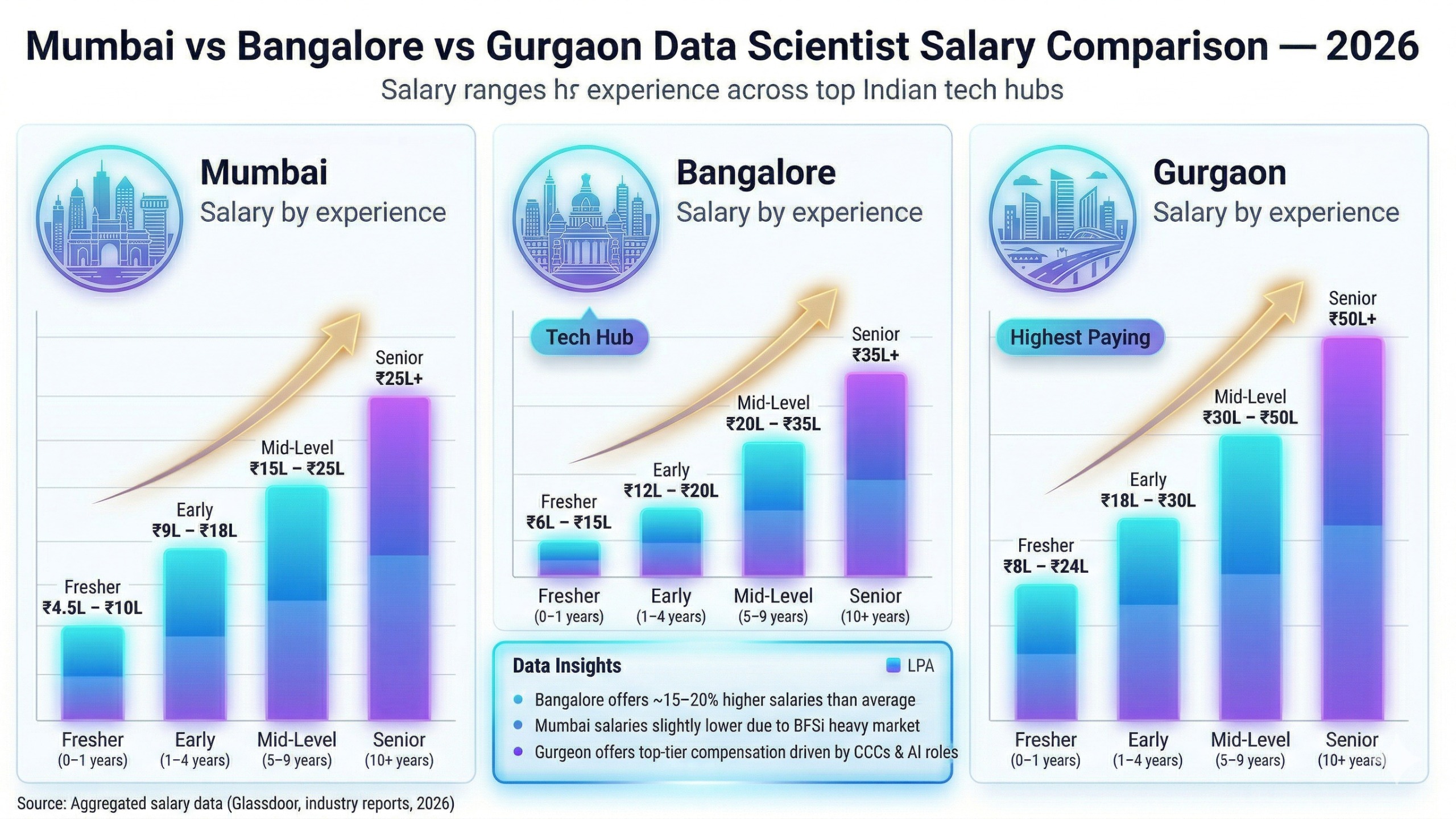
Data Scientist Salary in Mumbai 2025: Experience-Based Breakdown
The single most important variable in your salary is your years of relevant experience. Here is the honest, current-market breakdown.
Entry-Level Data Scientists (0–2 Years): ₹6.5L – ₹14L
The entry-level band has the highest variance in India's data science market, and nowhere is that variance more pronounced than in Mumbai. A fresher joining a FinTech startup in Powai and a fresher joining a GCC in Vikhroli can have a 2x difference in their starting salaries — not because the skills required are categorically different, but because of the institution they are entering from and the specific skill emphasis they bring.
What drives the variance at entry level:
Institution pedigree: Data scientists from IITs, IIMs, IISc, or top NITs entering Mumbai's BFSI and FinTech sector command starting packages of ₹12L–₹18L at firms like Goldman Sachs, Razorpay, and Jio. Graduates from non-premier institutions with strong portfolios and projects can realistically expect ₹6.5L–₹10L from mid-market employers.
GenAI and LLM skills: The most dramatic differentiator at the entry level in 2026 is whether a candidate has working knowledge of LLMs, RAG pipelines, and agentic workflows — or whether they only know classical ML. An entry-level candidate who can demonstrate a production-level RAG pipeline project alongside a traditional ML capstone is now being offered ₹11L–₹14L roles at firms that would have offered ₹8L for the same experience profile two years ago.
Domain relevance: A data science graduate who has done a project on credit default prediction using SEBI-published data will receive a more competitive offer from an HDFC subsidiary than one who submitted a generic Kaggle project on house prices.
Realistic entry salary benchmarks in Mumbai (2026):
| Profile | Expected Starting Salary |
|---|---|
| Premier institute (IIT/IIM) + GenAI skills | ₹12L–₹18L |
| Non-premier institute + strong portfolio + GenAI skills | ₹9L–₹14L |
| Non-premier institute + standard ML portfolio, no GenAI | ₹6.5L–₹9L |
| Career switcher (non-CS background) + data science certificate | ₹5L–₹8L |
Mid-Level Data Scientists (3–7 Years): ₹18L – ₹33L
This is Mumbai's most active hiring band — the "sweet spot" where demand from FinTech, BFSI, and GCC employers is highest and where the supply shortage is most acute. Mid-level data scientists with the right combination of technical skills and domain expertise in financial services are the most competed-for candidates in the market.
Why the 3–7 year band is so valuable:
- Enough experience to work independently on complex problems without significant supervision
- Not yet at the cost level of a senior scientist (₹35L+) that smaller FinTech firms cannot sustain
- Recent enough in training to be fluent in modern tooling (LangChain, LlamaIndex, modern MLOps practices)
- Enough exposure to real business problems to understand the difference between a technically correct model and a business-useful one
Mid-level salary ranges by employer type in Mumbai:
| Employer Type | Salary Range | Notes |
|---|---|---|
| FinTech Startups (Razorpay, Zepto, Groww) | ₹20L–₹30L + equity | Equity can add ₹10L–₹40L over a 4-year vest |
| Mumbai BFSI (HDFC, ICICI, Axis Analytics CoEs) | ₹18L–₹28L | Stable, benefits-heavy, strong bonus structure |
| GCCs (JP Morgan, Goldman Sachs, HSBC) | ₹25L–₹35L | Global exposure, strong long-term growth |
| IT Services (TCS, Infosys, Wipro data practices) | ₹16L–₹24L | Lower ceiling; useful for building diverse project exposure |
| Analytics Consulting (Fractal, EXL, Mu Sigma) | ₹18L–₹30L | Client variety; faster skill development curve |
The critical transition: Data scientists who pass ₹25L at the mid-level are almost universally those who have added at least one of the three skill multipliers covered below — GenAI, MLOps, or deep domain expertise. The ones stuck at ₹18–20L at Year 5 are typically those with a technically narrow profile (good at building models, weak at deploying them or explaining them to business stakeholders).
Senior and Lead Data Scientists (8+ Years): ₹35L – ₹60L+
Senior data scientist roles in Mumbai blend technical leadership, business strategy, and team management in proportions that vary significantly by employer — and so do the salaries. The range is wide because the role definition is wide.
Senior Individual Contributor (8–12 years, deep technical): ₹35L–₹52L — focused on the most complex modelling problems, architecture decisions for data science systems, mentoring junior scientists. Typical at GCCs and FinTech product companies.
Data Science Lead / Manager (8–12 years, people management): ₹42L–₹60L — leading a team of 5–15 scientists, setting technical direction, owning model performance outcomes for a product or business unit. Typical at HDFC Bank CoE, Jio Platforms, Fractal Analytics.
Principal Data Scientist / Head of Data Science (12+ years): ₹60L–₹90L+ — setting the data science strategy for an organisation or major division, reporting to C-suite, owning the decision to build vs. buy vs. integrate AI capabilities. Prevalent at GCCs, large product companies, and senior roles at BFSI firms.
What separates a ₹38L senior from a ₹58L senior: The technical floor is comparable. What differs is the scope of impact, the clarity of business attribution ("my credit model reduced defaults by ₹43Cr last year"), leadership track record, and — increasingly — depth of expertise in GenAI and agentic systems. Seniors who have successfully led the transition of their teams from classical ML to LLM-integrated workflows are commanding a visible premium over those who have not.
Best Data Science Jobs Mumbai: Top-Paying Sectors
Understanding which sectors pay the most is as important as understanding your experience tier. The same skills, applied in different sectors, generate meaningfully different compensation. Here is where Mumbai's best data science jobs are concentrated and what they pay.
FinTech: The Highest-Paying Sector in Mumbai
Mumbai's FinTech sector — anchored by NPCI (National Payments Corporation of India), Razorpay, Paytm, PhonePe's Mumbai operations, BharatPe, and a dense ecosystem of B2B FinTech infrastructure companies — consistently leads Mumbai's data science compensation benchmarks.
Why FinTech pays more:
The business impact of data science in FinTech is direct and measurable in rupees: a better fraud detection model means fewer chargebacks; a better credit model means lower default rates; a better personalisation algorithm means higher transaction frequency. When data science generates profit that can be directly attributed to model performance, companies pay for it accordingly.
NPCI is a particularly notable employer. Handling 12+ billion UPI transactions monthly, NPCI's need for fraud detection, anomaly detection, and network reliability models at scale is extraordinary — and the data science roles here offer exposure to problems and transaction volumes that few organisations globally can match.
FinTech salary benchmarks (Mumbai, 2026):
| Role | Salary Range |
|---|---|
| Data Scientist II — Fraud & Risk (3–5 yr) | ₹22L–₹32L |
| Senior Data Scientist — Personalisation (5–8 yr) | ₹32L–₹48L |
| Lead Data Scientist — Payments Analytics (8–12 yr) | ₹45L–₹65L |
Banking (BFSI): Stability, Scale, and the Mumbai Premium
The data science practices at HDFC Bank, ICICI Bank, Kotak Mahindra, and Axis Bank have matured significantly since 2020. What were once small analytics teams supporting basic reporting are now full-scale Data Science Centres of Excellence — running credit risk models on millions of loan applications monthly, building customer propensity models across 70-million-customer datasets, and increasingly deploying GenAI for customer service, document processing, and regulatory compliance.
JP Morgan's technology centre in Mumbai — one of the largest outside the United States — is among the city's most sought-after employers for senior data scientists. The combination of investment banking domain exposure, world-class infrastructure, and global salary benchmarks creates a compensation package that few Indian employers can match at the ₹40L–₹75L senior level.
Banking sector salary benchmarks (Mumbai, 2026):
| Role | Salary Range |
|---|---|
| Data Scientist — Credit Risk (3–5 yr) | ₹20L–₹30L |
| Senior Data Scientist — Customer Analytics (5–8 yr) | ₹28L–₹45L |
| Lead Data Scientist / Head of AI CoE (10+ yr) | ₹50L–₹80L+ |
Retail and E-Commerce: Growth Velocity
Nykaa, Tata Digital (the data and analytics arm of the Tata Group's digital businesses), and Reliance Retail's analytics division offer a different value proposition from BFSI — faster iteration cycles, consumer behaviour data at massive scale, and the experience of shipping models that reach tens of millions of users within days of deployment.
Salaries are slightly below the BFSI premium at the senior level but competitive at mid-level, with strong equity components at growth-stage companies.
E-Commerce salary benchmarks (Mumbai, 2026):
| Role | Salary Range |
|---|---|
| Data Scientist — Recommendation & Personalisation (3–5 yr) | ₹20L–₹28L |
| Senior Data Scientist — Growth & Revenue Analytics (5–8 yr) | ₹28L–₹40L |
| Principal Data Scientist (8–12 yr) | ₹42L–₹58L |
The Skill Multipliers: What Pushes You Into Mumbai's Top 10% (₹48L+)
Data scientists earning ₹48L+ in Mumbai are not simply those with the most years of experience. They are the ones who have deliberately built skills that are scarce, difficult to develop, and directly connected to the highest-value business problems. There are three primary multipliers.
| Skill Cluster | Baseline Salary (INR) | Premium Added | Est. Total CTC (LPA) | Why it Commands a Premium |
| Data Analytics Baseline (Python, SQL, Tableau/PowerBI) | ₹10.0L – ₹12.0L | — | ₹10.0L – ₹12.0L | Core requirements for EDA, reporting, and basic automation. |
| Classical Machine Learning (Scikit-Learn, Stats, Validation) | ₹10.0L – ₹12.0L | +₹3.0L – ₹8.0L | ₹13.0L – ₹20.0L | Ability to design, validate, and deploy predictive models. |
| Big Data & Engineering (Spark, Hadoop, Snowflake) | ₹10.0L – ₹12.0L | +₹6.0L – ₹12.0L | ₹16.0L – ₹24.0L | Expertise in scaling pipelines and handling massive datasets. |
| Cloud & MLOps (AWS/Azure/GCP, Docker, MLflow) | ₹10.0L – ₹12.0L | +₹5.0L – ₹14.0L | ₹15.0L – ₹26.0L | Critical for moving models from "notebooks" to production. |
| Deep Learning (NLP, Computer Vision, PyTorch) | ₹10.0L – ₹12.0L | +₹6.0L – ₹18.0L | ₹16.0L – ₹30.0L | Specialist premium for complex vision and speech architectures. |
| Generative AI & LLMs (Fine-tuning, RAG, Agents) | ₹10.0L – ₹12.0L | +₹12.0L – ₹28.0L | ₹22.0L – ₹40.0L | High demand for building AI-ready products and agentic workflows. |
Multiplier 1: GenAI and LLM Integration — Beyond Traditional ML
The transition from "builds ML models" to "builds AI-powered systems integrating LLMs" is the most significant salary multiplier in Mumbai's 2026 data science market. It is not a minor extension of existing skills — it is a distinct capability set, and organisations are paying for it accordingly.
What this looks like in practice:
- RAG pipelines: Designing and deploying Retrieval-Augmented Generation systems that connect LLMs to institutional knowledge bases (internal research, policy documents, historical transaction data) — enabling AI-powered search, Q&A, and analysis at scale
- Agentic workflows: Using LangGraph, CrewAI, or custom agent architectures to build multi-step AI workflows that can research, analyse, recommend, and act without human intervention at each step
- LLM fine-tuning: Using techniques like LoRA and QLoRA to adapt foundation models to domain-specific tasks — particularly high-value in BFSI where off-the-shelf models lack the vocabulary and context of financial services
- LLM evaluation: Implementing RAGAS, DeepEval, or custom evaluation frameworks to measure and continuously improve the quality, faithfulness, and relevance of LLM outputs in production
Salary impact: Mid-level data scientists who add this skill set report 25–45% salary improvements through promotions or strategic job changes. The skill is rare enough that the market actively bids for it.
Multiplier 2: MLOps and Cloud — The Ability to Deploy at Scale
The gap between a data scientist who can build a model in a Jupyter notebook and one who can deploy it to production — with monitoring, retraining pipelines, version control, CI/CD, and cost management — is enormous. Most data scientists can do the former. Far fewer can do the latter.
The MLOps skill set that commands a premium:
- Model deployment: FastAPI/Flask for model serving, Docker containerisation, Kubernetes basics for orchestration
- Cloud ML platforms: AWS SageMaker (most common in Mumbai's BFSI sector), Azure Machine Learning, Google Vertex AI — knowing how to train, version, and deploy models in cloud environments
- Pipeline orchestration: Apache Airflow, Prefect, or Dagster for scheduling and monitoring data and ML pipelines
- Monitoring and observability: Implementing data drift detection, model performance monitoring, and alerting systems that catch model degradation before it affects business outcomes
- Feature stores: Feast, Tecton, or Databricks Feature Store — centralising and versioning the features that models depend on
Salary impact: Data scientists with strong MLOps skills at the mid-level (3–7 years) are consistently offered ₹4L–₹8L above the band for their experience level. At senior levels, the ability to architect and own an organisation's end-to-end ML platform is the primary driver of ₹55L–₹70L packages.
Multiplier 3: Domain Expertise — Understanding the Business Logic of Financial Markets
This is the multiplier that takes the longest to build and is the hardest to replace. A data scientist who understands the technical side deeply and understands why credit risk models work the way they do in the Indian regulatory context, how UPI transaction networks create specific fraud patterns, or why a bank's NPA provisioning requirements affect the acceptable precision-recall trade-off of a default prediction model — that person is operating at a level no career-switcher or recent graduate can immediately match.
Mumbai-specific domain expertise that commands a premium:
- Credit Risk and BFSI: Understanding Basel III/IV, Ind AS 109 provisioning, the RBI's Prompt Corrective Action framework, CIBIL scoring methodology, and how these regulatory requirements constrain model design — not just model accuracy
- Algorithmic Trading and Quantitative Finance: Understanding how models interact with market microstructure, liquidity dynamics, and regulatory requirements around algorithmic trading
- Payments and FinTech: Understanding network effects in payments, UPI's technical architecture, the specific fraud patterns in peer-to-peer transfers vs. merchant payments, and NPCI's data sharing frameworks
- Insurance Analytics: Actuarial concepts, claim frequency and severity modelling, and IRDAI compliance requirements for AI-driven underwriting
Building genuine domain expertise takes 3–5 years of immersive exposure — which is why it is a moat that generates long-term salary premium. The analyst who combines this domain knowledge with strong GenAI and MLOps skills sits in a category that has essentially no supply ceiling: the market will keep paying more because finding them is genuinely difficult.
Company Benchmarks: Who Pays the Most in Mumbai
Domestic Giants
Fractal Analytics (BKC) — One of India's leading analytics consulting firms, with major BFSI and retail clients. Mid-level (3–7 yr): ₹20L–₹32L. Senior (8+ yr): ₹35L–₹55L. Strong for developing diverse domain experience across multiple Fortune 500 clients.
Reliance Jio / Jio Platforms (BKC/Navi Mumbai) — With 450+ million subscribers, Jio's data volume is extraordinary. Data scientists here work on recommendation, churn, network analytics, and increasingly GenAI-powered telecom applications. Mid-level: ₹22L–₹34L. Senior: ₹38L–₹58L.
Tata Digital (BKC/Lower Parel) — The digital and analytics arm spanning Tata Neu, Tata 1mg, BigBasket, and Tata CLiQ. A rare opportunity to work across consumer retail, health, and e-commerce domains under one analytical umbrella. Mid-level: ₹20L–₹30L. Senior: ₹35L–₹52L.
Nykaa (Powai/Andheri) — India's leading beauty and fashion e-commerce platform. Particularly strong for consumer analytics, personalisation, and supply chain data science. Mid-level: ₹18L–₹28L. Equity upside at senior levels.
Global Firms in Mumbai
JP Morgan (Vikhroli/BKC) — Among Mumbai's highest-paying employers for senior data scientists and ML engineers. The GCC handles quantitative modelling, risk analytics, and increasingly GenAI-powered financial research tools. Senior: ₹50L–₹80L+. Highly competitive entry process.
Goldman Sachs (Bengaluru with Mumbai GCC presence) — Quantitative and data science roles with global exposure. Senior: ₹55L–₹85L+. Among the highest absolute compensation packages available in India's data science market.
Google (BKC) — Applied ML and data science roles with Google's compensation standards. The Mumbai office handles significant data infrastructure and analytics work for Google Pay and cloud customers. Senior: ₹60L–₹90L+ (with equity).
Microsoft (BKC) — Applied AI and data science roles, increasingly GenAI-focused with Copilot and Azure AI integration work. Senior: ₹55L–₹80L+ (with equity and RSUs).
HSBC Analytics (Pune/Vikhroli GCC) — Strong BFSI domain exposure, global risk and compliance modelling. Mid-level: ₹24L–₹38L. Senior: ₹40L–₹62L.
Salary Negotiation Intelligence: What Mumbai Recruiters Don't Tell You
The Counter-Offer Problem
Mumbai's data science market is experiencing a specific phenomenon: companies are offering counter-offers at 30–50% above current salary to retain data scientists who have received external offers, rather than proactively compensating them at market rate. The implication is clear — if you have not tested your market value externally in the past 18–24 months, you are almost certainly being paid below what a competing offer would generate.
The Equity Blind Spot
Base salary comparison is only half the picture at FinTech companies and growth-stage startups in Powai and Andheri. A ₹24L offer with 0.05% equity at a Series C company raising at a ₹500Cr valuation is worth significantly more than a ₹27L base-only offer at a large corporate — if the company achieves even modest growth. Data scientists who evaluate offers purely on base salary are systematically undervaluing FinTech offers.
The Skills Premium Window
The premium for GenAI and MLOps skills is at its peak right now. As more data scientists add these skills over the next 18–24 months, the supply-demand gap will narrow and the premium will compress. The salary multiplier for adding these skills in 2026 is meaningfully higher than it will be in 2028. The market is rewarding early movers.
The Mumbai vs. Remote Calculation
An increasing number of Mumbai data scientists are receiving remote or hybrid offers from Bengaluru and Hyderabad companies — sometimes at salaries below the Mumbai market rate, justified by the "you can live anywhere" argument. For senior roles with deep BFSI domain expertise, the Mumbai-specific premium is real and should not be traded away casually. For generalist roles that do not require Mumbai's specific sector exposure, the comparison is more complex.
Are You Being Underpaid? The Self-Assessment Checklist
Run through this checklist honestly:
- Years of experience vs. salary band: Is your current salary within the range for your experience tier shown in this guide? If you are at Year 4 earning ₹16L, you are below the ₹18–28L mid-level band for Mumbai.
- Skill premium check: Have you added GenAI skills, MLOps, or deep domain expertise in the past 18 months? If yes, has your salary moved accordingly? If not, the market is now valuing your updated skill set higher than your current employer has recognised.
- Last external offer date: If you have not interviewed externally in the past 18 months, you do not know your market value. You know what your current employer is willing to pay, which is a different — and often lower — number.
- Sector comparison: Are you in IT services (₹16–24L mid-level) when your skills could place you in a BFSI or FinTech role (₹22–35L)? Sector transitions for lateral moves are among the highest-ROI salary changes available in Mumbai's 2026 market.
- GenAI skills gap: Is the absence of GenAI and LLM knowledge the ceiling on your current role or the reason you are being passed over for the senior promotion? Closing this gap in 3–6 months could translate directly into a ₹6L–₹15L salary increase through promotion or job change.
Data Scientist Salary Mumbai 2025: The Path to ₹30L+ in 24 Months
For mid-level data scientists currently earning ₹18–22L, the path to ₹30L+ within 24 months follows a consistent pattern in Mumbai's market:
Month 1–3: Build the GenAI skill layer. Add LangChain, RAG pipeline experience, and basic agent orchestration to your existing ML skills. Build one production-quality project that demonstrates this new capability.
Month 4–6: Establish your domain depth publicly. Write one technical article, give a talk at a Mumbai data science meetup, or contribute to an open-source project in your domain (BFSI, FinTech, E-Commerce). Visible domain expertise accelerates recruiter outreach significantly.
Month 7–9: Strengthen MLOps skills. Get certified in AWS SageMaker or Azure ML. Deploy at least one model to a cloud environment with proper monitoring. This credential, combined with GenAI skills, places you in the top quartile of mid-level candidates in Mumbai's market.
Month 10–12: Test the market. Interview at 3–5 companies in the BFSI/FinTech tier above your current employer. Use the offers — whether or not you accept them — as leverage in a conversation with your current employer about market alignment.
Month 13–24: Make the strategic move. The data scientists who cross ₹30L+ within two years almost always do it through a well-timed job change rather than organic promotion — which typically delivers 8–12% annually vs. the 40–60% step-up a market-level job change generates.
Are You Being Underpaid? Get Your Free Data Science Salary Audit
This guide gives you the framework. What it cannot give you is the specific, personalised answer to your specific situation — your current salary vs. what the market would pay for your skill set, your experience, and your target employers in Mumbai.
TechPaathshala's Free Data Science Salary Audit is a one-on-one session designed for exactly this: data professionals in Mumbai who suspect they are earning below their market value and want a clear, honest assessment — not a generic salary report, but a personalised analysis of your position in the market and a concrete plan to close the gap.
In the audit, you will:
- Benchmark your salary against the specific experience-tier, sector, and skill-profile bands in Mumbai's 2026 market — getting a precise answer to "what should I be earning?" rather than a range that spans ₹20 lakhs
- Identify your skill multiplier gaps — which of the three multipliers (GenAI, MLOps, or domain expertise) would most directly and immediately improve your market value, and what a realistic 6-month plan to close that gap looks like
- Get a target company list — the 10–15 Mumbai companies most likely to pay you at or above your market rate, based on your specific background and target role, with guidance on how to position your application for each
- Prepare for negotiation — understanding the difference between the first offer you will receive and the offer you could close if you negotiate effectively, with data on typical offer-to-close movements in your target band
The audit is free. It takes 45 minutes. And it has consistently produced the most actionable conversation our participants have had about their careers — because it is grounded in Mumbai's actual market data, not general advice.
👉 Book Your Free Data Science Salary Audit at TechPaathshala — and find out exactly where you stand, what you are worth, and what to do about it next.
TechPaathshala is a Mumbai-based technology education platform helping data professionals understand their market value, close skills gaps, and make their next career move with confidence.