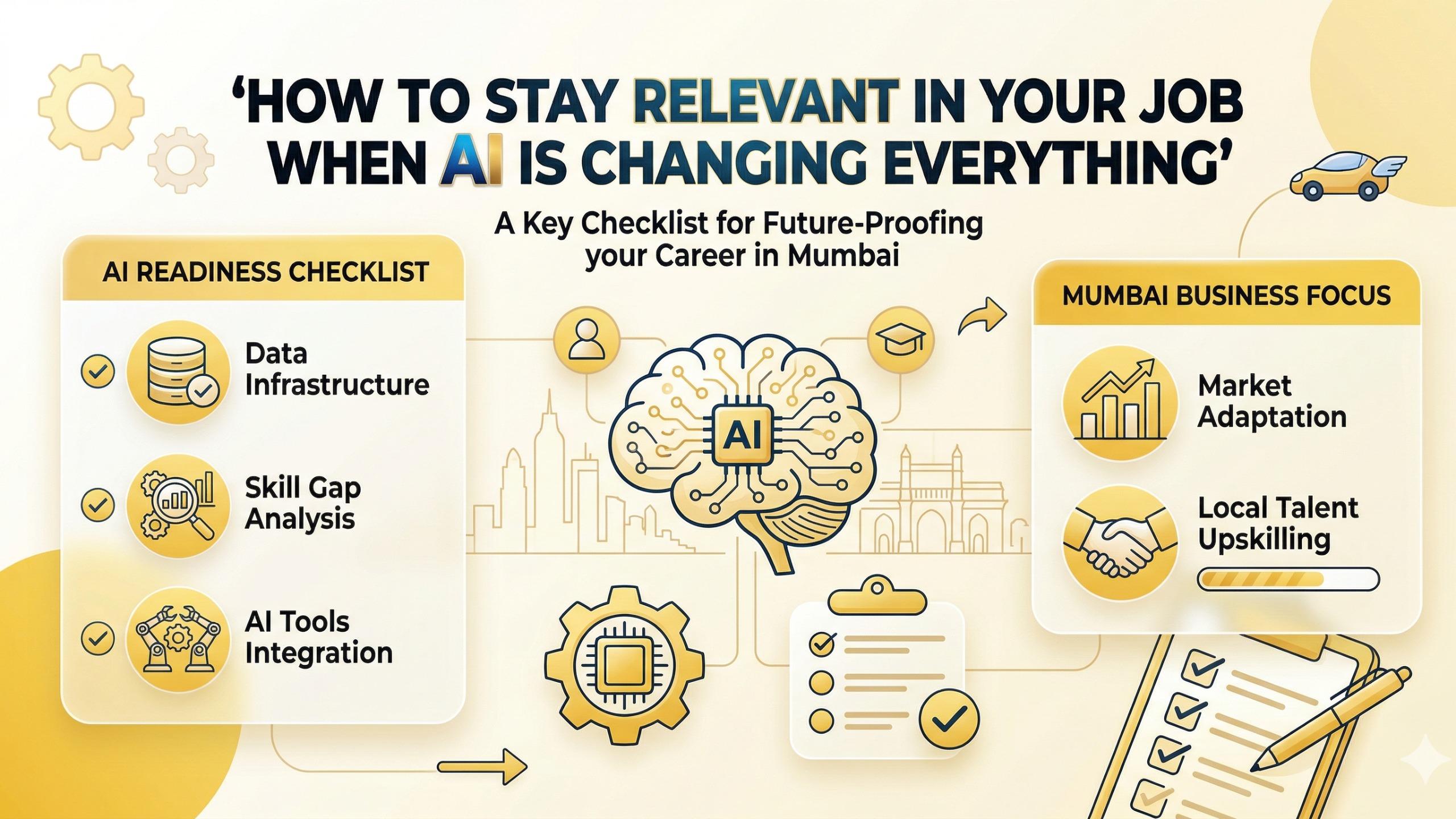
How to Stay Relevant in Your Job When AI is Changing Everything
Contents
- The Honest Truth: What AI Is Actually Doing to Jobs
- Why Staying Relevant Is Both Urgent and Achievable
- The Three Angles You Need to Work
- Angle 1: Reframe — AI as Career Threat vs. Career Accelerator
- Angle 2: Upskill and Reskill — What to Actually Learn
- Tier 1: AI Fluency (Non-Negotiable for Everyone)
- Tier 2: Workflow Automation (High-Value Differentiator)
- Tier 3: Domain-Specific AI Application (Your Competitive Moat)
- Angle 3: The Human Skills AI Cannot Replace
- Contextual Judgment
- Relationship and Trust Building
- Communication That Moves People
- Ethical Reasoning and Accountability
- Your 90-Day Action Plan
- The Career Arc That Is Opening Right Now
Sometime in the last 18 months, a quiet anxiety crept into offices across India.
It did not arrive with a dramatic announcement. It arrived in small moments. A manager who used to spend three hours writing a project proposal now finishes it in forty minutes. A marketing executive's entire content calendar — the thing that used to take a team of four — is now handled by two people and a set of AI tools. A customer service team that had twelve representatives now has six, with the same response volume.
Nobody's job title changed. Nobody received a formal memo. But something shifted, and everyone felt it.
If you have felt that shift — whether you are five years into your career, fifteen years in, or still preparing to enter the workforce — this post is written for you. Not to add to the anxiety, but to replace it with something more useful: a clear-eyed look at what is actually happening, what it means for your career, and the specific steps you can take to not just survive this transition but come out ahead of it.
The Honest Truth: What AI Is Actually Doing to Jobs
Let's start with what the data and ground reality actually show — because the conversation around AI and jobs tends toward two unhelpful extremes.
Extreme 1: "AI will replace everyone." This is not what is happening. Across India's knowledge economy — IT, banking, marketing, HR, finance, operations — wholesale replacement of entire job functions is rare. What is happening is that the composition of those jobs is changing. The parts that were repetitive, rule-based, and predictable are being automated. The parts that require judgment, relationships, creativity, and context are becoming more prominent — and more valuable.
Extreme 2: "AI is just a tool, nothing to worry about." This is also not accurate. The productivity gap between professionals who use AI tools effectively and those who do not is becoming measurable and visible. In some sectors, a single AI-augmented professional now does what previously required two or three people. Hiring volume for entry-level roles that involve largely routine work has quietly declined in several industries.
The accurate picture sits between these extremes: AI is not replacing professionals — but professionals who use AI are increasingly replacing professionals who do not. This distinction is the most important thing to understand about how to stay relevant with AI at work in 2026.
Your job is not under threat from AI. Your job as it currently exists may be. The version of your job that evolves to incorporate AI intelligently — that is where the opportunity lives.
Why Staying Relevant Is Both Urgent and Achievable
The good news — and this is genuinely good news — is that the window for this transition is still open. Unlike technological shifts of the past (the move from paper to computers, from desktop to mobile), this one is happening fast enough to feel threatening but slow enough that professionals who start adapting now will be well-positioned before the mainstream catches up.
A few anchoring realities for the Indian job market specifically:
Most Indian organisations are still early in their AI adoption. The companies that are furthest along — large IT firms, funded startups, MNCs — are still figuring out which workflows to automate and how. This means that professionals who develop AI fluency now will arrive at that conversation with skills their organisations need but do not yet have internally.
AI literacy is becoming a hiring signal across all sectors. Job descriptions across industries — not just technology — are beginning to explicitly list comfort with AI tools as a desired or required attribute. This is new, and it is accelerating.
The skills gap is real and workable. Most professionals are not behind because they are unwilling to learn. They are behind because nobody has clearly told them what to learn. That clarity is what this guide is for.
The Three Angles You Need to Work
Staying relevant in the AI era is not a single action. It is three simultaneous shifts — in how you think about the threat, in what skills you develop, and in what human capabilities you consciously invest in. Each angle is necessary. None is sufficient on its own.
Angle 1: Reframe — AI as Career Threat vs. Career Accelerator
The framing you bring to this question will determine almost everything about how you respond to it. And framing, unlike technical skills, can change overnight.
The threat frame asks: What parts of my job might AI take over? This is a useful diagnostic question — but only if it leads somewhere. On its own, it produces anxiety and paralysis.
The accelerator frame asks: Which parts of my job would I most want to off-load to AI so I can focus on what actually requires me? This is the question that leads to action.
Here is a reframe exercise worth doing this week:
Write down everything you did at work in the past five days. Every task, every deliverable, every meeting output. Now categorise each item into one of three columns:
Column A — Repetitive and rule-based. Data entry. Formatting reports. Scheduling. Sending templated communications. Searching for information. Summarising documents you've read. These are the tasks most susceptible to automation — and the tasks you should be actively trying to hand to AI tools.
Column B — Judgment and context-dependent. Navigating a difficult client relationship. Deciding which risks in a project plan are worth flagging. Understanding why a number looks wrong even though the formula is correct. Reading the room in a team meeting. These tasks require human judgment and are not going anywhere.
Column C — Creative and relational. Building trust with a new team member. Generating a genuinely novel solution to a problem your organisation has never seen before. Persuading a sceptical stakeholder. These are the tasks where human presence is not just useful but irreplaceable.
The professionals who stay most relevant are not the ones who fight to protect Column A. They are the ones who accelerate the automation of Column A so they can invest more of their time and energy in Columns B and C — where the salary premium lives.
This reframe is not naive optimism. It is a strategic orientation that changes which actions make sense to take next.
Angle 2: Upskill and Reskill — What to Actually Learn
This is where most advice gets vague. "Learn AI" is not actionable. Here is what is.
Tier 1: AI Fluency (Non-Negotiable for Everyone)
AI fluency does not mean learning to code or understanding how neural networks work. It means being able to use AI tools effectively as part of your professional workflow — and being able to talk about that usage with enough specificity to signal competence.
What this looks like in practice:
- Using ChatGPT or Claude not just to generate text, but to think through problems, stress-test your reasoning, draft communications, summarise long documents, and analyse data you paste in
- Writing prompts that produce reliable, structured output — not just asking questions and hoping for the best
- Knowing when AI output needs to be verified and having the judgment to catch errors
- Using at least one AI-powered tool specific to your domain (Notion AI for knowledge workers, Jasper for marketers, GitHub Copilot for developers, Harvey AI for legal professionals, etc.)
The honest time investment: Two to four weeks of deliberate daily practice — 30 minutes a day — is enough to develop meaningful AI fluency from zero. The barrier is not the learning curve. It is starting.
Tier 2: Workflow Automation (High-Value Differentiator)
Understanding how to connect tools so that routine workflows run automatically — using platforms like Zapier, Make, or n8n — is the skill that separates professionals who are AI-aware from professionals who are AI-productive.
This does not require technical knowledge. It requires process thinking: the ability to look at a repetitive workflow, identify its trigger and its steps, and connect them in a tool designed to make that easy.
Why this matters for career relevance: A professional who can both do their job and automate the repetitive parts of it is doing the work of 1.5 people. In a world where hiring managers are thinking about headcount efficiency, that person is meaningfully harder to replace than someone who can only do one of those things.
Tier 3: Domain-Specific AI Application (Your Competitive Moat)
This is where generic AI advice stops being useful and your specific career context begins to matter.
The most valuable professional in any AI-augmented team is not the person who knows AI tools best in the abstract. It is the person who knows AI tools and knows the domain deeply enough to use them in ways that produce accurate, trustworthy, domain-appropriate output.
An AI tool in the hands of a finance professional who understands Indian accounting standards produces something useful. The same tool in the hands of someone who does not understand those standards produces something that looks right but may not be.
For HR professionals: Learn to use AI for job description writing, resume screening (with appropriate human oversight), interview question generation, and employee communication drafting. The human judgment layer — understanding culture fit, recognising bias, making final decisions — remains yours.
For marketing professionals: Learn AI content tools (Jasper, Claude), generative visual tools (Canva Magic Studio, Adobe Firefly), social media scheduling with AI copy variants, and SEO tools like Surfer. The strategic layer — understanding the audience, making creative decisions, reading market signals — remains yours.
For finance and operations professionals: Learn to use AI for data summarisation, anomaly detection in spreadsheets, report generation, and process documentation. The judgment layer — interpreting what the numbers mean in business context, making recommendations under uncertainty — remains yours.
For students entering the workforce: You have a specific advantage that mid-career professionals do not: you can build AI fluency before your first job rather than retrofitting it into an existing workflow. Use this. Graduate with at least one demonstrable AI skill — an automation you built, a portfolio of AI-assisted work, a project that used AI tools in a documented way. This will be visible to hiring managers in ways that traditional credentials increasingly are not.
Angle 3: The Human Skills AI Cannot Replace
This is the part of the conversation that tends to get dismissed as wishful thinking. It is not. The specific human capabilities that AI cannot replicate in professional contexts are well-documented, consistently observed, and becoming more valuable as AI handles more of the routine cognitive work.
Contextual Judgment
AI systems are trained on patterns in historical data. They are exceptionally good at recognising those patterns and applying them. They are not good at situations that are genuinely novel, that require understanding of unspoken context, or that involve competing values that cannot be resolved by optimising a single metric.
The manager who senses that a high-performing team member is quietly disengaging — from a tone of voice in a meeting, from a pattern of micro-behaviours that no dataset captures — is exercising contextual judgment. The analyst who looks at a technically correct financial model and says "this assumption doesn't reflect how our clients actually behave" is exercising contextual judgment. AI cannot do either of these things reliably.
Invest in this skill by deliberately practising it. When you make a judgment call, articulate why. When you override a data-driven recommendation with your gut, examine whether the gut was right and why. Developing your contextual judgment is a practice, not a passive attribute.
Relationship and Trust Building
Trust, in professional contexts, is built through time, consistency, vulnerability, and shared experience. It cannot be automated. It cannot be generated by an AI at scale.
The salesperson who has maintained a relationship with a client for seven years, who knows the client's internal politics and personal professional anxieties, who has shown up when things went wrong — that professional is not replaceable by an AI assistant with access to the same CRM data. The relationship is the value.
As AI takes over more of the transactional and informational interactions in professional contexts, the relationships that are built on genuine human trust become more, not less, commercially valuable. Invest in yours deliberately.
Communication That Moves People
AI can write grammatically correct, logically structured, and factually accurate communications. It does it quickly and at scale. What it consistently fails to produce is communication that genuinely moves people — that inspires a team that is flagging, that shifts a sceptic's deeply held position, that makes a complex and uncomfortable truth land in a way the audience can actually receive.
This kind of communication requires empathy, timing, courage, and an understanding of the specific human beings in the room. It is learnable. It is also entirely human.
Practical investment: Take your written and verbal communication seriously as a professional skill, not just a tool. Read widely. Write often. Seek feedback on how your communication lands with real people. This investment compounds in ways that no certification can replicate.
Ethical Reasoning and Accountability
As AI tools are used for more consequential decisions — hiring, lending, performance evaluation, resource allocation — the question of who is responsible for those decisions becomes more important, not less.
AI does not have moral accountability. It cannot be held responsible. The professional who understands the ethical dimensions of how AI is being used in their organisation, who can identify when an AI-generated recommendation reflects a biased pattern in historical data, who can articulate the human values at stake in a technology decision — that professional is indispensable in ways that become more visible as AI is applied to more sensitive domains.
This is not a niche skill for ethicists. It is an emerging professional competency for anyone in a decision-making role.
Your 90-Day Action Plan
Staying relevant with AI at work is not a five-year project. It is a 90-day shift in habits and priorities that compounds into a multi-year career advantage. Here is what the first 90 days look like.
Days 1–30: Build the Foundation
- Create free accounts on ChatGPT and Claude. Use them every day for at least one work task — even a small one.
- Identify the three most repetitive tasks in your current workflow. Research whether any of them can be automated using Zapier or a similar tool.
- Read one article per week about how AI is being used in your specific industry in India. Stay current on what your sector is actually doing, not what the general AI narrative says.
Days 31–60: Build One Thing
- Build one working automation using Zapier or Make. Even a simple one — form to spreadsheet to email notification. The act of building teaches you more than any tutorial.
- Add one AI step to your existing workflow. Use Claude or ChatGPT to help you draft, summarise, or analyse something you would previously have done manually. Evaluate the output critically.
- Start documenting what you learn. A Notion page, a journal, a LinkedIn post — the form does not matter. Articulating what you are doing builds your professional visibility and sharpens your own understanding.
Days 61–90: Go Visible
- Share something you have built or learned with your team or manager. Not as a performance, but as a contribution — "I automated this process and here is what it saved." Visibility matters for career relevance.
- Apply for a structured learning program that takes you deeper. AI fluency developed through self-directed experimentation has a ceiling. Structured learning accelerates past it.
- Identify one human skill — relationship building, communication, contextual judgment — that you want to invest in over the next year. Make a plan that is as concrete as your AI learning plan.
The Career Arc That Is Opening Right Now
Here is the bigger picture, stated plainly.
The professionals who will look back on 2026 as a turning point in their careers will not be the ones who waited until AI adoption was unavoidable and then scrambled to catch up. They will be the ones who made a decision in 2026 — before it was obvious, before everyone else did — that they were going to lean into this transition rather than away from it.
The skills are learnable. The tools are accessible. The window is open.
The only question is whether you decide to walk through it.