How to Become a Data Scientist in Mumbai — Step by Step Roadmap (2026)
Contents
- Before the Roadmap: What Data Scientists Actually Do in Mumbai
- Foundation Level: The Non-Negotiable Starting Point
- Foundation Skill 1: Python Programming Fundamentals
- Foundation Skill 2: Mathematics and Statistics
- Foundation Skill 3: SQL for Data Science
- Intermediate Level: The Core Data Science Toolkit
- Intermediate Skill 1: Python Data Stack — NumPy, Pandas, and Visualisation
- Intermediate Skill 2: Machine Learning with Scikit-learn
- Intermediate Skill 3: Feature Engineering
- Advanced Level: The Specialisation That Commands Senior Salaries
- Advanced Skill 1: Advanced Algorithms and Ensemble Methods
- Advanced Skill 2: Model Deployment and MLOps Fundamentals
- Advanced Skill 3: Communication and Business Translation
- The Portfolio That Gets You Hired in Mumbai
- The Most Important Thing This Roadmap Cannot Tell You
Data Scientist was called "the sexiest job of the 21st century" in 2012. In 2026, it is simply one of the most in-demand, best-compensated, and most intellectually demanding roles in Mumbai's technology and financial ecosystem — and the path to it is clearer than it has ever been.
The challenge for most people who want to make this transition is not motivation or intelligence. It is direction. The internet is full of advice on what a data scientist does, but conspicuously short on precise, honest guidance on how to actually become one — especially from the range of starting points that real people come from. A non-technical professional in their late twenties with an economics degree. A final-year computer science student who has never used Python for anything beyond college assignments. A data analyst who has been working with SQL and Power BI for two years and wants to move into modelling.
Each of these starting points is different. The destination — a Mumbai data science role at a FinTech, e-commerce, or product company — is the same.
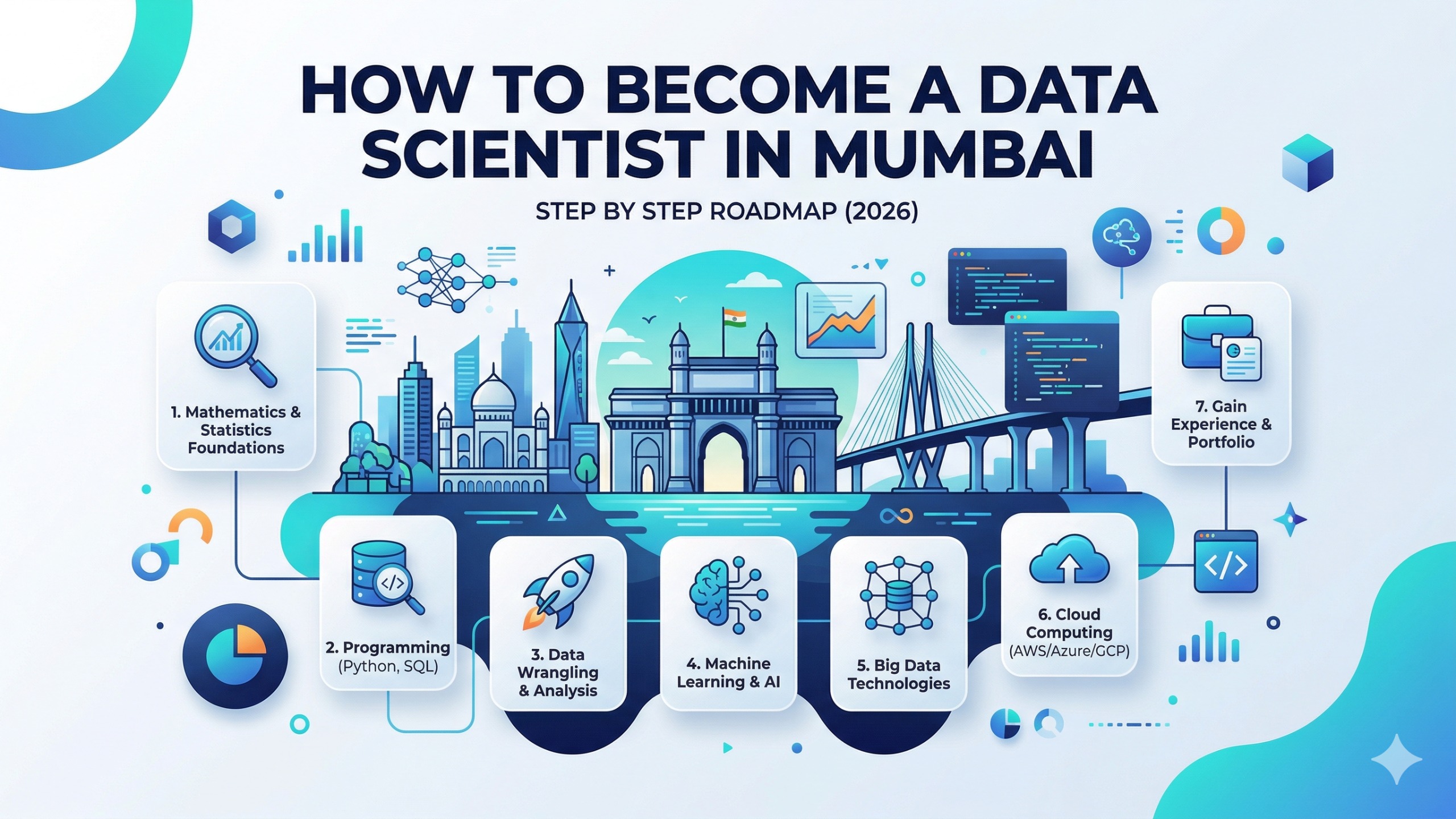
This roadmap is structured as a skills-based progression: Foundation → Intermediate → Advanced. Each level has a clear definition of what belongs there, what job-readiness looks like at that level, and how long a focused learner should expect to spend before the skills are genuinely interview-ready rather than just "in progress."
Read through the full roadmap first. Then identify honestly which level you are currently at. That is your starting point.

Before the Roadmap: What Data Scientists Actually Do in Mumbai
The job title "data scientist" covers a wide range of actual work in practice. Understanding what Mumbai companies specifically mean by it — versus what the global discourse around data science implies — will help you build the right skills for the right market.
In Mumbai's FinTech and banking sector (Razorpay, BillDesk, HDFC, Bajaj Finance, Zerodha), data scientists primarily work on: credit risk modelling (predicting loan default probability), fraud detection (identifying anomalous transaction patterns), customer lifetime value prediction, product recommendation engines, and churn prediction. The work is heavily applied, uses well-established algorithms (logistic regression, gradient boosting, survival analysis), and requires strong SQL, Python, and domain knowledge of financial products.
In Mumbai's e-commerce and D2C sector (Nykaa, Meesho, and similar), data scientists work on: demand forecasting, personalisation and recommendation systems, price optimisation, inventory management models, and A/B test analysis at scale. The emphasis on experiment design and statistical rigour is higher here than in FinTech.
In consulting and analytics firms with Mumbai presence (Deloitte Analytics, EY, KPMG, boutique analytics consultancies), data scientists work on client-specific modelling projects across industries. The breadth of problems is wider, the client communication requirements are higher, and the model types vary significantly by engagement.
What this means for your roadmap: The skills that make you hire-ready at Mumbai's top data science employers are not cutting-edge deep learning research skills. They are rigorous statistical foundations, strong Python for data and modelling, SQL for data access and feature engineering, and the communication ability to explain a model's output to a business stakeholder. The roadmap that follows reflects this reality.
Foundation Level: The Non-Negotiable Starting Point
What it is: The skills without which you cannot do meaningful data science work — period. Every data scientist, regardless of how senior or specialised, has these foundations solid.
Who needs this level: Complete beginners with no technical background, non-CS graduates entering data science, and anyone who has been "learning data science" through YouTube videos without building these foundations deliberately and systematically.
Honest time estimate: 8–12 weeks at 1–1.5 hours per day for a focused learner starting from zero.
Foundation Skill 1: Python Programming Fundamentals
Python is the primary language of data science. Not R. Not MATLAB. Not SAS. In Mumbai's 2026 job market, Python proficiency is the baseline technical expectation for every data science role at every level.
The Python fundamentals required for data science are not general Python mastery — you do not need to build web applications or understand async programming. You need a specific subset that enables data work.
What foundation-level Python looks like:
Variables and data types (integers, floats, strings, booleans), lists, tuples, dictionaries, and sets — and the methods that operate on each. Conditional statements (if, elif, else). Loops (for, while) and list comprehensions. Functions — defining them, passing arguments, returning values, understanding scope. File I/O — reading and writing CSV and text files. Error handling with try/except. Installing and importing libraries with pip and import.
# The kind of Python a foundation-level learner should be comfortable writing

def analyse_sales(filepath):
    """Load a CSV file and return basic sales metrics."""
    sales = []

    try:
        with open(filepath, 'r') as f:
            next(f)  # skip header
            for line in f:
                parts = line.strip().split(',')
                amount = float(parts[2])
                city = parts[3]
                sales.append({'amount': amount, 'city': city})
    except FileNotFoundError:
        print(f"File not found: {filepath}")
        return None

    total = sum(item['amount'] for item in sales)
    avg = total / len(sales) if sales else 0
    cities = list(set(item['city'] for item in sales))

    return {
        'total_sales': total,
        'avg_sale': avg,
        'num_transactions': len(sales),
        'cities': cities
    }

result = analyse_sales('mumbai_sales.csv')
print(result)
What foundation-level Python does not include yet: Pandas, NumPy, machine learning libraries — these come at the Intermediate level, built on top of this Python base.
How to build this: Python.org's official tutorial, "Automate the Boring Stuff with Python" (free online), or any structured beginner Python course. The key is writing code every day, not just reading about it.
Foundation Skill 2: Mathematics and Statistics
This is the skill most data science learners skip or underprioritise — and the most common reason candidates fail data science technical screens at Mumbai's top companies.
Data science is applied mathematics. The algorithms you will use are mathematical objects. The ability to understand why a model works, why it fails, and how to improve it requires mathematical intuition — not the ability to derive proofs, but a working comfort with the concepts.
The mathematical foundation for data science:
Linear Algebra (the essentials):
- Vectors and matrices — what they are and how to think about them geometrically
- Matrix multiplication — understanding the operation (not just how to compute it, but what it means)
- Dot products and their relationship to similarity
- Eigenvalues and eigenvectors — conceptual understanding (critical for PCA)
- Transpose and inverse operations
Calculus (the essentials):
- Derivatives — what a derivative means (rate of change), how to find derivatives of common functions
- Partial derivatives — derivatives of functions with multiple variables (critical for understanding gradient descent)
- The chain rule — essential for backpropagation in neural networks (important even if you are not specialising in deep learning)
- Gradients and the gradient vector
Statistics and Probability (the essentials — and the most important for Mumbai's market):
- Descriptive statistics: mean, median, mode, variance, standard deviation, skewness, kurtosis
- Probability: conditional probability, Bayes' theorem, independent vs. dependent events
- Probability distributions: normal, binomial, Poisson, uniform — what they model and when to use them
- Hypothesis testing: null and alternative hypotheses, p-values, Type I and Type II errors, statistical significance and power
- Confidence intervals
- Correlation and covariance
- Central Limit Theorem — why it matters for everything
What foundation-level statistics looks like in practice:
Given a dataset of loan applicants with their approval outcomes, you can: describe the distribution of key variables, test whether approval rates differ significantly between two groups (hypothesis test), identify correlations between features, and explain what the p-value of 0.03 in a test result means in business language.
Resources: StatQuest with Josh Starmer (YouTube — the best free statistics resource for ML practitioners), Khan Academy for calculus, "Mathematics for Machine Learning" (free PDF from Deisenroth et al., Cambridge University Press).
Foundation Skill 3: SQL for Data Science
SQL at the data science level goes beyond the analyst baseline. Data scientists use SQL not just to retrieve data, but to engineer features — transforming raw data in the database before it reaches Python, creating the training dataset for a model, and interrogating model outputs at scale.
Foundation-level SQL for data science:
Everything in the data analyst SQL foundation (SELECT, WHERE, JOIN, GROUP BY, CTEs) plus: window functions (ROW_NUMBER, LAG, LEAD, NTILE, PERCENT_RANK — used extensively for feature engineering), advanced aggregation (ROLLUP, CUBE for multi-level summaries), self-joins (joining a table to itself — used for time-based feature engineering), and date manipulation for creating time-based features (days since last transaction, rolling 30-day averages).
-- Feature engineering example: customer recency, frequency, monetary value (RFM)
-- This is the kind of SQL a data scientist writes before model training

WITH customer_rfm AS (
    SELECT
        customer_id,
        -- Recency: days since last order
        DATEDIFF(CURRENT_DATE, MAX(order_date))     AS days_since_last_order,
        -- Frequency: number of orders in last 12 months
        COUNT(DISTINCT order_id)                     AS order_count_12m,
        -- Monetary: total spend in last 12 months
        SUM(order_amount)                            AS total_spend_12m,
        -- Average order value
        AVG(order_amount)                            AS avg_order_value,
        -- Days between first and last order (customer tenure)
        DATEDIFF(MAX(order_date), MIN(order_date))  AS customer_tenure_days
    FROM orders
    WHERE order_date >= DATE_SUB(CURRENT_DATE, INTERVAL 12 MONTH)
    GROUP BY customer_id
),
rfm_scored AS (
    SELECT
        customer_id,
        days_since_last_order,
        order_count_12m,
        total_spend_12m,
        avg_order_value,
        customer_tenure_days,
        -- Quintile scoring for each RFM dimension
        NTILE(5) OVER (ORDER BY days_since_last_order ASC)  AS recency_score,
        NTILE(5) OVER (ORDER BY order_count_12m DESC)       AS frequency_score,
        NTILE(5) OVER (ORDER BY total_spend_12m DESC)       AS monetary_score
    FROM customer_rfm
)
SELECT
    customer_id,
    recency_score,
    frequency_score,
    monetary_score,
    (recency_score + frequency_score + monetary_score) AS rfm_total_score
FROM rfm_scored
ORDER BY rfm_total_score DESC;
This query builds an RFM (Recency, Frequency, Monetary) feature set — one of the most common feature engineering patterns in e-commerce and retail data science in Mumbai. Writing this kind of SQL is what distinguishes a data scientist from a data analyst in technical screens.
Intermediate Level: The Core Data Science Toolkit
What it is: The Python libraries, machine learning algorithms, and model evaluation skills that constitute the working toolkit of a practising data scientist.
Who needs this level: Engineers and CS graduates who have Python but no ML experience. Analysts who know SQL and basic Python but have not yet built models. Anyone who has completed foundational courses but has not yet built a complete end-to-end ML project.
Honest time estimate: 10–14 weeks at 1.5 hours per day for someone who has solid foundations. Shorter for engineers with Python experience; longer for non-tech professionals building on fresh foundations.
Intermediate Skill 1: Python Data Stack — NumPy, Pandas, and Visualisation
NumPy for numerical computing:
import numpy as np

# The operations data scientists use NumPy for most
arr = np.array([14, 22, 8, 35, 17, 44, 9, 28])

print(f"Mean: {np.mean(arr):.2f}")
print(f"Std Dev: {np.std(arr):.2f}")
print(f"Median: {np.median(arr):.2f}")
print(f"25th percentile: {np.percentile(arr, 25):.2f}")
print(f"75th percentile: {np.percentile(arr, 75):.2f}")

# Boolean masking — filtering arrays by condition
above_mean = arr[arr > np.mean(arr)]
print(f"Values above mean: {above_mean}")

# Reshaping — critical for ML input preparation
matrix = arr.reshape(2, 4)
print(f"Reshaped to 2x4:\n{matrix}")
Pandas for data manipulation — the intermediate level:
import pandas as pd

df = pd.read_csv('mumbai_customers.csv')

# Missing value strategy
print(df.isnull().sum())
df['age'].fillna(df['age'].median(), inplace=True)
df.dropna(subset=['customer_id', 'city'], inplace=True)

# Feature creation
df['is_mumbai'] = (df['city'] == 'Mumbai').astype(int)
df['high_value'] = (df['total_spend'] > df['total_spend'].quantile(0.75)).astype(int)
df['log_spend'] = np.log1p(df['total_spend'])  # log transform for skewed distribution

# Merging datasets
transactions = pd.read_csv('transactions.csv')
merged = df.merge(
    transactions.groupby('customer_id').agg(
        num_transactions=('order_id', 'count'),
        avg_transaction=('amount', 'mean'),
        last_transaction=('date', 'max')
    ).reset_index(),
    on='customer_id',
    how='left'
)

# Time-based feature engineering
merged['last_transaction'] = pd.to_datetime(merged['last_transaction'])
merged['days_since_last_txn'] = (pd.Timestamp.today() - merged['last_transaction']).dt.days
Visualisation for exploratory data analysis (EDA):
The visualisation skills required at the intermediate level are not aesthetic — they are analytical. The question is whether you know which chart type reveals which kind of pattern, and whether you can interpret what you see.
import matplotlib.pyplot as plt
import seaborn as sns

fig, axes = plt.subplots(2, 2, figsize=(14, 10))

# Distribution of key variable
sns.histplot(df['total_spend'], bins=50, kde=True, ax=axes[0, 0])
axes[0, 0].set_title('Distribution of Customer Spend (note: right skew)')

# Correlation heatmap — identify multicollinearity before modelling
numeric_cols = df.select_dtypes(include=[np.number]).columns
correlation_matrix = df[numeric_cols].corr()
sns.heatmap(correlation_matrix, annot=True, fmt='.2f', cmap='coolwarm', ax=axes[0, 1])
axes[0, 1].set_title('Feature Correlation Matrix')

# Churn rate by segment
churn_by_city = df.groupby('city')['churned'].mean().sort_values(ascending=False)
churn_by_city.plot(kind='bar', ax=axes[1, 0])
axes[1, 0].set_title('Churn Rate by City')
axes[1, 0].set_ylabel('Churn Rate')

# Spend distribution by churn status
df.boxplot(column='total_spend', by='churned', ax=axes[1, 1])
axes[1, 1].set_title('Spend Distribution by Churn Status')

plt.tight_layout()
plt.savefig('eda_dashboard.png', dpi=150, bbox_inches='tight')
plt.show()
Intermediate Skill 2: Machine Learning with Scikit-learn
Scikit-learn is the standard Python machine learning library and the tool used in the majority of production ML projects at Mumbai's data-driven companies. The algorithms that appear most in Mumbai data science interviews and job descriptions:
Classification algorithms (for predicting categories):
- Logistic Regression — the baseline for binary classification (churn yes/no, fraud yes/no, default yes/no)
- Decision Trees — interpretable, good for explaining model logic to stakeholders
- Random Forest — ensemble of decision trees, strong out-of-the-box performance
- Gradient Boosting (XGBoost, LightGBM) — the workhorse of Mumbai's FinTech ML projects
Regression algorithms (for predicting continuous values):
- Linear Regression — the baseline for continuous prediction
- Ridge and Lasso — regularised regression for handling multicollinearity and feature selection
- Random Forest Regressor, XGBoost Regressor
Clustering algorithms (for segmentation):
- K-Means — customer segmentation, product grouping
- DBSCAN — anomaly detection, identifying unusual transaction clusters
- Hierarchical Clustering — market basket analysis
A complete classification workflow — the core skill:
import pandas as pd
import numpy as np
from sklearn.model_selection import train_test_split, cross_val_score, StratifiedKFold
from sklearn.preprocessing import StandardScaler, LabelEncoder
from sklearn.ensemble import RandomForestClassifier, GradientBoostingClassifier
from sklearn.linear_model import LogisticRegression
from sklearn.metrics import (classification_report, confusion_matrix,
                             roc_auc_score, roc_curve)
from sklearn.pipeline import Pipeline
import matplotlib.pyplot as plt
import warnings
warnings.filterwarnings('ignore')

# --- DATA PREPARATION ---
df = pd.read_csv('customer_churn_features.csv')

# Encode categorical variables
le = LabelEncoder()
df['city_encoded'] = le.fit_transform(df['city'])
df['segment_encoded'] = le.fit_transform(df['segment'])

# Define features and target
feature_cols = [
    'age', 'tenure_months', 'total_spend_12m', 'avg_order_value',
    'num_transactions', 'days_since_last_order', 'city_encoded',
    'segment_encoded', 'log_spend'
]

X = df[feature_cols]
y = df['churned']

print(f"Class distribution:\n{y.value_counts(normalize=True).round(3)}")

# --- TRAIN-TEST SPLIT ---
# Stratified split preserves class proportions in both sets
X_train, X_test, y_train, y_test = train_test_split(
    X, y, test_size=0.2, random_state=42, stratify=y
)

# --- MODEL TRAINING WITH PIPELINE ---
# Pipeline ensures scaler is fit only on training data (prevents data leakage)
pipeline = Pipeline([
    ('scaler', StandardScaler()),
    ('model', RandomForestClassifier(
        n_estimators=200,
        max_depth=8,
        min_samples_leaf=10,
        class_weight='balanced',  # handles class imbalance
        random_state=42
    ))
])

pipeline.fit(X_train, y_train)

# --- EVALUATION ---
y_pred = pipeline.predict(X_test)
y_prob = pipeline.predict_proba(X_test)[:, 1]

print("\nClassification Report:")
print(classification_report(y_test, y_pred))
print(f"AUC-ROC Score: {roc_auc_score(y_test, y_prob):.4f}")

# Cross-validation for robust performance estimate
cv = StratifiedKFold(n_splits=5, shuffle=True, random_state=42)
cv_scores = cross_val_score(pipeline, X, y, cv=cv, scoring='roc_auc')
print(f"\n5-Fold CV AUC: {cv_scores.mean():.4f} (+/- {cv_scores.std():.4f})")

# --- FEATURE IMPORTANCE ---
rf_model = pipeline.named_steps['model']
importance_df = pd.DataFrame({
    'feature': feature_cols,
    'importance': rf_model.feature_importances_
}).sort_values('importance', ascending=False)

print("\nTop 5 Most Important Features:")
print(importance_df.head())
The model evaluation skills that Mumbai DS interviews test most:
Understanding the difference between accuracy and AUC-ROC (and when each is appropriate), interpreting a confusion matrix (true positives, false positives, false negatives, true negatives), understanding precision vs. recall trade-offs (in fraud detection, false negatives are more costly; the model should be tuned accordingly), cross-validation vs. train-test split (why cross-validation gives a more reliable performance estimate), and data leakage — the most common and most serious mistake in ML pipelines (information from the test set contaminating the training process).
Intermediate Skill 3: Feature Engineering
This is the skill that most separates experienced data scientists from those who have only completed courses. Algorithms are public knowledge — everyone can implement a Random Forest. The quality of the features you build from raw data is what determines whether your model actually works.
The feature engineering patterns that appear most in Mumbai DS work:
For FinTech (credit, fraud, payments):
- Transaction velocity features: number of transactions in last 1/7/30 days
- Deviation features: current transaction amount vs. customer's historical average
- Time-based features: day of week, hour of day, is_weekend, is_month_end
- Network features: number of unique merchants, average merchant rating
For E-commerce (churn, LTV, recommendation):
- RFM features (recency, frequency, monetary — as demonstrated in the SQL section)
- Category diversity: number of distinct product categories purchased
- Return rate, discount dependency, channel preference features
- Sequential features: was the last order different from usual behaviour?
For HR Analytics (attrition prediction):
- Tenure buckets (0–6 months, 6–18 months, 18–36 months, 36+ months)
- Performance trajectory (is rating improving or declining over last 3 reviews?)
- Manager change, team change, location change flags
- Compensation relative to market/peers
The ability to look at a raw dataset and know which features to engineer — based on domain knowledge and intuition about what drives the target variable — is what makes a data scientist effective. It is learned through practice on real datasets, not through textbooks.
Advanced Level: The Specialisation That Commands Senior Salaries
What it is: The skills that take a data scientist from "can build models" to "can build reliable, production-grade ML systems and communicate their implications to business stakeholders."
Who needs this level: Analysts and intermediate practitioners aiming for senior data scientist roles (₹18L–₹30L+ in Mumbai). Engineers who have built models but have not deployed them to production. Data scientists who can build models but struggle to explain them to non-technical audiences.
Honest time estimate: 12–20 weeks at 1.5–2 hours per day, typically overlapping with real project work rather than pure course-based learning.
Advanced Skill 1: Advanced Algorithms and Ensemble Methods
XGBoost and LightGBM — the production workhorses:
Gradient boosting models (XGBoost, LightGBM, CatBoost) dominate competition leaderboards and real-world FinTech ML applications because of their superior performance on tabular data relative to other algorithms. Understanding not just how to use them but how to tune them — learning rate, tree depth, number of estimators, regularisation parameters, early stopping — is what separates advanced practitioners from intermediate ones.
Neural Networks for structured data:
While deep learning's primary domain remains unstructured data (images, text, audio), neural networks are increasingly used for tabular data at Mumbai's larger data-driven organisations. Understanding the architecture (layers, neurons, activation functions), training process (forward pass, loss calculation, backpropagation, gradient descent), regularisation techniques (dropout, batch normalisation, L1/L2 regularisation), and implementation in TensorFlow/Keras or PyTorch is the advanced technical skill that opens doors to roles at the intersection of data science and AI engineering.
Time Series Modelling:
A critical specialisation for Mumbai's FinTech and e-commerce data science teams. Demand forecasting, stock price analysis, transaction volume prediction, and customer usage patterns all involve time series data. The models that appear most in Mumbai DS JDs: ARIMA and SARIMA (classical statistical methods), Prophet (Facebook's open-source forecasting library, widely adopted for business forecasting), and LSTM/GRU networks for complex sequential patterns.
Advanced Skill 2: Model Deployment and MLOps Fundamentals
A model that lives only in a Jupyter notebook is not a data science product. It is an experiment. The skill of taking a model from notebook to production — where it processes real data, returns real predictions, and is monitored for performance degradation — is the advanced skill that most course-based learners never develop.
The production ML pipeline:
Model serialisation (saving a trained model with pickle or joblib so it can be loaded without retraining), building a REST API to serve predictions (Flask or FastAPI in Python), containerising the model with Docker, deploying to a cloud platform (AWS SageMaker, Google Vertex AI, Azure ML), and setting up monitoring for model performance in production (detecting data drift, monitoring prediction distribution, alerting on performance degradation).
# A minimal FastAPI model serving endpoint
from fastapi import FastAPI
from pydantic import BaseModel
import joblib
import pandas as pd
import numpy as np

app = FastAPI(title="Churn Prediction API")

# Load trained model at startup
model = joblib.load('churn_model_pipeline.pkl')

class CustomerFeatures(BaseModel):
    age: float
    tenure_months: float
    total_spend_12m: float
    avg_order_value: float
    num_transactions: int
    days_since_last_order: int
    city_encoded: int
    segment_encoded: int
    log_spend: float

class PredictionResponse(BaseModel):
    customer_id: str
    churn_probability: float
    churn_prediction: bool
    risk_segment: str

@app.post("/predict", response_model=PredictionResponse)
async def predict_churn(customer_id: str, features: CustomerFeatures):
    feature_df = pd.DataFrame([features.dict()])
    churn_prob = model.predict_proba(feature_df)[0, 1]
    churn_pred = churn_prob > 0.5

    risk_segment = (
        "High Risk" if churn_prob > 0.7 else
        "Medium Risk" if churn_prob > 0.4 else
        "Low Risk"
    )

    return PredictionResponse(
        customer_id=customer_id,
        churn_probability=round(float(churn_prob), 4),
        churn_prediction=bool(churn_pred),
        risk_segment=risk_segment
    )
This is what a junior deployment looks like. Understanding it, being able to build it and debug it, and knowing how to extend it to a production-grade system with authentication, rate limiting, logging, and monitoring — this is the advanced skill that justifies senior data scientist compensation.
Advanced Skill 3: Communication and Business Translation
This is the skill that the technical roadmap above does not teach — and the one that most directly determines career trajectory at the senior level.
A data scientist who can build a 94% accurate churn model but cannot explain to a product manager why 94% accuracy might still be the wrong metric — or what the model is actually measuring, and what its failure modes are — is a data scientist who will always need a technical manager between them and the business.
A data scientist who can build the same model and then walk a business stakeholder through: "here is what we are optimising for, here is the trade-off we are making between catching more churning customers and falsely flagging retained customers, here is the business action we recommend based on this model's output, and here is how we will know if the model is degrading in production" — that data scientist is ready for a leadership track.
The communication skills that Mumbai DS roles at senior level require:
Translating model outputs into business language (not "the AUC is 0.87" but "the model correctly identifies 8 out of 10 customers who are about to churn, with 1 in 5 of its flagged customers being a false alarm"), structuring findings as a narrative with a clear recommendation, writing a model card (a standardised document that explains a model's purpose, training data, performance metrics, limitations, and appropriate use cases), and presenting to non-technical stakeholders without condescension or jargon.
The Portfolio That Gets You Hired in Mumbai
At every level of the roadmap, the output that matters is not the course certificate. It is the work you have built and can demonstrate.
Foundation portfolio: A GitHub repository with Python scripts that solve real analytical problems, and SQL queries that answer real business questions on a public dataset. Evidence that you can write clean, readable code.
Intermediate portfolio: Two or three end-to-end ML projects on GitHub. Each project should have: a clear problem statement (the business question), a data exploration section (EDA with visualisations), a feature engineering section, at least two models compared on appropriate metrics, a clear conclusion, and a README that a non-technical person can understand. Kaggle competition placements (top 20–30%) are a strong supplementary signal.
Advanced portfolio: At least one deployed model — accessible via a public URL, demonstrating that you can move from notebook to production. Documentation that explains the model's purpose, performance, limitations, and how its predictions should be used. Evidence of MLOps practice: reproducible training pipelines, versioned models, monitoring logic.
| Experience Level | Skill Level | Typical Salary Range (₹ LPA) | Key Skills | Hiring Demand in Mumbai |
|---|---|---|---|---|
| 0–1 Years | Beginner | ₹4 – ₹8 LPA | Python, Excel, Basic Statistics, SQL | Moderate (freshers, internships, trainees) |
| 1–3 Years | Junior | ₹6 – ₹12 LPA | Python, Pandas, Data Visualization, SQL, ML Basics | High (startups & analytics firms) |
| 3–5 Years | Mid-Level | ₹10 – ₹20 LPA | Machine Learning, Feature Engineering, APIs, Cloud Basics | Very High (fintech, e-commerce, SaaS) |
| 5–8 Years | Senior | ₹18 – ₹35 LPA | Deep Learning, NLP, Big Data (Spark), MLOps | Very High (product companies, AI teams) |
| 8+ Years | Lead / Principal | ₹30 – ₹60+ LPA | AI Strategy, System Design, Team Leadership, Advanced AI | Critical demand (leadership roles) |
The Most Important Thing This Roadmap Cannot Tell You
Skills are necessary. They are not sufficient.
The data scientists who move fastest through Mumbai's career ladder — from fresher to senior, from senior to lead — share something that no roadmap produces: they are genuinely curious about the problems they work on. They ask questions about the business before they ask questions about the data. They read the output of their models with scepticism. They are not satisfied when the model is "good enough" if they do not understand why.
This curiosity is not teachable in a formal sense. But it is cultivatable — by working on problems you find genuinely interesting, by reading about how data science is being applied in the industries you want to work in, and by surrounding yourself with practitioners who set a standard you want to rise to.
The roadmap gives you the skills. The curiosity gives the skills somewhere meaningful to go.