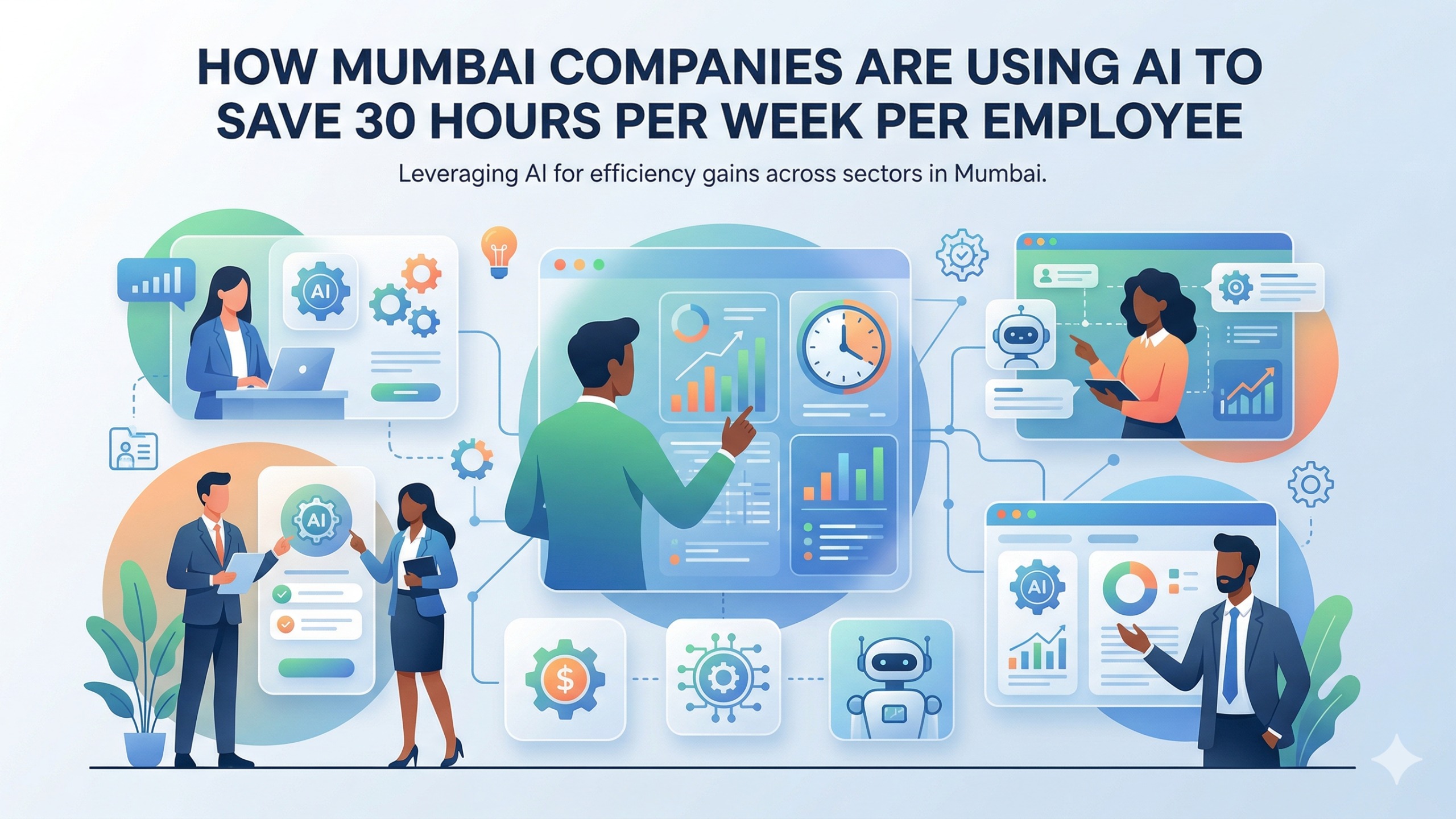
How Mumbai Companies Are Using AI to Save 30 Hours Per Week Per Employee
Contents
- First: Why Mumbai Businesses Have a Specific Urgency
- The Calculation: Where Does 30 Hours Actually Come From?
- Department-by-Department: What Mumbai Companies Are Actually Doing
- HR and Talent Acquisition — 18–22 Hours Saved Per Week Per HR Professional
- Marketing and Content — 12–16 Hours Saved Per Week Per Marketer
- Customer Service — 20–28 Hours Saved Per Week Per Customer Service Employee
- Finance and Operations — 10–14 Hours Saved Per Week Per Finance/Ops Professional
- Sales — 8–12 Hours Saved Per Week Per Sales Professional
- The Implementation Reality: What Works and What Doesn't
- Your Starting Point: The 2-Hour AI Audit
- The Hours Are There. The Question Is Whether You Claim Them.
Thirty hours. Per employee. Per week.
That number sounds implausible until you start breaking it down — until you sit with a team and map every hour that goes into writing emails that follow templates, pulling data from systems that do not talk to each other, formatting reports that have the same structure every month, answering customer queries with responses that are 80% identical each time, scheduling meetings across five calendars, and manually moving information from one tool to another.
When you actually map it, thirty hours is not a ceiling. For some roles in some organisations, it is a conservative estimate.
Mumbai's most operationally sophisticated companies — from BKC's FinTech firms to Andheri's D2C brands to Powai's SaaS startups — have spent the last 18 months doing exactly this mapping exercise. They are calling it different things: AI adoption programmes, workflow automation initiatives, productivity transformation. What they are doing is the same: finding the thirty hours and giving them back.
This guide covers how they are doing it — department by department, tool by tool, and number by number. The examples are drawn from real workflows across Mumbai's business landscape. The tools are the ones actually being deployed, not the ones that make for good conference slides. The ROI figures are grounded in what organisations in India's market are actually experiencing.
If you are a business owner, an HR or operations manager, or a working professional wondering whether the AI productivity claims are real — this post is your answer.
First: Why Mumbai Businesses Have a Specific Urgency
Before the department-by-department breakdown, it is worth understanding why Mumbai's business community has adopted AI productivity tools at a rate that is noticeably faster than the national average.
Talent cost is high and rising. Mumbai commands a salary premium of 20–35% over most other Indian metros for comparable roles. At ₹8–12 LPA for a mid-level professional, the cost of a human being spending four hours per day on automatable work is significant and quantifiable. Every hour saved by AI is a measurable return on the tool investment.
The competitive density is intense. In categories like D2C, FinTech, and professional services, Mumbai businesses compete with both well-funded startups and established incumbents. The companies that move faster — that respond to customer queries in minutes rather than hours, that produce reports in hours rather than days, that scale their marketing content without scaling their headcount — have a structural advantage that compounds over quarters.
The operational complexity is higher. Mumbai businesses typically operate across more channels, more customer segments, and more regulatory contexts than comparable businesses in smaller markets. Managing this complexity without AI augmentation requires either more people or more hours per person — both of which have hard limits.
The result is a business environment where AI adoption is not a curiosity or an experiment. It is a competitive necessity that the leading organisations have already acted on.

The Calculation: Where Does 30 Hours Actually Come From?
Before walking through each department, here is the base calculation that most Mumbai businesses use when they audit their AI time-savings opportunity.
Consider a 50-person company with roles distributed across HR (5), Marketing (8), Sales (10), Operations (7), Finance (5), and Customer Service (10), plus leadership and support roles.
Category 1: Repetitive writing tasks (emails, reports, proposals, job descriptions) Average time per employee per week: 5–8 hours AI reduction potential: 60–70% Hours saved per employee per week: 3–5 hours
Category 2: Data lookup and manual compilation (pulling reports, updating trackers, formatting data) Average time per employee per week: 4–6 hours AI reduction potential: 70–80% Hours saved per employee per week: 3–5 hours
Category 3: Internal communication processing (reading, categorising, and acting on emails and messages) Average time per employee per week: 3–5 hours AI reduction potential: 40–50% Hours saved per employee per week: 1–2.5 hours
Category 4: Customer-facing repetitive communication (answering standard queries, follow-ups, confirmations) Average time per customer-facing employee per week: 8–12 hours AI reduction potential: 60–75% Hours saved per employee per week: 5–9 hours (for customer-facing roles)
Category 5: Scheduling and coordination (meeting scheduling, follow-up reminders, status updates) Average time per employee per week: 2–3 hours AI reduction potential: 60–70% Hours saved per employee per week: 1–2 hours
Conservative total across a mixed workforce: 13–19 hours per employee per week. For customer-facing roles specifically: 22–32 hours per employee per week.
The "30 hours" headline is achievable — but it represents the top end, primarily for roles where a significant portion of work is customer communication, report generation, and data compilation. The realistic average across a mixed workforce is 15–20 hours per employee per week — still a figure that, at Mumbai talent costs, represents a compelling return on tool investment.
| Department | Role Type | Tasks Automated by AI | Time Saved (%) | Tools / AI Examples | Business Impact |
|---|
| Marketing | Digital Marketer | Ad copy, SEO content, campaign analysis | 40–60% | ChatGPT, Jasper AI | Faster campaigns, lower CAC |
| Sales | Sales Executive | Lead qualification, follow-ups, CRM updates | 30–50% | HubSpot, Zoho CRM | Higher conversion rates |
| Customer Support | Support Agent | FAQs, ticket resolution, chat support | 50–70% | Zendesk, Haptik | 24/7 support, reduced costs |
| HR | Recruiter | Resume screening, interview scheduling | 40–65% | HireVue, LinkedIn Recruiter | Faster hiring cycles |
| Finance | Analyst | Report generation, forecasting, data entry | 30–55% | Excel + AI, QuickBooks | Reduced manual errors |
| Operations | Operations Manager | Workflow automation, reporting | 35–60% | Zapier, Make | Improved efficiency |
| IT / Engineering | Developer | Code generation, debugging, documentation | 40–70% | GitHub Copilot, ChatGPT | Faster development cycles |
| Data Science | Data Scientist | EDA, model building, reporting | 30–60% | ChatGPT, AutoML | Increased productivity |
| Retail | Store Manager | Inventory tracking, demand forecasting | 25–50% | AI analytics tools, POS AI systems | Better stock management |
| Real Estate | Sales Manager | Lead nurturing, pricing insights, CRM automation | 30–55% | Housing.com, MagicBricks | Faster deal closures |
Department-by-Department: What Mumbai Companies Are Actually Doing
HR and Talent Acquisition — 18–22 Hours Saved Per Week Per HR Professional
Human Resources in Mumbai's growth-stage companies operates under persistent volume pressure. A company growing from 50 to 200 employees over 18 months is not just hiring at three times the rate — it is managing three times the onboarding communications, three times the policy queries, three times the documentation, and three times the coordination overhead.
The workflows where Mumbai HR teams are deploying AI:
Job Description Generation and Optimisation (saves 2–3 hours per JD) Writing a well-structured, inclusive, keyword-optimised job description used to take an HR professional 45–90 minutes per role. With AI tools (Claude, Jasper, or dedicated HR AI platforms), the process is: input the role requirements in bullet points → AI generates a structured JD → HR professional reviews, adjusts for culture and specificity → publish.
A Powai-based SaaS company with high-volume engineering hiring reported reducing JD creation time from 75 minutes to 12 minutes per role — a saving of over an hour per hire across their recruitment volume.
Resume Screening (saves 4–6 hours per open role per week) The initial screening pass — reading 80–150 applications for a single role, shortlisting 15–20 for a recruiter call — is the highest-volume, lowest-judgment task in recruitment. AI tools (Workable's AI screening, Greenhouse's filtering, or custom prompts via Claude fed with resume text) can perform an initial filter against defined criteria, produce a ranked shortlist with reasoning, and flag edge cases for human review.
Important caveat that Mumbai's HR teams are navigating: AI resume screening requires explicit bias monitoring. Models trained on historical hiring data can perpetuate historical biases. The best implementations use AI for the initial relevance filter (does this candidate have the required technical skills?) and human judgment for all contextual evaluation (cultural fit, growth trajectory, role-specific considerations).
Interview Scheduling Automation (saves 1.5–2 hours per candidate) The back-and-forth of scheduling a three-round interview process — coordinating the candidate's availability with three interviewers across two time zones — is pure coordination overhead. Tools like Calendly with AI scheduling, Notion AI calendar integration, or Zapier automations connecting the ATS to calendar and email handle this without HR involvement after the initial setup.
Offer Letter and Onboarding Document Generation (saves 1–2 hours per hire) Offer letters, appointment letters, NDA templates, IT access request forms, bank account forms, welcome emails — the onboarding document stack for a single hire involves 8–12 documents, many of which are personalised templates. AI document generation, connected to the ATS data, produces this stack automatically for each hire.
Policy Query Management (saves 3–5 hours per week for the team) "How many sick days do I get?" "What is the WFH policy?" "When does my health insurance kick in?" An AI-powered internal chatbot connected to the HR policy documentation answers these queries without HR involvement. WhatsApp or Slack-based implementations are common in Mumbai's mid-size companies, with Yellow.ai and Voiceflow being the most commonly deployed platforms.
Mumbai company example: A 150-person Andheri-based FinTech reported that their HR team of three was handling all of the above before AI, spending an estimated 22 hours per week per person on these automatable tasks. Post-implementation, the same three-person team handles 40% more hiring volume with the recovered time going to strategic HR work — culture initiatives, manager development, and retention programmes.
Marketing and Content — 12–16 Hours Saved Per Week Per Marketer
Mumbai's marketing teams operate in one of the most multilingual, multi-channel, high-frequency content environments in India. A D2C brand in Navi Mumbai might need: daily Instagram content in English and Hindi, weekly WhatsApp broadcast messages, biweekly email campaigns, monthly blog posts, ongoing Google Ads copy variants, and regional festival campaign content — for four to six campaigns simultaneously.
This volume, at human-only speed, requires a team of 8–10 for a mid-size brand. With AI augmentation, teams of 3–4 are achieving equivalent output.
The workflows where Mumbai marketing teams are deploying AI:
Social Media Content Calendar Production (saves 4–6 hours per week) The workflow: create a monthly content brief (themes, key dates, campaign priorities) → input to an AI tool (Claude, Jasper, or Notion AI) → generate captions in multiple formats and tones → review and schedule via Buffer or Hootsuite. A single content brief produces a month's worth of captions across platforms in under two hours, compared to two days of manual writing.
A Bandra-based beauty D2C brand with 85,000 Instagram followers reported that their single social media manager now produces content across four platforms (Instagram, LinkedIn, Twitter/X, Pinterest) in the time she previously spent on Instagram alone.
Advertising Copy Variants (saves 2–3 hours per campaign) Performance marketing requires testing multiple ad copy variants — different headlines, different value propositions, different CTAs — against each other to find what converts. Writing 15 variants of an ad manually takes a copywriter 90–120 minutes. AI generates 15 variants in 5 minutes. The marketer selects, refines, and tests rather than creating from scratch.
Email Campaign Drafting (saves 1.5–2 hours per campaign) Subject line, preview text, body copy, and CTA for a segmented email campaign — written to a brand voice brief — is a routine AI task. A Thane-based furniture e-commerce company reported reducing campaign production time from 4 hours to 45 minutes per campaign, enabling them to increase campaign frequency by 3x.
Regional Language Adaptation (saves 3–4 hours per regional campaign) Translating and culturally adapting campaign copy from English to Hindi and Marathi — a Mumbai business standard — used to require a bilingual copywriter or a translation agency. AI translation (DeepL, Google Translate with editorial review, or Claude with a localisation prompt) reduces this to a review-and-refine task rather than a creation task.
SEO Blog Production (saves 3–5 hours per post) An AI-assisted blog workflow: content brief → AI-generated first draft → human editor reviews for accuracy, brand voice, and Mumbai-specific context → publish. Reduces per-post time from 4–6 hours of writing to 1–1.5 hours of editing and quality review.
ROI calculation for a 5-person Mumbai marketing team: At ₹9 LPA average (₹750/hour), saving 12 hours per week per person = ₹9,000/week/person = ₹45,000/week for the team = ₹23.4 lakhs per year in recovered productive capacity. Against an AI tool budget of ₹15,000–25,000/month (₹1.8–3 lakhs/year), the ROI is 7–13x.
Customer Service — 20–28 Hours Saved Per Week Per Customer Service Employee
Customer service is the department where AI saves the most time, most consistently, because it has the highest proportion of repetitive, rule-based interactions relative to any other function.
In Mumbai's D2C and e-commerce sector — where WhatsApp is the primary customer communication channel — the volume of inbound queries is enormous and the query types are highly predictable: order status, delivery timeline, return initiation, exchange request, product query, payment issue, and complaint escalation. Across most D2C brands, 65–75% of all inbound queries fall into these categories and can be resolved with a standard response.
The workflows where Mumbai customer service teams are deploying AI:
WhatsApp Automation for Standard Queries (saves 6–9 hours per agent per week) Tools like Yellow.ai, Wati, and Chatfuel, connected to the WhatsApp Business API, handle the first response layer automatically. Order status queries are resolved by pulling from the order management system. FAQs are answered from a knowledge base. Return and exchange initiations are completed through a conversational flow. Only complex cases — complaints requiring judgment, exceptions to policy, emotionally distressed customers — are routed to human agents.
A Kurla-based electronics D2C brand with 8 customer service agents deployed WhatsApp automation in Q3 2025. Within 60 days, 68% of all inbound WhatsApp queries were fully resolved by automation. The human agents' workload dropped from 120+ queries per day to 38 queries per day, and first response time dropped from 4 hours to under 2 minutes.
AI-Drafted Email Responses (saves 3–4 hours per agent per week) For email-based support (more common in B2B contexts), AI drafts a response to each incoming query for the agent to review, personalise, and send. The agent's role shifts from "write the response" to "verify and approve the response" — a significantly faster task.
Ticket Categorisation and Routing (saves 1–2 hours per team per week) Incoming support tickets are automatically categorised by type, priority, and appropriate team — eliminating the manual triage step that previously required a senior agent to review every ticket before routing.
Post-Resolution Survey Analysis (saves 2–3 hours per week for the team) CSAT survey responses, aggregated weekly or monthly, are analysed by AI to identify patterns — which product categories generate the most complaints, which issue types have the lowest resolution satisfaction, which agents have the highest and lowest satisfaction scores. What previously required manual reading and coding of survey responses is done automatically.
Finance and Operations — 10–14 Hours Saved Per Week Per Finance/Ops Professional
Finance and operations functions in Mumbai's mid-size companies carry significant manual data work — consolidating reports from multiple systems, reconciling figures, formatting outputs for leadership review, and managing approval workflows.
The workflows where Mumbai finance and ops teams are deploying AI:
Automated MIS Report Generation (saves 3–4 hours per week) Monthly Management Information System (MIS) reports — P&L summaries, cash flow statements, sales performance breakdowns, operational KPI dashboards — follow the same structure every period. The data changes; the format does not. Automating the data extraction, consolidation, and formatting using Power Automate, Zapier, or custom Python scripts with AI-assisted narrative generation reduces a 4–6 hour monthly task to a 30-minute review and sign-off.
Invoice Processing and Validation (saves 2–3 hours per week) Incoming invoices — PDF or email-based — are processed by AI document extraction tools (Nanonets, Docsumo, or custom LLM pipelines) that extract vendor name, invoice number, amount, line items, and due date, cross-reference against purchase orders in the accounting system, flag discrepancies, and populate the accounts payable tracker automatically.
A Borivali-based logistics firm processing 200+ vendor invoices per month reduced their accounts payable processing time from 3 days to 4 hours per month using Nanonets connected to their Tally ERP.
Expense Report Processing (saves 1.5–2 hours per week) Employee expense submissions are validated against policy (is this category reimbursable? does the amount exceed the allowed limit? is the receipt attached?), approved within policy automatically, and flagged for manager review only when exceptions occur.
Contract Review First Pass (saves 2–3 hours per contract) AI contract review tools (Harvey AI, ContractPodAi, or prompt-based Claude workflows) perform an initial review of vendor contracts, flagging non-standard clauses, missing provisions, and potential risk areas for legal or finance review. What previously required a full read-through before knowing where to focus is reduced to reviewing a structured summary with flagged items.
Sales — 8–12 Hours Saved Per Week Per Sales Professional
Sales is the function where AI adoption has been slowest — because the core of sales work (relationship building, negotiation, trust development) is human-intensive and resistant to automation. But the administrative and preparatory overhead around sales is substantial.
The workflows where Mumbai sales teams are deploying AI:
CRM Data Entry and Update Automation (saves 2–3 hours per week) Sales professionals hate CRM data entry. AI tools (Salesforce Einstein, HubSpot AI, or Zapier automations) automatically log email conversations, update deal stages, create follow-up tasks from email threads, and populate contact records — eliminating manual CRM maintenance.
Proposal and Pitch Document Generation (saves 2–3 hours per proposal) Proposal first drafts — structured from the CRM data about the prospect, their industry, and the proposed solution — are generated by AI and refined by the sales professional. A BKC-based enterprise software company reported reducing proposal turnaround time from 3 days to same-day delivery after implementing an AI-assisted proposal workflow.
Lead Research and Qualification Preparation (saves 1.5–2 hours per qualified lead) Before a discovery call, a sales professional needs to know: the prospect's company background, recent news, LinkedIn profile, relevant industry context, and how they fit the ideal customer profile. AI research tools (Clay, Apollo.io's AI features, or a custom Claude workflow) compile this brief automatically from the prospect's website, LinkedIn, and news sources.
Follow-Up Email Drafting (saves 1–1.5 hours per week) Post-meeting follow-up emails — personalised to the conversation, including action items and next steps — are drafted by AI from the meeting notes or call transcript. The sales professional reviews, adjusts, and sends.
The Implementation Reality: What Works and What Doesn't
The time savings above are achievable. They are not automatic.
Mumbai companies that have successfully captured these savings share three implementation characteristics that companies still struggling do not:
They started with one department, one workflow, and made it work before expanding. The organisations that tried to implement AI across all functions simultaneously produced confusion, low adoption, and abandoned tools. The ones that started with a single high-volume, high-repetition workflow — usually customer service or HR documentation — created a visible win that built internal credibility for further adoption.
They addressed the cultural barrier before the technical one. The most common failure mode in AI adoption is not that the tools do not work — it is that employees do not use them, because they have not been given the context for why the tools are being introduced, adequate time to learn them, or reassurance that AI augmentation is not the first step toward role elimination. The companies with the highest adoption rates held explicit conversations about AI before deploying tools.
They built measurement into the implementation from Day 1. "We think this is saving time" is not the same as "we know this is saving 4.2 hours per week per agent, and here is the data." The companies that track time savings, output volume, error rates, and customer satisfaction before and after AI implementation can defend the investment, identify where it is underperforming, and make the case for expanding it.
[Insert Infographic: The 2026 Mumbai Business AI Implementation Roadmap — From First Tool to Full Deployment]
Your Starting Point: The 2-Hour AI Audit
You do not need a consultant or a six-month transformation programme to start capturing AI time savings. You need two hours and a willingness to look honestly at where your team's time is going.
The 2-hour AI audit:
Hour 1 — Map the repetitive work. Ask every team member to write down the five tasks they do most frequently that feel mechanical — things they have done the same way hundreds of times, where the value is in the doing rather than the thinking. Compile the list across the team.
Hour 2 — Score each item on two dimensions:
- Volume: How many times per week does this task occur, across the whole team?
- Repeatability: How predictable is this task? Is it always the same structure with different specific details, or does it genuinely vary each time?
The items with high volume and high repeatability are your first automation candidates. Pick the one at the top of the list. Find the tool that addresses it (use the department breakdowns above as a starting map). Implement it with one team member in a trial. Measure the result. Expand if it works.
This is how Mumbai's most AI-productive companies started. Not with a strategy document or a vendor selection committee. With one workflow, one tool, and one honest measurement.
The Hours Are There. The Question Is Whether You Claim Them.
Thirty hours per employee per week is not science fiction. It is the sum of the small repetitive tasks that fill the hours of every knowledge worker in every Mumbai organisation — tasks that feel productive in the moment but do not represent the uniquely human judgment, creativity, and relationship-building that actually builds a business.
The organisations that reclaim those hours are not replacing their people. They are making their people more valuable — by giving them back the time to do the work that only they can do.
That is the actual case for AI adoption in Mumbai's businesses. Not the technology story. The people story.