How Agile Workflow in Training Prepares You Better for Real Jobs
Contents
- The Day 1 Problem: Why Technical Skills Alone Leave New Developers Stranded
- Agile in a Learning Context: What It Means to Train in Sprints
- The Four Pillars of Agile Training at TechPaathshala
- Pillar 1: Daily Stand-Ups — Building the Communication Muscle
- Pillar 2: Sprint Planning — Learning to Break Complexity into Delivery
- Pillar 3: Code Reviews and Pull Requests — The Fastest Path to Production-Quality Code
- Pillar 4: Retrospectives — The Habit That Makes Everything Improve
- Why Employers in Mumbai's Tech Parks Love Agile-Trained Developers
- The Agile-Trained Developer vs. The Course-Completion Developer: A Side-by-Side
- The Bigger Picture: Why Agile Training for Full Stack Developers Is a Signal of Industry Readiness
- Experience the Difference Yourself
There is a specific kind of confusion that hits almost every new developer on their first week at a real job. They have finished their course, passed their assessments, built their portfolio projects. They know React. They know Node.js. They can design a database schema and explain what JWT authentication does.
And then they sit down at their desk on Day 1, open their laptop, and find — not an assignment, not a tutorial, not a clear task with a defined output — but a Jira board with 47 tickets, a stand-up in 20 minutes, and a message from their tech lead asking for an update on a pull request they haven't been told exists yet.
This is the Day 1 shock. And it is almost universal.
Not because new developers are underprepared technically — many are technically excellent. But because the process of working as a developer in a real company — the language, the rituals, the rhythms of Agile workflow — is something that almost no technical training program teaches. It is assumed you will pick it up on the job. And you will — but that learning period costs the company two to three months of reduced productivity, and it costs you two to three months of feeling like you're behind, underperforming, and out of your depth despite genuinely knowing your craft.
Agile training for full stack developers is the solution to this gap. And it is what TechPaathshala is built around.
The Day 1 Problem: Why Technical Skills Alone Leave New Developers Stranded
Let's map out what the first month at a real tech job actually looks like — versus what most training programs prepare you for.
What training programs prepare you for:
- Understand a concept
- Build an exercise or project around that concept
- Pass an assessment
- Move to the next concept
What real companies expect from Day 1:
- Join a Sprint that is already in progress
- Pick up a ticket from the backlog, understand its context and acceptance criteria
- Ask the right questions in stand-up without sounding lost
- Write code that meets team standards — naming conventions, folder structure, PR description format
- Submit a pull request, respond to review comments professionally, and iterate
- Communicate blockers clearly before they become delays
- Demo completed work at Sprint Review without freezing under the pressure of live feedback
- Reflect honestly in a Retrospective about what slowed you down and why
None of these skills appear in a standard coding curriculum. They are not about technology — they are about the professional practice of being a developer. And Mumbai's tech companies, from Andheri startups to BKC Fintech firms to Navi Mumbai's IT services parks, are hiring for both. A developer who knows React but cannot function in an Agile team is, from a hiring manager's perspective, only half-ready.

Agile in a Learning Context: What It Means to Train in Sprints
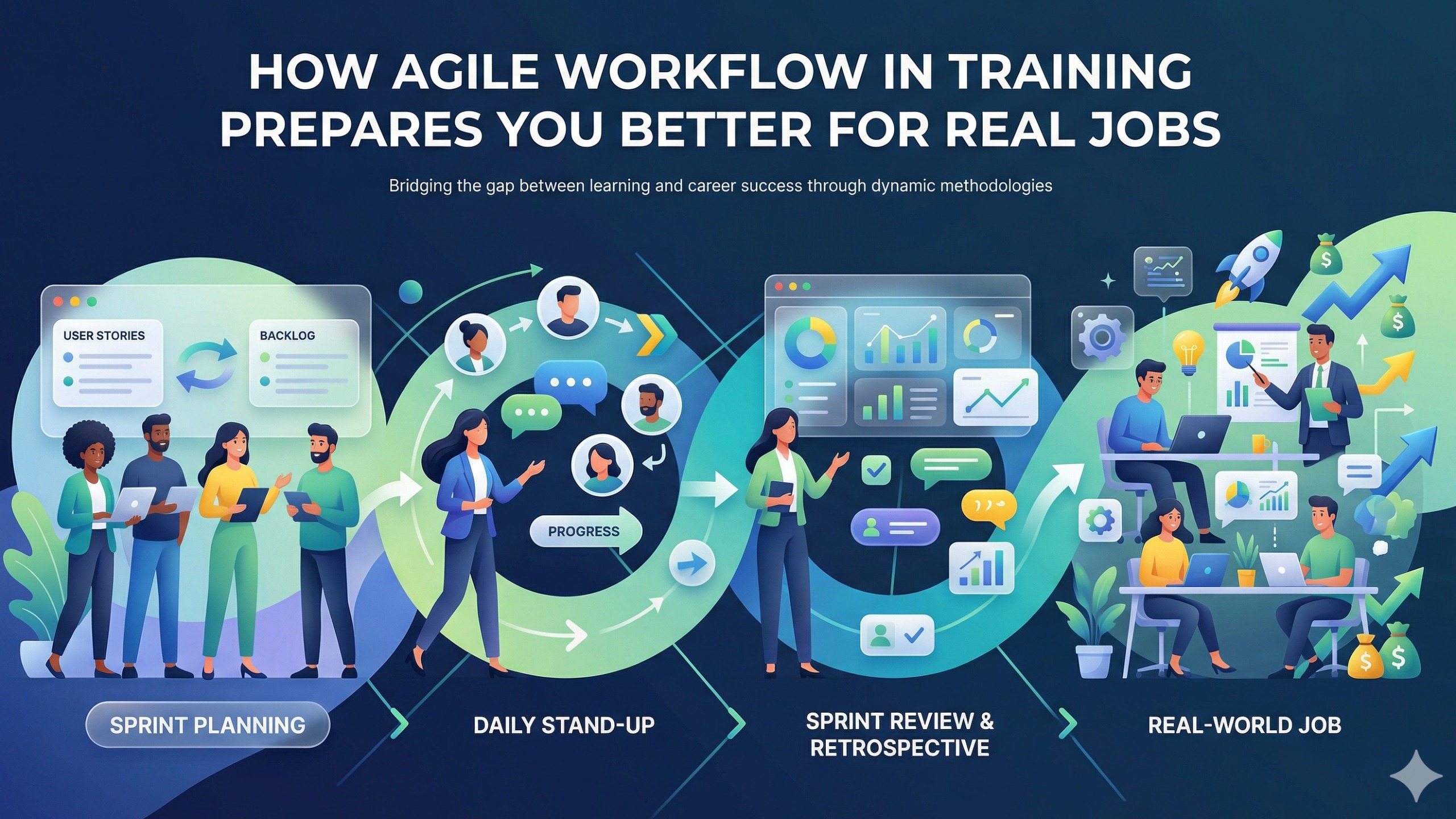
Agile is a set of principles and practices for building software iteratively — in short cycles called Sprints — with continuous feedback, adaptation, and team collaboration at every stage. It was designed for software teams at companies like Spotify, Netflix, and Indian Fintechs that need to move fast, respond to changing requirements, and deliver working software consistently rather than in massive, infrequent releases.
Most developers learn about Agile in a half-day workshop after they are already hired. At TechPaathshala, students learn in Agile from their very first project week.
This is the pedagogical shift that changes everything: instead of finishing a course, students complete Sprints. Instead of submitting assignments, they close tickets. Instead of receiving grades, they receive code review feedback. Instead of working alone, they work in cohorts that simulate the cross-functional dynamics of a real development team.
The curriculum content — React, Node.js, Spring Boot, databases, deployment — is identical to what a traditional program teaches. The container in which that content is delivered is entirely different. And that container is what produces developers who arrive at their first job feeling oriented rather than overwhelmed.
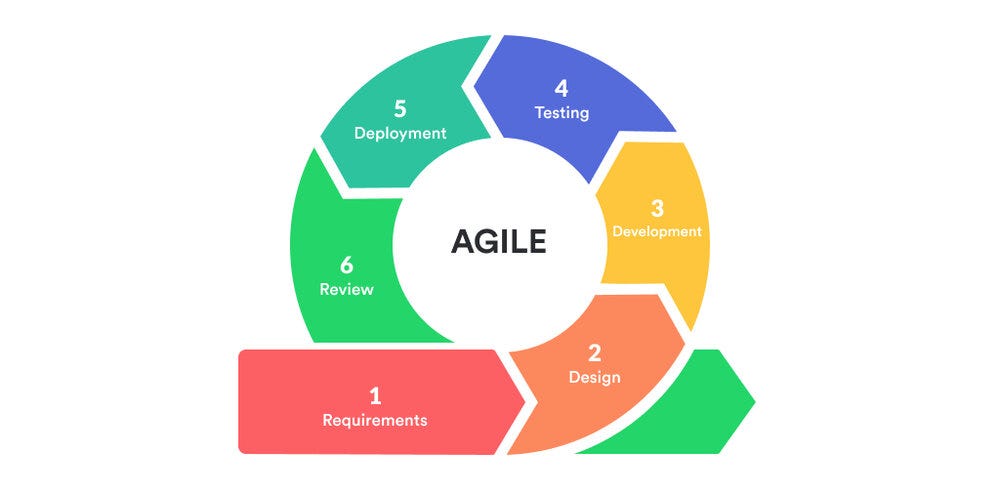
The Four Pillars of Agile Training at TechPaathshala
Pillar 1: Daily Stand-Ups — Building the Communication Muscle
The daily stand-up is one of the most deceptively simple practices in Agile. Three questions, 15 minutes, every morning. What did you work on yesterday? What are you working on today? Is anything blocking your progress?
In a real company, the stand-up serves multiple functions simultaneously: it keeps the team aligned, surfaces blockers before they cascade into delays, and creates a culture of accountability without micromanagement. A developer who handles stand-ups well — who is concise, specific, and honest about blockers — signals professional maturity to their team and their manager. A developer who rambles, understates problems, or arrives unprepared signals the opposite.
At TechPaathshala, stand-ups are not optional rituals — they are a trained skill. Here is what that training actually develops:
Precision in progress reporting. "I was working on the authentication module" is a stand-up answer. "Yesterday I completed the JWT generation and validation logic — the token is being issued correctly on login. Today I'm implementing the refresh token endpoint. I'm blocked on a CORS issue when the frontend tries to hit the /auth/refresh route from a different port — I'll need 10 minutes with a mentor after stand-up" is a stand-up answer that makes a team lead feel like they have a reliable, professional developer on their hands.
The first kind of answer is what most new developers give. The second kind is what TechPaathshala students give after four weeks of daily practice — because the skill is trained, not assumed.
Normalising the blockers conversation. One of the most common and most damaging habits new developers bring to their first job is the tendency to sit quietly on a problem for hours — or days — rather than surface it as a blocker. This comes from training environments where asking for help feels like admitting inadequacy. It is the exact opposite of what Agile teams need.
At TechPaathshala, stand-ups create a daily, socially normalised moment for surfacing blockers. Students learn early that announcing a blocker is not a sign of weakness — it is a sign of professional discipline. A blocker disclosed at 9:30 AM can be resolved by 10:00 AM. A blocker silently struggled with until 4:00 PM costs the Sprint half a day. Mumbai's tech companies, which move fast and measure delivery, deeply value developers who have internalised this distinction.
Pillar 2: Sprint Planning — Learning to Break Complexity into Delivery
Sprint Planning is where a team takes a large project goal — "build the checkout feature" or "implement user authentication" — and breaks it into specific, individually completable tasks with clear acceptance criteria. These tasks are called User Stories, and writing them well is a learned skill.
A well-written User Story follows a simple format: As a [user type], I want to [action], so that [outcome]. "As a registered user, I want to log in with my email and password, so that I can access my account dashboard." This format forces the writer to think about who needs the feature and why — not just what needs to be built.
For a Full Stack developer, Sprint Planning practice builds four capabilities that directly translate to workplace value:
Scope instinct. The ability to look at a feature requirement and recognise whether it is one ticket or ten. A new developer who underestimates scope commits to timelines they cannot meet; one who overestimates creates unnecessarily fragmented work that loses the big picture. Sprint Planning practice, repeated across multiple projects, calibrates this instinct — and calibrated scope estimation is one of the most valued skills in Mumbai's product and startup engineering teams.
Dependency mapping. "The order confirmation email can't be built until the order creation API exists, which can't exist until the database schema is finalised." Real development work is full of these dependencies, and surfacing them in Sprint Planning prevents them from becoming blockers mid-Sprint. Students who have done Sprint Planning know to ask "what does this ticket depend on?" before committing. Students who haven't often discover the dependency when it is already causing a delay.
Acceptance criteria fluency. Every ticket should specify exactly what "done" means — what the feature does, how edge cases are handled, what the expected behaviour is when something goes wrong. Students who write acceptance criteria for their own tickets develop a precision in their thinking that makes their code cleaner, their PRs smaller, and their testing more thorough.
Estimation confidence. Estimating how long a task will take is difficult, and experienced developers are still wrong regularly. But there is a difference between "I don't know" and "Based on similar tickets in our last Sprint, I'd estimate this at 3–5 hours, with the main uncertainty being the third-party API integration." Sprint Planning practice moves students from the former to the latter — and interviewers at Mumbai tech companies frequently probe for this capability directly.
[Insert Screenshot: Example of a Student Kanban Board]
Pillar 3: Code Reviews and Pull Requests — The Fastest Path to Production-Quality Code
This is the single most transformative practice in TechPaathshala's Agile training model. And it is the practice most completely absent from traditional coding education.
When you learn to code through tutorials and courses, your code is reviewed by no one except an automated test suite. You develop habits that work — that produce code which runs — but that would raise eyebrows in a professional code review. Variable names that made sense to you at 11 PM but are cryptic to anyone else. Functions that do three things when they should do one. Components that are 400 lines long because breaking them up felt like extra work. Authentication logic that works in the happy path but has no error handling for edge cases.
None of these habits are visible to you until someone who writes professional code reads yours and tells you, specifically, what needs to change. This is what a code review does. And at TechPaathshala, every project feature goes through a pull request reviewed by a mentor before it is merged.
Here is what the PR review process teaches, step by step:
Writing a meaningful PR description. A pull request is not just a code change — it is a communication document. A good PR description explains what the change does, why it was made, how to test it, and what edge cases were considered. Writing this forces you to think about your own code from a reader's perspective — which is the beginning of writing code for teams rather than for yourself.
Responding to review comments professionally. Receiving feedback on code you worked hard on and feel proud of is emotionally difficult. It requires separating your identity from your output — a skill that takes deliberate practice. TechPaathshala's review process is designed to be direct but constructive, modelling the communication style of Mumbai's best engineering teams. Students who have gone through 20 or 30 review cycles before their first job have already built the resilience and professional equanimity that typically takes 6–12 months to develop on the job.
Understanding what "production-ready" actually means. There is a specific quality of code that experienced developers recognise as professional — and a specific quality they recognise as "student code." The difference is not just syntax or framework knowledge. It is error handling, input validation, separation of concerns, consistent naming conventions, the absence of commented-out code, and the presence of meaningful comments where they actually add clarity. A mentor's code review teaches this vocabulary efficiently and specifically — "this function should return a meaningful error message when the user ID is not found, not an empty response" is a correction that takes 30 seconds to deliver and 5 minutes to implement, but that changes how a student thinks about API design permanently.
Giving reviews as well as receiving them. At TechPaathshala, peer code review is part of the process — students review each other's pull requests under mentor guidance. The discipline of reading someone else's code carefully, forming a coherent opinion about its quality, and communicating that opinion constructively is a senior developer skill. Beginning to develop it during training means arriving at the first job with a perspective that most peers won't develop for years.
Pillar 4: Retrospectives — The Habit That Makes Everything Improve
The Sprint Retrospective is the practice that separates teams that get better from teams that stay the same. At the end of every Sprint, the team answers three questions together: What went well? What didn't go well? What will we do differently in the next Sprint?
This sounds simple. It is deceptively difficult to do honestly and productively — especially when it requires naming your own contribution to something that went wrong.
For students in a learning environment, Retrospectives build a metacognitive habit: the practice of observing your own learning process, identifying what is and isn't working, and adjusting. Students who do this regularly develop what might be called learning agility — the ability to improve their own improvement rate. Over a 10–12 month learning journey, this compound effect is substantial.
But the workplace value extends further. Developers who are comfortable in Retrospectives — who can say "I underestimated the complexity of that ticket and it held up the Sprint, here's what I'll do differently" — are developers that engineering managers trust. The willingness to be honest about your own performance without defensiveness is one of the rarest and most valued qualities in a development team. It cannot be taught in a lecture. It has to be practised.
Why Employers in Mumbai's Tech Parks Love Agile-Trained Developers
Let's translate the Agile training pillars into the specific language that Mumbai hiring managers use when they describe what they are looking for.
"We need someone who can hit the ground running." Every tech company in Mumbai — from Powai startups to BKC banking firms to Navi Mumbai IT services companies — says this. What they mean is: someone who already understands how work is organised, communicated, and delivered in a professional team. An Agile-trained developer walks in knowing what a Sprint is, what a stand-up requires, what a PR description should contain, and what "definition of done" means. The onboarding period compresses from 2–3 months to 2–3 weeks. For a startup on a tight runway, that difference is meaningful. For an enterprise IT firm billing client hours, it is directly financial.
"We want developers who communicate well, not just developers who code well." Mumbai's engineering culture has evolved to value communication explicitly — because the cost of miscommunication in a fast-moving team is high. Delayed features, rework due to misunderstood requirements, and missed dependencies all trace back to communication failures. An agile training full stack developer who has done 200 stand-up answers and 30 code reviews has practiced technical communication more in their training program than most developers practice in their first year on the job.
"We need someone who takes ownership." Ownership is the quality of treating your assigned work as your responsibility from beginning to end — not just writing the code, but ensuring it is tested, reviewed, merged, deployed, and working in production. Agile Sprint structure trains ownership because every ticket has a named owner who follows it through its entire lifecycle. Students who have done this in a training context arrive at the workplace with the ownership reflex already activated.
"We save at least 2 months of onboarding time with candidates who already know Agile tools." A candidate who has worked with GitHub Projects, Jira, or Trello in a structured way — creating tickets, managing boards, linking PRs to issues, tracking Sprint velocity — reduces onboarding overhead for the hiring team by a measurable and meaningful amount. Agile tooling is not complex, but familiarity with the workflow patterns it supports takes time to develop. Agile-trained developers show up with that familiarity already intact.
These are not hypothetical benefits. They are the specific reasons that TechPaathshala's placement alumni are consistently prioritised by Mumbai's best tech employers, from Andheri's product startups to the enterprise IT corridors of Airoli and Mahape.
The Agile-Trained Developer vs. The Course-Completion Developer: A Side-by-Side
| Dimension | Course-Completion Developer | Agile-Trained Developer |
|---|---|---|
| First week on the job | Disoriented by Jira, stand-up format, and PR process | Immediately functional; understands the workflow |
| Stand-up communication | Vague, over-long, or uncertain | Concise, specific, and honest about blockers |
| Blocker behaviour | Sits on problems silently for hours | Surfaces blockers early, with context |
| Code quality | Works, but written for "it passes" not "it's maintained" | Reviewed, iterated, and written with team readability |
| PR process | Unfamiliar; the first PR is a learning experience | Comfortable; has written 30+ PRs with reviewer feedback |
| Estimation | "I don't know how long it will take" | "Based on similar work, probably 4–6 hours; depends on X" |
| Receiving feedback | Defensive or deflated | Professional; separates code quality from personal identity |
| Retrospective participation | Passive, uncomfortable with self-critique | Honest and constructive; used to the format |
| Agile tooling (Jira, GitHub Projects) | Needs training | Already productive |
| Onboarding cost for employer | 2–3 months | 2–3 weeks |
The Bigger Picture: Why Agile Training for Full Stack Developers Is a Signal of Industry Readiness
The value of Agile training for full stack developers in Mumbai's market is not just procedural. It reflects a deeper truth about what separates developers who advance quickly from developers who plateau.
Developers who advance quickly are not always the most technically brilliant. They are the ones who communicate trust — to their team leads, their product managers, and their peers. They deliver what they commit to. They surface problems before they become crises. They absorb feedback without fragility. They make the people around them more effective, not just themselves.
These are precisely the qualities that Agile practice develops — not as abstract character traits, but as specific, repeated behaviours that become second nature over months of deliberate training.
Mumbai's best engineering teams know this. It is why "Agile experience" appears in the majority of Full Stack Developer job descriptions posted by companies in Powai, BKC, and Navi Mumbai's IT parks. And it is why candidates who can demonstrate genuine Agile fluency — not just the ability to name Agile ceremonies, but the ability to operate inside them effectively — consistently move further and faster in Mumbai's tech hiring process than their technically equivalent peers.
Experience the Difference Yourself
The most effective argument for Agile training is not a description of it. It is a demonstration.
TechPaathshala hosts an Agile Demo Day — a live, open event where current students demonstrate their Sprint work in a real Sprint Review format. You will see:
- Students presenting features they built during the previous Sprint to a simulated stakeholder audience
- A live retrospective where students reflect openly on what went well and what they'd change
- A look inside TechPaathshala's student Kanban boards — the actual tickets, PRs, and workflow tools students use throughout the program
- A Q&A with mentors and current students about how the Agile training model shapes the learning experience
Whether you are a student evaluating training programs, an HR manager looking for a pipeline of genuinely job-ready developers, or an engineering lead who has felt the cost of onboarding developers who've never worked in Agile — this event is worth 90 minutes of your time.
There is no sales presentation. There is no pitch. It is exactly what the name says: a demonstration of what real developer training looks like when it takes the workplace seriously from day one.
👉 Register for TechPaathshala's Agile Demo Day — and see for yourself what job-ready actually means.
TechPaathshala is a Mumbai-based Full Stack developer training platform. Our Sprint-based Agile training model is designed to produce developers who are not just technically skilled, but genuinely workplace-ready — from their first stand-up to their first production deployment.