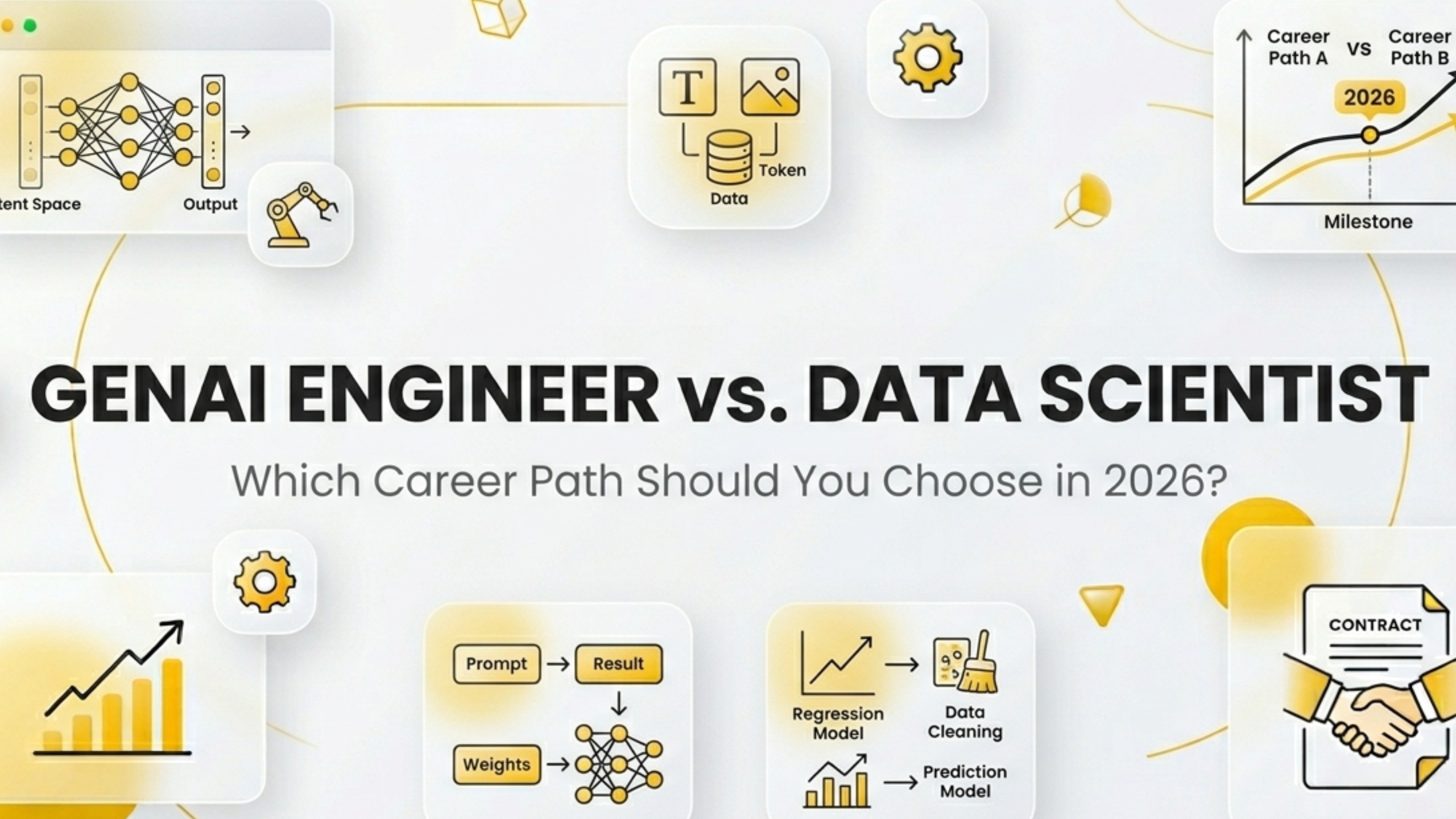
GenAI Engineer vs. Data Scientist: Which Career Path Should You Choose in 2026?
Contents
- How 2026 Has Clearly Split These Two Roles
- Role Definitions: What Each Does Day-to-Day
- What a Data Scientist Actually Does
- What a GenAI Engineer Actually Does
- Day in the Life: Side-by-Side Comparison
- Skill Stack Breakdown
- Data Scientist Skills
- GenAI Engineer Skills
- Mumbai and India Market Trends: Where the Demand Is Going
- Hiring Volume: 2024 vs. 2026
- Salary Comparison: Mumbai 2026
- Transition Pathways: Can You Move Between These Roles?
- Data Scientist → GenAI Engineer
- Software Engineer → GenAI Engineer
- GenAI Engineer → Data Scientist
- The "Both" Question: Do You Need to Know Both?
- Quick Career Quiz: Which Path Fits You?
- The Honest Assessment: Which Has Better Long-Term Prospects?
- What Mumbai's Top Employers Are Looking For in 2026
- GenAI Engineer vs. Data Scientist: The Decision Framework
- Your Next Step: Get Clarity Before You Commit
There is a question that Mumbai's tech professionals are asking with increasing urgency as 2026 reshapes the AI landscape: is "genai engineer vs data scientist 2026" a choice between two careers, or between the past and the future?
The answer is more nuanced than either framing suggests — and getting it right could be worth ₹20–30 lakhs in annual salary difference over the next three years.
Here is the clearest way to understand the split: Data Scientists find the needle in the haystack. GenAI Engineers build the magnet that finds it automatically.
Both roles are valuable. Both require serious technical skill. But they are solving fundamentally different problems, operating in different parts of the product stack, and generating different levels of demand in Mumbai's 2026 job market. This guide gives you the honest, detailed breakdown to make the right call for your career.
How 2026 Has Clearly Split These Two Roles
Until 2023, the boundary between data science and AI engineering was blurry. Both roles touched Python, both touched models, and "ML Engineer" was used interchangeably with "Data Scientist" in many job descriptions. Large Language Models changed that.
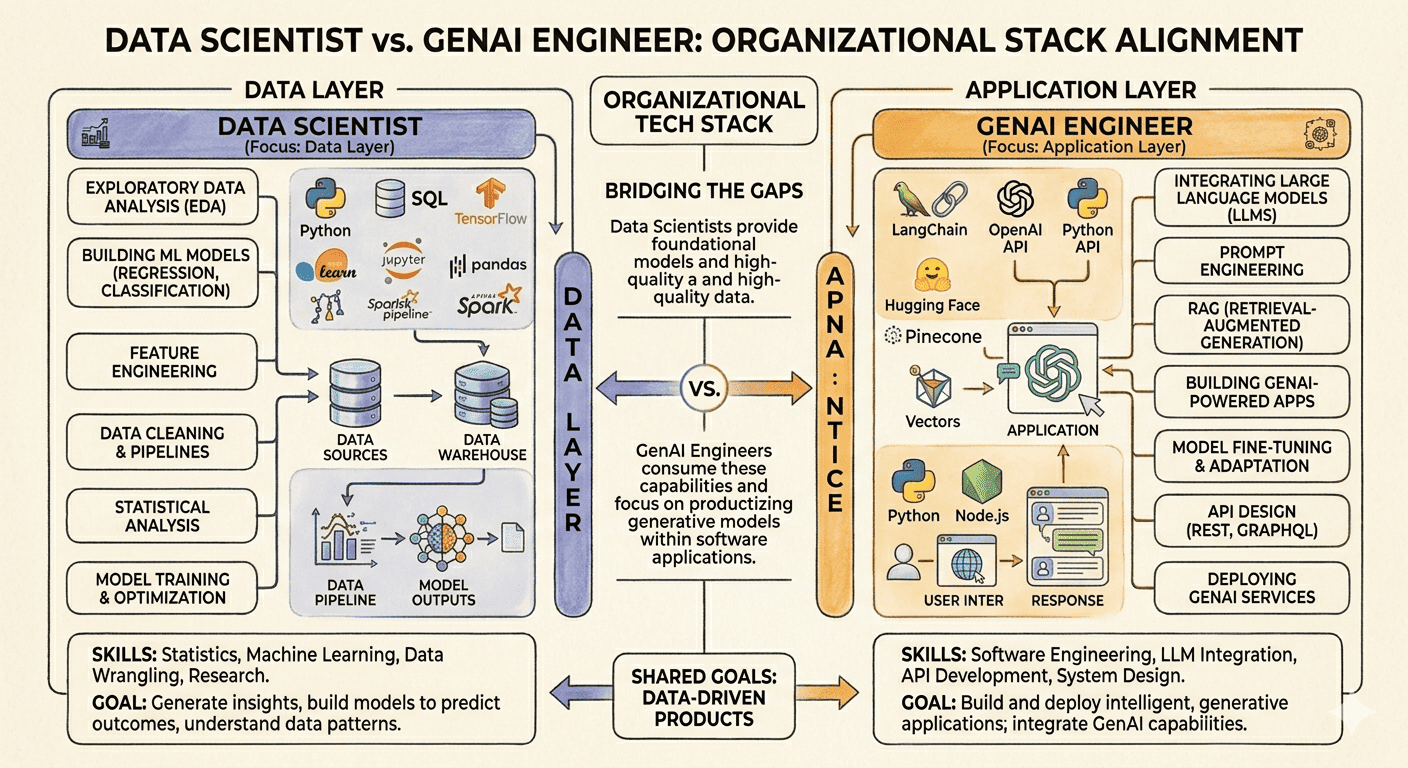
The emergence of foundation models — GPT-4, Gemini, Claude, Llama — created an entirely new category of engineering work: building production-grade AI applications on top of pre-trained models rather than training models from scratch. This work is what GenAI Engineers do. It requires a distinct skill stack from classical data science, produces different kinds of outputs, and sits in a different place in the organisation's hierarchy.
The split, plainly stated:
- Data Scientists answer business questions by analysing data. Their output is insight, models, or dashboards. They live close to the data warehouse and the analytics layer.
- GenAI Engineers build AI-powered applications and workflows. Their output is a deployed system — a RAG pipeline, a conversational agent, an AI-augmented product feature. They live close to the product and the backend engineering layer.
In 2026, these are two different jobs with two different career ladders. And in Mumbai's market, they are generating two very different hiring volumes.
Role Definitions: What Each Does Day-to-Day
What a Data Scientist Actually Does
A Data Scientist's core job is extracting structured insight from unstructured reality. The day-to-day work involves:
- Pulling data from databases, APIs, and warehouses (SQL, Spark, BigQuery)
- Cleaning and transforming messy, incomplete data into usable form
- Building statistical models or classical ML models (regression, classification, clustering, time series)
- Evaluating model performance, tuning hyperparameters, managing bias/variance trade-offs
- Communicating findings to business stakeholders through visualisations and executive summaries
- In some organisations: retraining and maintaining deployed ML models (though this bleeds into MLOps territory)
In a Mumbai BFSI firm like HDFC or ICICI, a Data Scientist might spend their week building a credit risk model, analysing churn patterns in a customer cohort, or producing a forecast dashboard for the CFO's quarterly review.
In an e-commerce company or consumer tech firm, they might be working on recommendation engine improvements, A/B test analysis, or fraud pattern detection.
The output is insight or a model. The stakeholder is usually a business team or product manager.
What a GenAI Engineer Actually Does
A GenAI Engineer's core job is building AI-powered systems that work reliably in production. The day-to-day work involves:
- Designing and implementing RAG (Retrieval-Augmented Generation) pipelines — connecting LLMs to internal knowledge bases via vector databases (Pinecone, ChromaDB, pgvector)
- Prompt engineering at a systems level — writing system prompts, few-shot examples, and output parsers that produce consistent, structured responses
- Building and orchestrating AI agents using frameworks like LangChain, LlamaIndex, LangGraph, or CrewAI
- Integrating LLM capabilities into existing products via APIs (OpenAI, Anthropic, AWS Bedrock, Google Vertex AI)
- Evaluating AI output quality using frameworks like RAGAS — managing hallucination rates, relevance scores, faithfulness metrics
- Deploying AI systems using Docker, FastAPI, cloud serverless functions, and CI/CD pipelines
- Fine-tuning models on domain-specific data where pre-trained performance is insufficient
In a Mumbai Fintech company like Razorpay or Paytm, a GenAI Engineer might be building an AI agent that handles merchant support queries autonomously, implementing a document intelligence pipeline that extracts and classifies financial data from PDFs, or deploying a code-generation assistant for the internal engineering team.
The output is a working, deployed system. The stakeholder is usually the engineering team or product owner.
Day in the Life: Side-by-Side Comparison
| Time | Data Scientist | GenAI Engineer |
|---|---|---|
| 9:00 AM | Pull yesterday's transaction data, check anomalies | Review agent conversation logs, identify failure patterns |
| 10:00 AM | Feature engineering for churn prediction model | Improve retrieval accuracy in RAG pipeline — tune chunking strategy |
| 12:00 PM | Exploratory data analysis, notebook review | Integrate new tool into LangGraph agent workflow |
| 2:00 PM | Present model findings to product team | Deploy updated FastAPI endpoint, test in staging |
| 4:00 PM | Statistical deep-dive: why did conversions drop last week? | RAGAS evaluation run: faithfulness score dropped from 0.84 to 0.71 — debug |
| 5:30 PM | Write SQL query to extract cohort for next experiment | Write system prompt v4, test against edge case queries |
The differences compound over time: Data Scientists develop deep expertise in statistical thinking and data manipulation. GenAI Engineers develop deep expertise in LLM behaviour, system architecture, and AI application design.
Skill Stack Breakdown
Data Scientist Skills
Core Technical:
- Python (pandas, NumPy, scikit-learn, statsmodels)
- SQL — advanced, including window functions and query optimisation
- Machine learning: supervised/unsupervised models, ensemble methods, model evaluation
- Statistics: probability, hypothesis testing, regression, Bayesian reasoning
- Data visualisation: Matplotlib, Seaborn, Plotly, Tableau, Power BI
- Experimentation: A/B testing design and analysis
Advanced Technical:
- Deep learning frameworks (TensorFlow, PyTorch) for image/NLP tasks
- Big data tools (Spark, Databricks, Hadoop)
- Cloud data platforms (AWS S3/Redshift, Google BigQuery, Azure Synapse)
- MLflow or similar for experiment tracking
Soft Skills:
- Statistical storytelling — translating model output to business language
- Stakeholder communication
- Business domain knowledge (Finance, E-Commerce, Healthcare, etc.)
GenAI Engineer Skills
Core Technical:
- Python (FastAPI, Pydantic, async programming)
- LLM APIs: OpenAI, Anthropic, Google Gemini, AWS Bedrock
- RAG pipeline construction: document loaders, chunking, embedding, vector search
- Vector databases: Pinecone, ChromaDB, pgvector, Weaviate, Qdrant
- Prompt engineering: system prompts, few-shot design, output parsers, structured generation
- LangChain / LlamaIndex for pipeline orchestration
- LangGraph / CrewAI for multi-agent workflows
Advanced Technical:
- Fine-tuning and PEFT methods (LoRA, QLoRA) for domain adaptation
- Evaluation frameworks: RAGAS, DeepEval, TruLens
- Containerisation: Docker, Kubernetes basics
- Cloud AI services: AWS Bedrock, Azure OpenAI, Google Vertex AI
- Observability: LangSmith, Helicone, custom logging for AI systems
Soft Skills:
- Systems thinking — designing workflows that handle edge cases at scale
- Product-oriented mindset — thinking about user experience, not just model accuracy
- Communication with non-technical stakeholders about AI capabilities and limitations
[Insert Table: Data Scientist vs GenAI Engineer — Full Skill Stack Comparison]
Mumbai and India Market Trends: Where the Demand Is Going
Hiring Volume: 2024 vs. 2026
The Mumbai job market has shifted measurably over the past 18 months. Based on job posting trends across Naukri, LinkedIn, and direct company career pages:
Data Scientist roles remain steady but are no longer growing at the exponential rate of 2019–2022. Demand is concentrated in:
- BFSI (HDFC, ICICI, Axis, Kotak) — risk modelling, fraud detection, credit scoring
- E-commerce and consumer tech — recommendation systems, demand forecasting
- Healthcare and pharma analytics
- Consulting (Deloitte, EY, McKinsey's analytics practices in BKC)
GenAI Engineer roles are growing at 3–4x the rate of Data Scientist openings in 2026-2027. High demand is visible at:
- GCC (Global Capability Centres) in Vikhroli, Airoli, and Navi Mumbai — JP Morgan, Goldman Sachs, Deutsche Bank, HSBC are all hiring GenAI Engineers
- Mumbai-based Fintech and SaaS startups (Razorpay, Zepto, Groww, Smallcase)
- Enterprise IT services firms (TCS, Infosys, Wipro) building GenAI consulting practices
- Product companies adding AI features to existing platforms
Salary Comparison: Mumbai 2026
| Experience Level | Data Scientist | GenAI Engineer | Difference |
|---|---|---|---|
| Fresher (0–1 yr) | ₹6L–₹10L | ₹8L–₹15L | +₹2L–₹5L |
| Mid-Level (2–4 yr) | ₹14L–₹22L | ₹20L–₹35L | +₹6L–₹13L |
| Senior (5–8 yr) | ₹25L–₹40L | ₹40L–₹65L | +₹15L–₹25L |
| Principal/Lead (8+ yr) | ₹40L–₹60L | ₹65L–₹90L+ | +₹20L–₹30L+ |
The salary differential reflects a supply-demand imbalance: there are far more trained Data Scientists than trained GenAI Engineers in India's talent pool, and the gap between demand and supply for GenAI Engineers is wider.
Transition Pathways: Can You Move Between These Roles?
Data Scientist → GenAI Engineer
This is the most common transition and one of the highest-ROI career moves available in Mumbai's 2026 market. Data Scientists have significant transferable skills:
- Python proficiency transfers directly
- Understanding of ML concepts (embeddings, tokenisation, attention mechanisms) provides crucial context
- Statistical evaluation mindset is directly applicable to RAGAS and AI output quality measurement
- Business domain knowledge is a competitive advantage — a GenAI Engineer who understands finance or BFSI can build better financial AI systems than one who doesn't
The skill gap to close: RAG architecture, LangChain/LlamaIndex, vector databases, LLM APIs, and prompt engineering at a systems level. Most Data Scientists can close this gap in 3–5 months of deliberate practice.
Software Engineer → GenAI Engineer
Also a strong transition pathway. Engineers bring:
- Systems thinking, API design, and deployment experience
- Docker, CI/CD, and cloud infrastructure knowledge
- Strong Python or JavaScript fundamentals
The skill gap to close: LLM-specific knowledge — prompt engineering, RAG concepts, agent orchestration, evaluation frameworks. Typically 2–4 months with structured learning.
GenAI Engineer → Data Scientist
Less common, but possible. Requires building out the statistics and classical ML foundation that most GenAI Engineers lack. Typically a longer transition (6–12 months) and rarely financially motivated — since GenAI roles currently pay more.
The "Both" Question: Do You Need to Know Both?
Senior AI roles — Principal AI Engineer, Head of AI, Chief AI Officer — increasingly expect comfort in both domains. But at the 0–5 year career stage, specialisation outperforms breadth. The market rewards GenAI depth more richly than Data Science depth right now, and attempts to be genuinely strong at both simultaneously often result in mediocrity at both.
The practical answer: choose one as your primary identity, build adjacent literacy in the other. A GenAI Engineer who understands when a statistical model is the right tool (rather than an LLM) is more valuable than one who has only ever worked with LLMs. A Data Scientist who can integrate their models into a LangChain pipeline adds leverage to their own output.
But your LinkedIn headline, your portfolio, your interview preparation, and your job search should be organised around one clear specialisation — not a blend.
Quick Career Quiz: Which Path Fits You?
Answer these questions honestly:
You are probably a better fit for Data Science if:
- You love working with data — cleaning it, exploring it, finding hidden patterns
- You enjoy statistical reasoning and hypothesis testing
- You want to be the person who tells the business why something happened
- You are drawn to domain expertise — becoming the AI authority in BFSI, or healthcare, or e-commerce
- You prefer working close to the data warehouse and analytics layer
You are probably a better fit for GenAI Engineering if:
- You enjoy building things — systems, workflows, applications that users interact with
- You think in terms of products and user experiences, not just models and metrics
- You are drawn to the "what can this LLM do" question more than the "what does this data say" question
- You want to be the person who builds the AI feature that ships to customers
- You prefer working close to the product and backend engineering layer
When the answer is still unclear:
- Build one RAG pipeline from scratch (LangChain + ChromaDB + OpenAI)
- Complete one end-to-end data science project (EDA → model → evaluation → presentation)
- Notice which one felt like problem-solving and which one felt like work
Your gut reaction after doing both is usually the correct answer.
The Honest Assessment: Which Has Better Long-Term Prospects?
Both roles have strong long-term prospects, but along different curves.
Data Science is a mature discipline. The foundational skills are well-understood, the career ladder is clear, and the demand from BFSI, healthcare, and e-commerce will remain stable for the foreseeable future. The risk: classical ML and statistical modelling is increasingly automated by AutoML platforms and AI-assisted analytics tools. The ceiling for a "pure" Data Scientist without AI fluency is lower in 2026 than it was in 2021.
GenAI Engineering is in its highest-growth phase. The skill premium is real and large right now. The risk: the tooling is evolving rapidly (LangChain's API has changed multiple times; new frameworks appear quarterly), and the role will mature and commoditise over time as best practices solidify and abstraction layers improve. The ceiling for a GenAI Engineer who keeps pace with the field is very high — but it requires continuous learning more aggressively than most technical roles.
The synthesis: GenAI Engineering has higher upside and higher velocity; Data Science has more stability and deeper domain moat. If you are earlier in your career (0–5 years) and want maximum financial return over the next 3–5 years, GenAI Engineering is the stronger bet. If you have deep domain expertise in BFSI or healthcare and a strong statistical foundation, doubling down on Data Science while adding GenAI literacy is a defensible and well-compensated path.
What Mumbai's Top Employers Are Looking For in 2026
GCCs (JP Morgan, Goldman Sachs, HSBC — Vikhroli/Airoli/BKC):
- GenAI Engineers for internal productivity tools, document intelligence, risk analysis automation
- Heavy emphasis on agentic AI (LangGraph, CrewAI) and enterprise security/compliance
Fintech Startups (Razorpay, Zepto, Groww — Powai/BKC):
- GenAI Engineers for customer-facing AI features, merchant support automation, fraud detection enhancement
- Data Scientists for growth analytics, experiment design, financial risk modelling
BFSI (HDFC, ICICI, Axis — BKC/Nariman Point):
- Both roles, but Data Scientists remain the larger volume hire
- Growing GenAI Engineering demand for customer service agents, document processing, regulatory compliance automation
IT Services (TCS, Infosys, Wipro — Powai/Andheri):
- Massive GenAI Engineering hiring for building GenAI capabilities to sell to enterprise clients
- Data Scientists needed for analytics consulting practices
[Insert Chart: Job Posting Volume — GenAI Engineer vs Data Scientist roles in Mumbai, 2024–2026]
GenAI Engineer vs. Data Scientist: The Decision Framework
Before making a final call, run through this framework:
Step 1 — Assess your current foundation. Do you have stronger data/statistics skills or stronger software engineering/API skills? Your transition cost is lower going toward the field that builds on your existing strengths.
Step 2 — Map your financial target. If your 3-year salary target is ₹30L+, GenAI Engineering gets you there faster and more reliably in Mumbai's current market.
Step 3 — Assess your learning appetite. GenAI Engineering requires faster-paced continuous learning. Data Science allows deeper, slower specialisation. Be honest about which model of learning you actually sustain over time.
Step 4 — Check your domain interest. If you are genuinely fascinated by a domain — banking, healthcare, logistics — and want to be the AI authority in that domain, Data Science gives you a clearer path to that expertise identity.
Step 5 — Look at the 10 most recent job postings you find genuinely exciting. Are they more often "build this AI feature/system" (GenAI Engineering) or "analyse this data/build this model" (Data Science)? Your honest reaction to real job descriptions is more reliable than any framework.
Your Next Step: Get Clarity Before You Commit
Choosing a career direction without structured guidance is expensive — in time, in wasted learning, and in opportunity cost. The professionals in Mumbai who have made this transition most efficiently have done it with a clear roadmap and an expert who could answer the specific, "which applies to my situation?" questions that articles like this one cannot personalise.
TechPaathshala's AI Career Counselling Session is a one-on-one session designed for exactly this decision point: developers, analysts, and business professionals at a career crossroads who want a clear, personalised answer to the GenAI Engineer vs. Data Scientist question — based on their current skills, target salary, timeline, and the specific opportunities in Mumbai's 2026 market.
In the session, you will:
- Get a skills assessment against the full GenAI Engineer and Data Scientist skill matrices — knowing exactly where you are and where you need to go is the starting point for any intelligent plan
- Receive a personalised roadmap — not a generic "learn Python, then ML, then deep learning" sequence but a specific 6–12 month plan calibrated to your background and target role
- Understand the Mumbai market — which companies are hiring for what, which skills command the largest salary premium in your target sector, and where the talent gaps are that you can position yourself to fill
- Leave with a decision — not a shortlist of options but a clear answer, a clear timeline, and clear next steps
👉 Book Your AI Career Counselling Session at Techpaathshala — and make the GenAI Engineer vs. Data Scientist decision with confidence rather than guesswork.
TechPaathshala is a Mumbai-based technology education platform helping developers, analysts, and business professionals navigate the AI transition — from foundational Python to advanced GenAI Engineering and Agentic AI development.