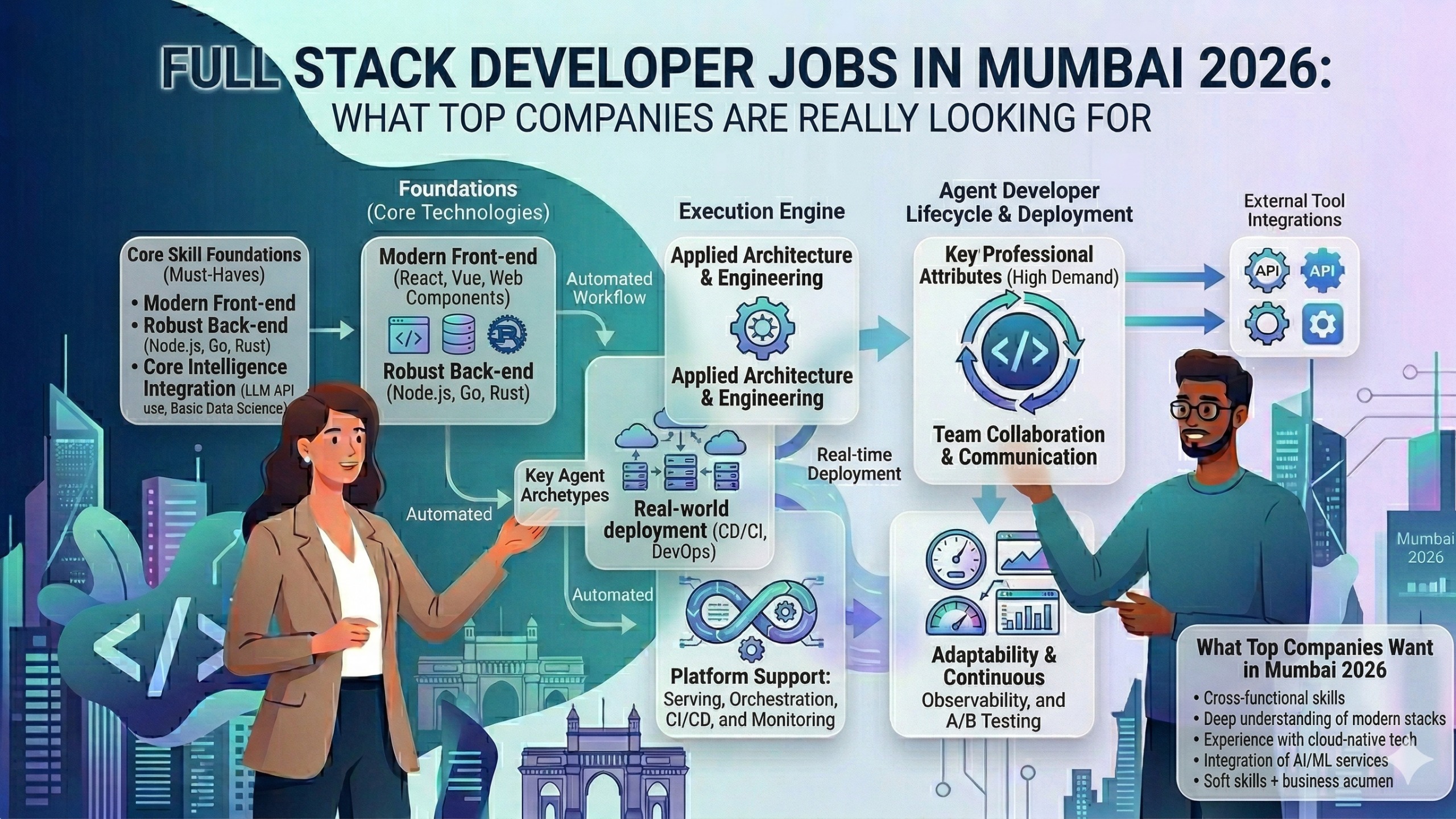
Full Stack Developer Jobs in Mumbai 2026: What Top Companies Are Really Looking For
Contents
- Why Mumbai Is a Different Market for Full Stack Developer Jobs in 2026
- The "Mumbai Premium" Skillset: Cloud-Native Is Now the Baseline
- The Shift to TypeScript and Next.js: Why "Just React" Is No Longer Enough
- The "AI-Plus" Requirement: What Mumbai's 2026 JDs Actually Mean
- Soft Skills for the Mumbai Hustle: Why Business Logic Is a Technical Skill Here
- The Mumbai Interview Gauntlet: What Each Round Is Actually Evaluating
- Stage 1: The Machine Coding Round
- Stage 2: System Design
- Stage 3: Cultural Fit
- Building the Portfolio That Gets You Past the Shortlist
- The Only Edge That Compounds
- Stop Guessing. Build What Recruiters Are Actually Looking For.
Every year, thousands of developers in India update their resumes, practice LeetCode, and apply to Mumbai's top tech companies. A small fraction of them get offers. The gap between the two groups is not intelligence, and it is rarely effort.
It is information asymmetry.
The developers who get hired at NPCI, BillDesk, Razorpay, and BrowserStack in 2026 are not necessarily the best coders in the pool. They are the ones who understood—specifically—what these companies are actually evaluating, and built their skills and portfolios accordingly.
This report closes that information gap. It is based on a ground-level reading of 2026 job descriptions, hiring patterns, and the technical expectations of Mumbai's most active engineering employers. If you are targeting full stack developer jobs in Mumbai, this is the brief you need before your next application.
Why Mumbai Is a Different Market for Full Stack Developer Jobs in 2026
Before getting into the technical requirements, it is worth understanding why the Mumbai market has its own character—and why preparing generically for "full stack roles in India" will leave you underqualified for roles here specifically.
Mumbai is not a city of IT services companies. It is a city of product companies, financial infrastructure, and consumer platforms that operate at India-scale. NPCI processes billions of UPI transactions. BillDesk handles payment routing for a significant share of India's digital commerce. Nykaa runs a multi-category e-commerce and retail operation with millions of active users. BrowserStack provides developer tooling used by engineering teams in over 150 countries.
These are not companies building internal tools for limited users. They are companies where a poorly optimised database query or a single unhandled API failure can affect millions of transactions and significant amounts of money in real time.
This context shapes everything about how these companies hire. The bar is not "can you build a CRUD app." The bar is "can you build something that won't break under load, can be extended by six other engineers, and can be debugged at 2 AM when something goes wrong in production."
Software engineer roles in BKC and tech jobs in Powai operate under this implicit standard. Understanding it is the first step to meeting it.
The "Mumbai Premium" Skillset: Cloud-Native Is Now the Baseline
Three years ago, knowing Docker was a differentiator. Two years ago, it was becoming expected. In 2026, not knowing Docker is a gap that will quietly eliminate you from shortlists before you receive a rejection email.
Why cloud-native proficiency became non-negotiable in Mumbai's market:
Mumbai's FinTech and E-commerce infrastructure runs on distributed, containerised systems. When NPCI scales UPI transaction processing during a high-volume event like a festive sale or a government scheme launch, it is doing so through orchestrated container clusters—not by manually spinning up servers. When Nykaa runs a sale campaign and traffic spikes 10x overnight, the infrastructure responds automatically—because it is designed to.
Full stack developers joining these teams are not just writing features. They are writing features that deploy into this infrastructure. You need to understand the environment your code lives in.
What Mumbai's top employers actually expect:
Docker is the floor. You need to be able to containerise a Node.js application, write a multi-service docker-compose.yml for local development (app + database + cache), understand image layering and build optimisation, and not be confused when a DevOps engineer asks you to check a container's logs for the service you built.
Kubernetes is the ceiling that is rapidly becoming the floor. You do not need to be a Kubernetes administrator. You need to understand: what a Pod is, what a Deployment and Service are, how horizontal scaling works, and how to read a kubectl logs output for your service. In a product engineering interview at a BKC-based FinTech, being able to say "I've deployed to a K8s cluster and understand the basic resource model" puts you ahead of 70% of candidates.
Serverless architectures are increasingly relevant for specific workloads—event-driven processing, scheduled jobs, webhook handlers, notification pipelines. AWS Lambda (or Azure Functions) knowledge signals that you can reason about compute costs, cold start tradeoffs, and stateless function design. This is not mandatory everywhere, but it is a genuine differentiator in roles where the JD mentions "cloud-native" or "event-driven architecture."
The cloud platform baseline: AWS is dominant across Mumbai's tech companies. Azure is growing, particularly in enterprise-adjacent firms. GCP has a presence in data-heavy companies. For full stack developer jobs in Mumbai, AWS literacy is the practical priority: EC2, S3, RDS, Elastic Load Balancer, CloudWatch for monitoring, and IAM for access control.
| Startup Name | Industry | Roles for Freshers | Key Skills Required | Notable Info |
|---|---|---|---|---|
| Zepto | Quick Commerce | Operations, Product Analyst, Marketing | Excel, Communication, Data Analysis | Fast-growing unicorn, high hiring demand |
| Upstox | FinTech | Customer Success, QA, Backend Intern | SQL, APIs, Finance basics | Backed by Ratan Tata |
| Razorpay | FinTech | Software Engineer, Support, Sales | JavaScript, APIs, Problem Solving | Expanding aggressively in India |
| CRED | FinTech | Product Ops, Data Analyst, Growth | SQL, Analytics, Marketing | Known for premium branding |
| Nykaa | E-commerce | Marketing Exec, Catalog Mgmt, Ops | Excel, Communication, CRM | Strong D2C brand presence |
| Dream11 | Gaming / SportsTech | Data Analyst, QA, Customer Support | SQL, Stats, Excel | India’s first gaming unicorn |
| Meesho | E-commerce | Operations, Business Analyst, Support | Excel, Communication | High fresher hiring volume |
| Licious | FoodTech | Supply Chain, Ops Executive | Logistics, Excel, Coordination | Strong backend ops roles |
| Pharmeasy | HealthTech | Support, Data Entry, Ops | Communication, Excel | Consistent hiring in ops roles |
| BookMyShow | EntertainmentTech | Marketing, Customer Experience | Communication, CRM | Mumbai HQ, good for freshers |
The Shift to TypeScript and Next.js: Why "Just React" Is No Longer Enough
If your portfolio is built entirely in JavaScript with Create React App, you are signalling—unintentionally—that you have not been paying attention to where the industry moved two years ago.
Mumbai's product-first startups and scale-ups have largely completed their migration to TypeScript. The engineering teams at Meesho, Groww, and similar companies have made this shift for specific, articulable reasons. Understanding those reasons helps you speak about TypeScript in interviews the way a practitioner would, not the way someone who just added it to their resume would.
Why TypeScript won in product engineering teams:
At scale, JavaScript's dynamic typing becomes a liability. When a codebase has 50,000 lines written by 15 engineers over 3 years, a function that accepts any type and returns any type becomes a maintenance nightmare. Refactoring is dangerous because you cannot know all the call sites. Runtime errors surface in production because the type mismatch was never caught earlier.
TypeScript moves these errors to compile time. The IDE catches the mistake before the code runs. The type definitions serve as lightweight documentation that stays in sync with the code. The refactoring experience becomes significantly safer because the compiler tells you every place the interface changed.
For a company like BillDesk where a payment processing bug has direct financial consequences, or BrowserStack where the developer tooling must be rock-solid, TypeScript is not a preference—it is an engineering risk management decision.
What interviewers want to see:
Not just "I know TypeScript syntax." They want to see: interfaces and type aliases, generic functions, union types and type narrowing, utility types (Partial, Pick, Omit, Record), and how to type async functions and API responses. If you can explain why you chose interface over type in a specific situation, you're demonstrating practitioner-level knowledge.
Next.js as the production standard:
Client-side React applications have a well-known set of limitations: poor SEO (content rendered after JavaScript loads), slower initial page load (large JS bundles), and no built-in server-side data fetching. For consumer-facing products—Nykaa's product pages, Meesho's listing pages, FinTech dashboards that need fast initial loads—these limitations matter commercially.
Next.js solves them. Server-Side Rendering (SSR) and Static Site Generation (SSG) mean that content is available immediately, both to users and to search engines. The App Router (Next.js 13+) enables fine-grained control over which components render on the server and which on the client. API Routes allow you to write lightweight backend endpoints in the same codebase.
For tech jobs in Powai and software engineer roles in BKC, Next.js now appears in a significant portion of full stack job descriptions. If your portfolio has a Next.js project with SSR, TypeScript, and a real data fetching pattern (not just useEffect calling an API), you are immediately more competitive than a candidate whose portfolio is entirely CSR React.
The "AI-Plus" Requirement: What Mumbai's 2026 JDs Actually Mean
A growing number of full stack developer job descriptions in Mumbai in 2026 include language like: "experience with AI/ML integrations," "familiarity with LLM APIs," or "ability to build AI-powered features." This addition is causing confusion among job seekers who assume it means becoming a machine learning engineer.
It does not.
What "AI Integration" actually means at the full stack level:
Companies are not asking their full stack developers to train models. They are asking them to build features that use models that already exist.
The practical skills this translates to:
LLM API integration. Calling the OpenAI API (or Anthropic API, or Google Gemini API) from a Node.js backend. Structuring prompts effectively. Handling streaming responses. Managing API keys securely. Implementing retry logic and error handling. Displaying AI-generated content in a React frontend with appropriate loading states and fallbacks. This is backend and frontend work with an AI service as the data source—the same skills you already have, applied to a new type of API.
RAG (Retrieval-Augmented Generation) features. A growing number of product features work like this: a user asks a question, the system retrieves relevant documents from a knowledge base, passes those documents + the question to an LLM, and displays a contextual answer. Building this requires understanding vector embeddings (conceptually), using a vector database (Pinecone, Weaviate, or pgvector for PostgreSQL), and wiring the retrieval and generation steps together in a backend service. This is a learnable full stack skill—not a research skill.
Why this matters for Mumbai's market specifically:
Mumbai's FinTech companies are integrating AI into customer service flows, fraud detection explanations, and document processing. E-commerce companies are building AI-powered search and recommendation explanation layers. Developer tools companies are building coding assistance features. In every case, the implementation work is full stack engineering work that uses AI APIs as infrastructure.
A portfolio that includes one well-built AI-integrated feature—a chatbot that uses RAG over a knowledge base, or a document summarisation tool that calls an LLM API—signals that you are current. Given how recently this expectation emerged, it remains a genuine differentiator in 2026 interview pools.
Soft Skills for the Mumbai Hustle: Why Business Logic Is a Technical Skill Here
This section tends to surprise developers who come to Mumbai from other tech markets in India. In Pune or Hyderabad, engineering interviews often remain almost entirely technical. In Mumbai—particularly for roles at the intersection of FinTech, payments, and consumer products—there is consistent evaluation of something that does not appear on skill matrices but reliably separates candidates at the offer stage.
It is the ability to understand and articulate why a feature exists.
The BKC boardroom reality:
Mumbai's product companies operate in close proximity to their business stakeholders. The engineering team at a BillDesk or a Razorpay is not in a separate building from the product and commercial teams. Developers regularly interact with product managers who are tracking transaction success rates, finance teams who are monitoring settlement cycles, and compliance officers who are enforcing regulatory requirements.
A developer who can only discuss the how of a feature—the implementation, the API design, the component structure—is a liability in these environments. A developer who can also articulate the why—"this feature reduces checkout abandonment by keeping the payment flow within the app rather than redirecting to a gateway"—is immediately more useful, more credible, and more promotable.
What this looks like in practice:
When you are asked in a Mumbai interview to walk through a project you've built, the strongest answers include business context. Not just "I built a payment flow component" but "I built a payment flow component where the key constraint was minimising user drops at the OTP verification step, because data showed that every second of additional latency at that point increased abandonment by 8%."
This framing—technical work explained in business outcome terms—is what senior engineers and tech leads in Mumbai do naturally. Demonstrating it as a candidate signals readiness for that level.
Technical debt conversations. Mumbai's engineering managers expect developers to understand that every architectural shortcut has a future cost. Being able to say "this implementation is intentionally simple for the MVP, and here's what we'd need to refactor when we scale" is a sign of maturity that earns trust early.
The Mumbai Interview Gauntlet: What Each Round Is Actually Evaluating
The three-stage interview process is now standard across Mumbai's mid-to-large tech employers. Understanding what each stage is actually measuring—not just what it appears to test—changes how you prepare.
Stage 1: The Machine Coding Round
Format: 60–90 minutes. A functional feature to build from scratch, usually in a shared coding environment. Typical prompts: build a rate-limited API endpoint, build a paginated list component with search and filter, implement a basic authentication flow.
What it appears to test: Can you write working code?
What it actually tests: Can you write working code under time pressure, make reasonable scope decisions when you can't complete everything, communicate your choices as you work, and produce code that someone else could maintain?
The candidates who do well are not necessarily the fastest coders. They are the ones who: read the problem statement fully before writing a line, ask one clarifying question upfront to confirm their understanding, implement the core requirement before attempting optional enhancements, and—critically—write code that is readable. Variable names that mean something. Functions that do one thing. A structure that suggests they understand the codebase will be read by other people.
How to prepare: Practice timed feature builds, not algorithmic puzzles. LeetCode prepares you for LeetCode. Machine coding rounds are a different skill. Practice building complete mini-features: an auth endpoint with JWT, a paginated API with filtering, a React form with validation and submission handling. Do it with a timer. Review your output critically.
Stage 2: System Design
Format: 30–45 minutes. An open-ended problem. Design a real-time food delivery tracking system. Design a payment processing service. Design a notification system that handles 10 million users.
What it appears to test: Do you know distributed systems theory?
What it actually tests: Can you reason through a problem you haven't solved before, make and defend trade-off decisions, and demonstrate that you understand the relationship between product requirements and technical architecture?
You are not expected to produce the perfect answer. There is no perfect answer. You are expected to: start by clarifying the functional and non-functional requirements (how many users? what's the acceptable latency? what's the consistency requirement?), propose a high-level architecture with components you can name and justify, identify the bottlenecks in your design and propose mitigations (caching, queue-based decoupling, database read replicas), and respond thoughtfully to pushback without becoming defensive.
For Mumbai-specific roles, be prepared to discuss: WebSocket-based real-time updates (relevant to trading platforms, delivery tracking, live payment status), Redis for caching and session management, message queues (Kafka, RabbitMQ) for decoupling high-throughput services, and PostgreSQL vs. NoSQL trade-offs for specific workloads.
How to prepare: Spend time with three or four canonical system design problems—URL shortener, notification service, ride-sharing backend, payment processing pipeline. For each one, practice the full arc: requirements → high-level design → deep dive → bottleneck discussion. Do this out loud, or with a practice partner. System design is a communication exercise as much as a technical one.
Stage 3: Cultural Fit
Format: Conversational. Often with a senior engineer, engineering manager, or VP Engineering. Questions that seem casual but are evaluating specific things.
What it appears to test: Are you a nice person?
What it actually tests: Will you add to or subtract from the team's ability to move fast, communicate clearly, and handle ambiguity without constant management?
Mumbai's fast-paced product culture means engineering teams operate with significant autonomy and significant pressure simultaneously. Interviewers are looking for signals that you: take ownership rather than waiting to be told what to do, communicate proactively when something is blocked or running late, handle feedback on your work without ego, and have genuine curiosity about the product and business—not just the technology.
The specific questions vary. The underlying evaluation is consistent: are you someone who makes the team better, or are you someone the team will need to manage?
| Category | Skill | Status (✔️/❌) |
|---|---|---|
| Frontend Fundamentals | HTML5 (semantic, accessibility) | ☐ |
| CSS3 (Flexbox, Grid, responsive) | ☐ | |
| JavaScript (ES6+, async/await, DOM) | ☐ | |
| Git & GitHub | ☐ | |
| Frontend Frameworks | React (hooks, state, routing) | ☐ |
| Component-based architecture | ☐ | |
| API integration (REST, fetch/axios) | ☐ | |
| Performance optimization | ☐ | |
| UI & UX Skills | Responsive design (mobile-first) | ☐ |
| Design principles (spacing, typography) | ☐ | |
| Figma basics | ☐ | |
| Accessibility (ARIA, contrast) | ☐ | |
| Backend Development | Node.js fundamentals | ☐ |
| Express.js | ☐ | |
| REST API (CRUD operations) | ☐ | |
| Authentication (JWT, OAuth) | ☐ | |
| Database Management | SQL (MySQL/PostgreSQL) | ☐ |
| NoSQL (MongoDB) | ☐ | |
| Schema design | ☐ | |
| CRUD with backend | ☐ | |
| Integration & DevOps | API error handling | ☐ |
| Environment variables | ☐ | |
| Deployment (Netlify/Vercel/AWS) | ☐ | |
| CI/CD basics | ☐ | |
| Testing & Debugging | Debugging (DevTools) | ☐ |
| Testing basics | ☐ | |
| Edge case handling | ☐ | |
| Projects | 3–5 full stack projects | ☐ |
| Auth + CRUD project | ☐ | |
| API-based project | ☐ | |
| Live deployment | ☐ | |
| Clean GitHub code | ☐ | |
| Job Readiness | Resume (project-focused) | ☐ |
| GitHub portfolio | ☐ | |
| LinkedIn profile | ☐ | |
| Basic DSA | ☐ | |
| Project explanation skills | ☐ |
Building the Portfolio That Gets You Past the Shortlist
Given everything above, a portfolio for full stack developer jobs in Mumbai in 2026 should demonstrate:
One cloud-deployed full stack application. Not running on localhost. Deployed on AWS or a comparable platform, with the deployment architecture described in the README. Bonus: containerised with Docker and deployed via a basic CI/CD pipeline.
TypeScript throughout. If your portfolio projects are in JavaScript, rewrite the most substantial one in TypeScript before your next application cycle. The rewrite itself will be a learning exercise that deepens your TypeScript fluency.
One Next.js project with SSR. A project that uses server-side rendering or static generation for at least part of its content—demonstrating that you understand when and why to use each rendering strategy.
One AI-integrated feature. A chatbot, a summarisation tool, a search feature backed by an LLM API. It does not need to be complex. It needs to be real, deployed, and described with enough specificity to demonstrate that you built it rather than copied it.
Git history that tells a story. Feature branches. Pull request descriptions that explain the why, not just the what. Consistent commit cadence. A project README that reads like professional documentation, not a homework submission.
The Only Edge That Compounds
The Mumbai tech market in 2026 is not looking for candidates who know a lot. It is looking for candidates who have built things under conditions that resemble real work—and who can articulate what they built, why they built it that way, and what they would do differently.
That combination—technical depth + deployment experience + business context + communication—is rare enough that it commands a premium. The ₹18L–₹25L full stack roles at Mumbai's top product companies are not out of reach. They are out of reach for candidates who prepared for a different interview than the one they're walking into.
Stop Guessing. Build What Recruiters Are Actually Looking For.
Join TechPaathshala's Full Stack Engineering Program and build the exact projects Mumbai's top CTOs are evaluating candidates on—using the same tools, workflows, and standards that define professional engineering at BKC's and Powai's highest-growth companies.
Our Full Stack program includes cloud deployment, TypeScript and Next.js, AI integration modules, and a structured system design curriculum—all delivered through our simulation-based environment where you work like a developer from Day 1.
Join the Full Stack Engineering Program →