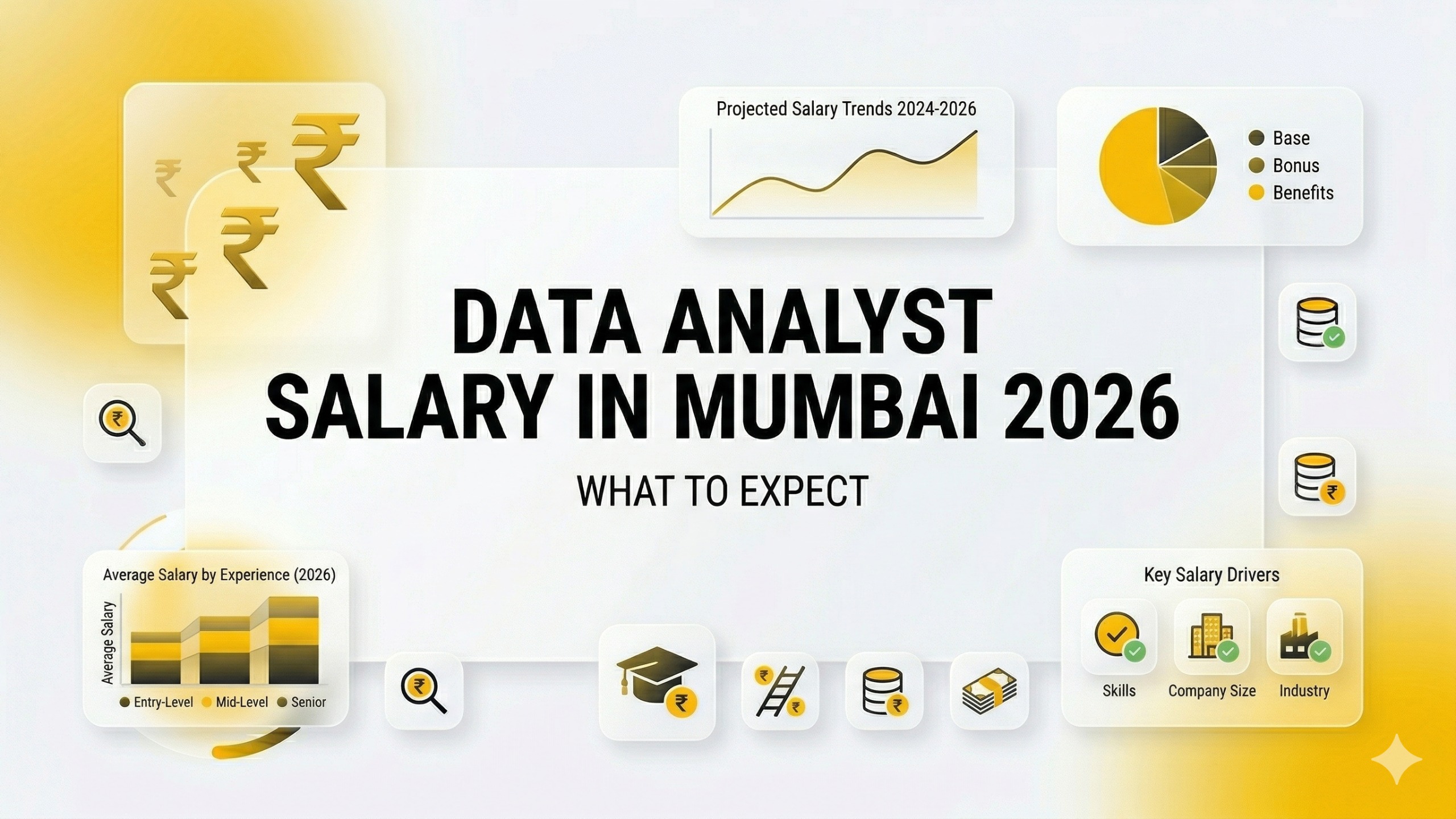
Data Analyst Salary in Mumbai 2026 — What to Expect
Contents
- Why Mumbai Is a Distinct Market for Data Analysts
- Data Analyst Salary in Mumbai 2026: By Experience Level
- Fresher / Entry Level (0–1 Year Experience)
- Junior Analyst (1–3 Years Experience)
- Mid-Level Analyst (3–5 Years Experience)
- Senior Analyst / Analytics Lead (5–8 Years Experience)
- Specialist Roles: Where Salaries Diverge Significantly
- What Actually Determines Where You Land in the Band
- For Freshers: The Salary-to-Investment Calculation
- For Career Switchers: Is the Switch Worth It?
- Your Next Step
If you have been Googling "data analyst salary in Mumbai" at 11 PM while questioning your career choices, you are in good company.
Data analytics has become one of the most searched career paths in India over the last three years — and for good reason. Every sector from FinTech to retail to logistics is sitting on more data than it knows what to do with, and the professionals who can turn that data into business decisions are in genuinely high demand. Mumbai, as India's commercial capital, is where a significant portion of that demand concentrates.
But salary information for data roles is notoriously scattered, inconsistently reported, and often either wildly optimistic (recruitment marketing) or outdated (surveys conducted eighteen months ago). This guide is an attempt at honest clarity — what data analysts in Mumbai are actually earning across experience levels, what drives the differences between the lower and upper ends of each band, and what you need to know whether you are a fresher mapping out a starting point or a working professional evaluating whether a switch into data makes financial sense.

Why Mumbai Is a Distinct Market for Data Analysts
Before the numbers, context matters — because Mumbai's data analyst market has specific characteristics that make it different from Bengaluru, Pune, or Hyderabad, and that directly affect salary levels.
The FinTech concentration. Mumbai is home to India's largest financial services ecosystem — NPCI, Razorpay, BillDesk, Zerodha's operations team, HDFC, Axis, Kotak, and dozens of lending and insurance technology companies. FinTech and banking are among the highest-paying sectors for data analysts because the decisions driven by analysis — credit risk, fraud detection, customer retention, product pricing — have direct and quantifiable business impact. Analysts who work in this ecosystem earn a Mumbai premium that their counterparts in other cities at equivalent experience levels often do not.
The e-commerce and D2C layer. Nykaa, Meesho, Reliance Retail's digital arm, and numerous D2C brands headquartered in or significantly operating from Mumbai have built data teams that analyse customer behaviour, supply chain performance, and marketing effectiveness. These roles typically pay slightly below FinTech but offer significant scope and fast career progression.
The consulting and agency market. Mumbai has a dense ecosystem of management consulting firms (McKinsey, BCG, Deloitte, KPMG) and analytics consulting agencies that serve clients across sectors. Consulting data analyst roles often pay above-market for freshers and mid-level candidates but come with higher workload and less domain depth than product company roles.
The cost-of-living adjustment. Mumbai salaries need to be contextualised against the city's cost of living — significantly higher than Pune or Hyderabad, and comparable to Bengaluru. A ₹6L package in Pune has different real purchasing power than a ₹6L package in Mumbai. The salary bands in this guide reflect Mumbai market rates and should not be directly compared with other city benchmarks.
Data Analyst Salary in Mumbai 2026: By Experience Level
The most useful way to present salary data is by experience band, because experience is the primary driver of variation within a given role title. Secondary drivers — sector, company size, tool stack, and demonstrated business impact — create the spread within each band.
Fresher / Entry Level (0–1 Year Experience)
| Profile | Salary Range (Annual CTC) |
|---|---|
| Graduate with basic Excel + SQL skills | ₹3.0L – ₹4.5L |
| Graduate with Python/R + SQL + one BI tool | ₹4.5L – ₹6.5L |
| Graduate from premium college or with internship portfolio | ₹6.0L – ₹8.5L |
| Fresher at a top-tier FinTech or consulting firm | ₹7.0L – ₹10.0L |
What drives the spread at fresher level:
The difference between a ₹3.5L offer and a ₹8L offer for a fresher with zero full-time experience is almost entirely explained by three things: the depth of the skill stack demonstrated, the quality of portfolio projects, and the company's sector and size.
A fresher who can write complex SQL queries, build a dashboard in Tableau or Power BI, and demonstrate a portfolio project that shows end-to-end analysis (data cleaning → exploratory analysis → insight → recommendation) is competing in a completely different shortlist from one who lists "proficient in Excel" on their resume.
For freshers targeting the upper end of the band — ₹7L–₹10L at a FinTech or consulting firm — the bar is: SQL at intermediate level minimum (window functions, CTEs, joins across multiple tables), Python for data manipulation (Pandas, NumPy), a BI tool (Power BI or Tableau), and ideally exposure to statistical concepts (hypothesis testing, regression) even at a conceptual level.
The internship multiplier: Freshers with a relevant data analytics internship — even an unpaid one with a documented project outcome — consistently receive 15–25% higher initial offers than candidates without one. An internship demonstrates that the candidate has worked with real, messy data rather than cleaned tutorial datasets, and has communicated findings to at least one actual stakeholder.
Junior Analyst (1–3 Years Experience)
| Profile | Salary Range (Annual CTC) |
|---|---|
| 1–3 years, basic SQL + Excel, limited Python | ₹5.0L – ₹8.0L |
| 1–3 years, SQL + Python + BI tool, good domain knowledge | ₹7.5L – ₹12.0L |
| 1–3 years at a FinTech/e-commerce, strong track record | ₹10.0L – ₹14.0L |
| 1–3 years at a top consulting firm with client exposure | ₹11.0L – ₹16.0L |
What drives the spread at junior level:
The most important variable at this experience band is not years of experience — it is what the analyst can point to as demonstrated business impact. "I reduced customer churn by 12% by identifying a pattern in usage data and proposing an intervention" is a fundamentally different interview narrative than "I built dashboards for the marketing team."
Junior analysts who have had the opportunity to own an analysis project end-to-end — from business question to data extraction to insight to recommendation to seeing the recommendation acted upon — progress significantly faster, both in role and in salary, than those whose experience has been primarily dashboard maintenance or report generation.
Domain knowledge also begins to matter at this band. A junior analyst who understands FinTech concepts — CAC, LTV, churn, credit risk metrics, UPI transaction flows — is more valuable to a Mumbai FinTech than one who understands only generic analytics methodology. Domain depth is learnable, and analysts who invest in understanding their industry's business logic during the first two years of their career are consistently in the upper quartile of their salary band by Year 3.
Mid-Level Analyst (3–5 Years Experience)
| Profile | Salary Range (Annual CTC) |
|---|---|
| 3–5 years, strong SQL + Python, BI proficiency | ₹12.0L – ₹18.0L |
| 3–5 years with advanced Python (ML basics) + strong domain | ₹16.0L – ₹22.0L |
| 3–5 years at top FinTech/e-commerce with strategic impact | ₹18.0L – ₹25.0L |
| 3–5 years in analytics consulting, client-facing | ₹18.0L – ₹28.0L |
What drives the spread at mid-level:
At this experience band, the salary spread within the band is wider than at earlier levels — ₹12L to ₹28L is a significant range for what is nominally the same "mid-level analyst" profile. Understanding what creates this spread is more practically useful than knowing the average.
The upper end of the mid-level band is occupied by analysts who have developed three things that most analysts at this experience level have not: Python for ML-adjacent work (the ability to build and interpret regression models, clustering analyses, and A/B test results without needing to hand off to a data scientist), strategic communication (the ability to present analysis to senior leadership in business terms and influence decisions), and ownership (having been the analyst responsible for a domain or product area, not just a task executor).
The lower end of the band is occupied by analysts with comparable years of experience who have remained in execution roles — building reports to specification, running analyses defined by others, and developing strong technical skills without developing the business judgment layer that makes those skills commercially valuable to senior stakeholders.
At this band, the technical skills necessary to access the ₹18L–₹25L range are: advanced SQL (optimisation, query performance analysis, complex aggregations), Python for data analysis and basic ML (scikit-learn for regression and classification, Pandas at an advanced level), a BI tool at power-user level, and working knowledge of at least one cloud data platform (BigQuery, Redshift, or Databricks).
Senior Analyst / Analytics Lead (5–8 Years Experience)
| Profile | Salary Range (Annual CTC) |
|---|---|
| 5–8 years, individual contributor, strong technical depth | ₹20.0L – ₹30.0L |
| 5–8 years with team leadership (2–5 analysts) | ₹25.0L – ₹38.0L |
| Analytics Manager / Head of Analytics at a growth-stage company | ₹30.0L – ₹50.0L |
| Senior Analytics roles at top-tier FinTech or MNC | ₹35.0L – ₹55.0L+ |
What drives the spread at senior level:
At the senior level, technical skills are necessary but no longer sufficient for the upper end of the band. The analysts earning ₹40L+ in Mumbai in 2026 are not the ones who know the most SQL or write the most elegant Python. They are the ones who have built the business judgment to identify which analyses matter, the communication skills to make those analyses drive decisions, and often the leadership ability to build and develop teams of analysts.
The transition from analyst to analytics lead — and the salary step-change that comes with it — is primarily a judgment and influence transition, not a technical one. Many technically excellent analysts plateau in the ₹20L–₹25L range because they continue to operate as execution specialists rather than developing the strategic and leadership dimensions that senior titles require.
For working professionals at 5+ years who are targeting the upper end of this band, the most direct path is: own a business outcome (not just an analysis), build a record of having influenced a significant business decision, and develop the ability to scope and manage analytical projects rather than just execute them.
Specialist Roles: Where Salaries Diverge Significantly
Within the broad "data analyst" category, certain specialisations command meaningfully different salary levels in Mumbai's market.
| Specialisation | Typical Salary Range (Mid-Level) |
|---|---|
| Business Analyst (product-focused) | ₹10.0L – ₹20.0L |
| Financial Analyst / Risk Analyst | ₹12.0L – ₹22.0L |
| Marketing Analytics Specialist | ₹10.0L – ₹18.0L |
| Product Analyst | ₹14.0L – ₹24.0L |
| Data Analyst (FinTech / Credit Risk) | ₹16.0L – ₹28.0L |
| Analytics Engineer (dbt, Spark, data pipelines) | ₹18.0L – ₹32.0L |
| Data Scientist (ML-focused) | ₹18.0L – ₹35.0L |
The highest-paying specialisations in Mumbai's market — Analytics Engineer and Data Scientist — require skills that extend meaningfully beyond traditional data analysis. Analytics Engineers build and maintain the data infrastructure that analysts query; they write production-grade data pipelines and know tools like dbt, Airflow, and Spark. Data Scientists build predictive models and require comfort with machine learning algorithms, experimentation frameworks, and statistical inference at a deeper level than most analysts develop.
For data analysts who want to increase their market value beyond the core analyst band, the two clearest upgrade paths in Mumbai's 2026 market are: toward Analytics Engineering (for those who enjoy infrastructure and engineering), or toward Data Science (for those who enjoy modelling and prediction). Both require deliberate skill investment beyond the standard analytics toolkit.
What Actually Determines Where You Land in the Band
Understanding salary ranges is useful. Understanding what determines your position within a range is more useful.
The portfolio problem. At the fresher and junior level, the most common reason candidates land at the lower end of the band is an absence of demonstrable work. A resume that lists tools and courses is not a portfolio. A GitHub repository with a data analysis project that goes from raw data to insight to visualisation to recommendation — documented clearly enough that a hiring manager can assess the quality of your thinking — is a portfolio. The difference in initial offer for candidates with and without one is consistently 20–35% in Mumbai's market.
The communication premium. Data analysts who can explain their findings clearly to non-technical stakeholders — and who can articulate the business implication of an analysis, not just its statistical outcome — earn more than equally technical analysts who cannot. This premium compounds over time: by mid-level, the communication differential between analysts at the same company who joined in the same year can be as large as ₹5L–₹8L annually.
The sector effect. The sector you work in matters significantly for data analyst salary in Mumbai. FinTech and investment management consistently pay 20–35% above the market median for equivalent experience levels. E-commerce and consumer products pay at or slightly above median. Traditional sectors (manufacturing, media, retail) pay below median. Moving from a traditional sector to FinTech at the same experience level often produces a 25–40% salary increase without any additional technical development.
The company size effect. Large, well-funded companies (Series C+ startups, listed companies, MNCs) pay above-market for data analyst roles because they have established salary bands and recruitment budgets that early-stage startups do not. Early-stage startups may offer equity compensation that can be significant if the company performs, but the fixed salary is typically below market median. For professionals prioritising salary certainty, larger companies are the better target; for those willing to accept salary trade-offs for potential equity upside, early-stage startups can make sense with careful evaluation.
The skills gap and the AI layer. In 2026-2027, a growing number of Mumbai companies are specifically looking for data analysts who have some familiarity with AI tools — using LLMs for data interpretation, building automated reporting workflows, or understanding how ML models work even without building them. Analysts who can demonstrate this familiarity are being offered 15–25% premiums over analysts with equivalent traditional analytics skills. This premium will likely decrease as AI fluency becomes more common, but it is real and material right now.
For Freshers: The Salary-to-Investment Calculation
If you are a final-year student or recent graduate evaluating whether to pursue data analytics as a career, the salary numbers above need to be set against the investment required to develop job-ready skills.
A realistic assessment: the tools and concepts required to compete for the ₹5L–₹8L fresher range — SQL at an intermediate level, Python basics, one BI tool, a portfolio project — can be developed in three to five months of structured learning. The investment is time (and possibly the cost of a structured course) against a starting salary that, within three to four years at reasonable progression, is very likely to be in the ₹12L–₹18L range.
The key word is "structured." Self-directed learning with tutorials is possible, but the jump from "I've watched a lot of YouTube" to "I can do this work in a real company" requires practice with real data, feedback on your analysis approach, and the kind of project experience that a good training program provides. Analysts who go through structured, project-based training consistently reach job-readiness faster and start at higher salary points than those who learn piecemeal.
For Career Switchers: Is the Switch Worth It?
If you are currently working in a non-data role — marketing, operations, finance, HR, even engineering — and evaluating a switch into data analytics, the salary comparison is only part of the picture.
The more important question is: what does your career trajectory look like in your current role versus in a data role, three to five years from now?
The data analytics career path in Mumbai's FinTech and product company ecosystem has a significantly steeper salary curve than most non-data professional tracks. The gap between a mid-career data analyst and a mid-career professional in a non-data role at the same company widens substantially as seniority increases — because data insight becomes more, not less, strategically valuable as you move up an organisation.
For professionals with domain expertise in finance, marketing, or operations, the switch to data analytics carries a specific advantage: domain knowledge is one of the hardest things for a generalist analyst to develop, and you already have it. A finance professional who learns SQL and Python is not competing with generalist analysts for FinTech data roles — they are competing with a much smaller pool of candidates who combine quantitative skills with genuine financial domain knowledge.
Your Next Step
Whether you are a fresher building toward your first offer or a working professional calculating the value of a career switch, the path to the salary levels in this guide runs through one thing: demonstrated, portfolio-grade analytical skill applied to real business problems.
Knowing the numbers is the easy part. Building the skills that justify them is where the work is — and where the right structured program makes a measurable difference in how quickly you get there.