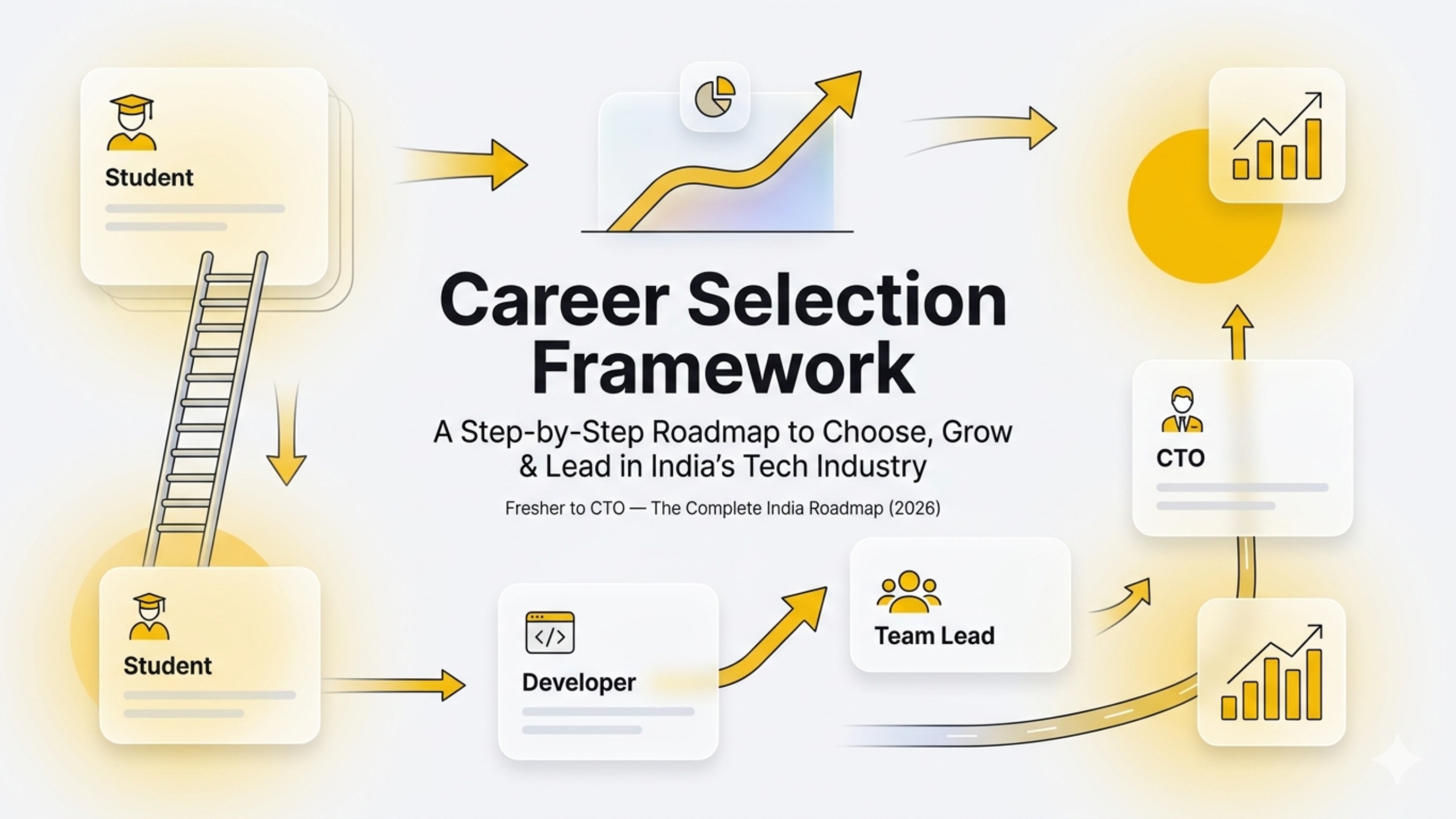
Career Selection Framework: Fresher to CTO — The Complete India Roadmap (2026)
Contents
- Four Rules for Every Stage
- Stage 0 — Before Your First Job
- Stage 1 — The Fresher (Year 0 to 2)
- Stage 2 — The Mid-Level Professional (Year 2 to 5)
- Stage 3 — The Senior Professional (Year 4 to 8)
- Stage 4 — The Engineering Leader (Year 7 to 12)
- Stage 5 — The CTO (Year 13 to 20+)
- The Summary
- Three Skills That Help at Every Stage
- The Journey Starts With One Decision
- Take the First Step With the Right Support.
Most career advice in India swings between two extremes.
One side says: take this course, get this certificate, apply to these companies. The other side says: work hard, follow your passion, success will come. Neither tells you what to actually do at each stage of your career — and why.
What you need is a map. One that shows you where you are, what the next step looks like, and what decisions matter most at each point in your journey.
This is that map — for students choosing their first career, for professionals planning what comes next, and for parents trying to guide someone they care about.
Four Rules for Every Stage
These four rules apply whether you are a fresher or a CTO. Keep them in mind every time you have to make a career decision.
1. Growth beats title. A junior developer who is learning every week is in a better position than a senior developer doing the same work on repeat. The level of the job title matters far less than how much you are improving.
2. Be great at one thing before you try to be good at everything. The person who is excellent at one skill gets hired and trusted. The person who is average at ten skills rarely stands out. Focus first. Expand later.
3. What you build today opens doors tomorrow. Skills, habits, and relationships compound over time. The effort you put in at 22 will shape what is available to you at 30. Start early and stay consistent.
4. Skills are yours forever. Companies are not. Companies change, downsize, and close. The skills you build while working there go with you. Always choose opportunities where you will grow — not just ones where you will earn more.

Stage 0 — Before Your First Job
Who this is for: Students, fresh graduates, and anyone switching into a tech career for the first time.
What this stage is about: Getting ready for your first job.
This is where the journey begins — and where most people either rush or overthink it.
Pick one career and focus on it. Data analyst, full stack developer, cloud engineer, data scientist — choose one. Trying to prepare for all of them at once means you will not be ready for any of them.
Learn the basics of that career. Every tech career has a starting point. For data analytics, it is SQL, Excel, and Power BI. For full stack development, it is JavaScript, React, and Node.js. For data science, it is Python and basic statistics. Start there.
Build real projects and put them online. Do not just follow tutorials. Build something that solves a real problem, and publish it on GitHub or a live link. This is what employers actually look at when they decide whether to call you.
How long does this take? With one to two hours of focused work per day, most people are ready to apply for their first job in three to six months.
Stage 1 — The Fresher (Year 0 to 2)
Common job titles: Junior Developer, Junior Analyst, Associate Engineer, Graduate Trainee
What this stage is about: Learning how real work gets done — and becoming someone your team can count on.
Your first job is not just about the technical work. It is about learning how professional teams operate. How do people communicate? How are decisions made? How does your work fit into the bigger picture?
Be someone people can rely on. Submit your work on time. Ask for help the right way — try to solve the problem first, then ask with specific context. Write code or produce analysis that others can understand, not just yourself.
Stay curious about what happens around you. When a feature goes live, see how customers respond. When a business decision is made, try to understand why. The people who grow fastest in their early years are the ones who care about the full picture, not just their small piece of it.
Stay in your first job long enough to see the results of your work. Moving companies every six months means you never find out whether what you built actually worked. That feedback is how you improve.
How do you know you are ready for the next stage? When you can pick up a task, complete it on your own, and explain your thinking clearly to a teammate — without needing someone to hold your hand through it.
Stage 2 — The Mid-Level Professional (Year 2 to 5)
Common job titles: Software Engineer, Data Scientist, Cloud Engineer, Senior Analyst
What this stage is about: Moving from someone who does tasks to someone who owns problems.
There is a real difference between the two. When you own a problem, you are responsible for the whole thing — understanding what needs to be done, figuring out how to do it, and making sure it actually gets there. You do not wait to be told every step.
Take on the harder problems. The easy path at this stage is to stick with what you already know. The growth path is to raise your hand for the messy, complicated work nobody else wants. That is where the real learning happens.
Understand how your work connects to everything else. How does the feature you built affect the rest of the product? How does the data you cleaned get used in the final report? Seeing these connections is what separates good professionals from great ones.
Learn to explain your work to people who are not in tech. At Stage 2, you will start working with people from other teams — marketing, operations, product, finance. Being able to explain what you are doing and why it matters, without using technical language, is one of the most valuable skills you can develop.
Use AI tools in your daily work. In 2026, the professionals who use AI to speed up repetitive work are simply more productive than those who do not. Build this habit now.
How do you know you are ready for the next stage? When your teammates come to you with difficult questions. When you are contributing ideas in discussions, not just completing assignments. When you have led at least one project from start to finish.
Stage 3 — The Senior Professional (Year 4 to 8)
Common job titles: Senior Engineer, Senior Data Scientist, Tech Lead, Staff Engineer
What this stage is about: Making the people around you better.
This is the stage where many talented people get stuck — not because they are not skilled enough, but because they have not made a mental shift.
Up to Stage 2, your value came from how good you were. At Stage 3, your value comes from how much better your team performs because you are on it.
Help others grow. When a junior colleague is stuck, guide them through the problem instead of just solving it for them. It is slower in the moment and much more valuable in the long run.
Make decisions that prevent future problems. Good decisions at Stage 3 can save your team weeks of work down the line. Start thinking about not just whether something works today, but whether it will still work easily six months from now.
A decision you will need to make at Stage 3:
At some point, you will face a fork. Make this choice consciously.
Option A — Go deeper as a technical expert. Keep solving harder and harder problems. Become the person others come to when nothing else works. This is a respected, well-paid career path that does not require managing anyone.
Option B — Move into leadership. Take responsibility for a team. Hire people, guide their growth, and be accountable for the team's results. This is the path toward Engineering Manager, Director, and eventually CTO.
Neither is better. They suit different people. Choosing the wrong one because it seemed like the obvious "next step" is one of the most common career mistakes in the industry.
How do you know you are ready for the next stage (if you choose leadership)? When you have led a team, even informally. When junior professionals consistently come to you for guidance. When you find yourself more interested in how the whole team is performing than in any single task.
Stage 4 — The Engineering Leader (Year 7 to 12)
Common job titles: Engineering Manager, Senior Manager, Director of Engineering, VP of Engineering
What this stage is about: Building a team that delivers results you could never achieve on your own.
At Stage 4, your job is no longer about your own output. It is about creating an environment where talented people can do their best work.
Hire well. The quality of the people on your team is the most important thing you control. One great hire can change what a team is capable of. One wrong hire can slow everyone down. Take hiring seriously.
Be honest with your team. Your team members need to know clearly when they are doing well and when they need to improve. Feedback that is always vague or always positive does not help anyone grow. The best managers give clear, kind, and consistent feedback.
Help your team see why their work matters. People do better work when they understand how it connects to the customer and the company. Make sure your team always knows the "why" behind what they are building.
An honest note: Not every great engineer makes a great manager. If you genuinely miss doing technical work, find people management draining, or feel more at home solving hard problems than running meetings — go back to Option A from Stage 3. That is a complete and excellent career. There is no shame in it.
Stage 5 — The CTO (Year 13 to 20+)
What this stage is about: Setting the direction for how technology is built across the entire company.
The CTO's day-to-day work looks very different depending on the size of the company.
At a small startup: The CTO is hands-on. They design the core systems, make the big technical decisions, and hire the first engineers. Being a strong technical thinker matters enormously here.
At a growing company: The CTO spends less time on individual technical decisions and more time building the engineering team — setting standards, hiring leaders, and making sure the organisation can keep pace with growth. People skills matter as much as technical ability here.
At a large company: The CTO is a senior company leader. They decide the long-term technology direction, represent the engineering team at the board and leadership level, and make decisions about where to invest in technology over the next three to five years. Understanding the business matters as much as understanding the technology.
What every CTO needs, no matter the company size:
A genuine technical background. CTOs who were never strong engineers lose the respect of their teams. All the leadership skills in the world cannot replace this foundation.
The ability to explain technology to non-technical people. Boards, investors, and customers need to understand what the engineering team is building and why it matters. The CTO has to make this clear, in simple terms.
The ability to handle pressure. The role comes with hard decisions, competing priorities, and no shortage of uncertainty. This kind of resilience is not something you can learn in one job — it builds over every difficult moment you handle at every earlier stage.
How long does it take?
In India's startup world, some people have reached CTO roles in 8 to 10 years — usually as founders or very early team members at fast-growing companies. For most people building their careers at established companies, 15 to 20 years is a more realistic timeline for a senior CTO role.
The timeline matters less than the direction. If you are growing consistently and making deliberate choices at every stage, you are on the right path.
The Summary
| Stage | Approximate Years | What It Is About |
|---|---|---|
| 0 — Before First Job | Pre-employment | Build skills and portfolio |
| 1 — Fresher | Year 0–2 | Learn how professional work is done |
| 2 — Mid-Level | Year 2–5 | Own problems, not just tasks |
| 3 — Senior | Year 4–8 | Make the people around you better |
| 4 — Leader | Year 7–12 | Build and lead a team |
| 5 — CTO | Year 13–20+ | Set the company's technology direction |
Three Skills That Help at Every Stage
Communicate clearly. Whether you are a junior developer explaining a bug or a CTO presenting to the board — the ability to speak and write clearly travels with you through every stage. Write often. Read your own work critically. Ask for feedback.
Build real relationships. The people you work with and meet throughout your career will refer you to opportunities, give you honest advice, and support you at key moments. Be genuinely helpful, be reliable, and be someone people enjoy working with.
Never stop learning. The technology industry changes faster than anyone can fully keep up with. The professionals who stay relevant are the ones who kept learning long after school ended. Make learning a weekly habit, not an occasional one.
The Journey Starts With One Decision
Every CTO in India started exactly where you are now — choosing a direction and taking the first step.
Find your current stage. Understand what the next one needs. Make the choices that build toward it.
Take the First Step With the Right Support.
TechPaathshala's programs are built for Stages 0, 1, and 2 — the years where the right skills, the right habits, and the right projects create the foundation that everything else builds on.
We offer programs in Full Stack Development, Data Analytics, Data Science, GenAI Engineering, and AI for Professionals — all built around real projects and real workplace conditions.