Building an AI-Ready Team Without Disrupting Your Business: A 2026 Strategy Guide
Contents
- The Honest Picture: Why Most AI Rollouts Fail
- The Culture-First Approach: Addressing AI Anxiety Before Deploying AI Tools
- Naming the Fear Directly
- Reframing the Message: Co-pilot, Not Replacement
- The Hybrid Upskilling Model: Train Your Domain Experts, Don't Replace Them
- The Three Tiers of AI Fluency
- The Internal Champions Programme
- Identifying Micro-Wins: The 90-Day Non-Disruption Rule
- What Qualifies as a Micro-Win
- The First 90 Days: A Micro-Win Map for Mumbai's Businesses
- The High-Stakes Quarantine List
- AI Change Management: Building the Governance Spine
- The 2026 AI Roles You Actually Need
- Role 1: The AI Orchestrator
- Role 2: The Data Steward
- Role 3: The AI Ethics Lead
- Build AI Ready Team Without Disruption: The 12-Month Integration Roadmap
- Phase 1 — Foundation (Months 1–3)
- Phase 2 — Integration (Months 4–6)
- Phase 3 — Scale (Months 7–12)
- The Competitive Cost of Waiting
- Design Your Transition: TechPaathshala's Corporate AI Strategy Consultation
The question is no longer whether your business needs to integrate AI. It is whether you can do it without breaking the things that currently work.
Every CTO, HR Director, and business owner in Mumbai has heard some version of the same pitch in the last 18 months: "Adopt AI or get left behind." The urgency is real. The ambiguity about how to act on it — without triggering a talent exodus, destroying institutional knowledge, or betting your Q3 revenue on a technology your team does not understand — is equally real.
The organisations that are winning the AI transition in 2026 are not the ones that moved fastest. They are the ones that moved most deliberately. They resisted the temptation to build an AI ready team without disruption by replacing experienced people with AI specialists who did not understand the business — and instead built AI capability into the people who already do. The distinction sounds subtle. The outcomes are not.
This guide is a practical strategy for leaders who are past the "should we do this?" conversation and into the harder one: "how do we do this without the wheels coming off?"
The Honest Picture: Why Most AI Rollouts Fail
Before the strategy, the diagnosis. A 2025 McKinsey survey found that fewer than 30% of enterprise AI initiatives delivered the business value they were designed to produce. The failure modes are remarkably consistent:
- Talent displacement anxiety destroyed collaboration. Employees who feared their roles were being automated withheld institutional knowledge, disengaged from training programmes, and actively avoided AI tools that felt like a threat. The tools were technically functional. The humans around them were not cooperating.
- AI specialists lacked business context. Firms that hired ML engineers and data scientists to "run AI" discovered that brilliant technologists who did not understand credit risk underwriting, or retail buyer behaviour, or logistics routing were building technically correct systems for the wrong problems.
- High-stakes workflows were disrupted too early. Revenue-generating processes that had been optimised over years were subjected to AI "improvements" in the first 90 days — before the organisation had developed the operational confidence to manage the edge cases that inevitably emerged.
- No one owned the governance. Data quality issues, model bias, hallucination incidents, and compliance gaps fell into the space between IT, Legal, and Business — owned by no one, addressed by everyone too late.
The organisations that avoided these failure modes did not have better technology. They had better change management. They understood that AI change management is fundamentally a human challenge with a technology component — not the other way around.
The Culture-First Approach: Addressing AI Anxiety Before Deploying AI Tools
The most expensive mistake a leader can make in an AI transition is skipping directly to tool procurement. The most important infrastructure for AI adoption is not the cloud platform or the LLM API. It is psychological safety — the organisational condition in which employees believe that engaging honestly with AI, including expressing concern, making mistakes, and acknowledging limitations, will not result in professional consequences.
Without psychological safety, AI adoption is performative. Employees use the tools in front of their manager and route around them when unobserved. Training programmes are attended but not applied. The organisation spends on AI capability it never actually extracts.
Naming the Fear Directly
The first conversation every AI-ready organisation needs to have is the one most avoid: "We know you are worried about your job. Here is what is actually happening."
Vague reassurances ("AI is a tool, not a replacement") do not reduce anxiety. Specificity does. The conversation needs to address:
What AI will automate in your organisation in the next 12 months: Be honest. If meeting summaries, email triage, and first-draft report generation are going to AI, say so. Employees who learn this later feel deceived. Employees who learn it now are positioned to develop the higher-order skills that sit above these tasks.
What it will not automate: The judgment calls, the relationship management, the regulatory interpretation, the institutional knowledge that makes your credit analyst understand why a particular customer's apparent risk profile is misleading because of a specific business event. These are not platitudes — they are genuine constraints on what AI currently does well in Mumbai's regulated business environment.
What the organisation is committing to for people whose roles change: Retraining investment, timeline transparency, and honest acknowledgment that some roles will evolve significantly. The organisations that retain talent through AI transitions are the ones that make credible commitments and keep them.
Reframing the Message: Co-pilot, Not Replacement
The framing that works — and that is consistent with how AI actually performs best in practice — is Co-pilot. The term is not accidental. A co-pilot does not fly the plane. They handle the instruments, monitor the systems, and flag issues so the pilot can focus on judgement, communication, and the decisions that require human situational awareness.
This framing is accurate for 2026's AI capabilities and honest about their limitations. Large Language Models hallucinate confidently. They lack situational context. They cannot exercise the judgment that comes from knowing a client for fifteen years or understanding the organisational dynamics behind a data anomaly. Your experienced employees provide exactly what AI lacks. AI provides exactly what volume and speed demand more of than your experienced employees can supply. The combination is what generates value.
The practical implication: every AI tool rollout should be accompanied by an explicit articulation of what human judgment it is intended to free up, not replace. Not "this tool will reduce analyst headcount." Rather: "this tool will handle the first-pass data extraction and formatting so our analysts can spend more time on the interpretation and recommendations that clients actually pay for."
The 5-Step AI Readiness Audit
Draft formal policies for acceptable AI tool usage.
[ ] 1. Psychological Safety Assessment
Survey employee sentiment and anxiety regarding AI.
Establish transparent communication about job roles and augmentation.
[ ] 2. Process Inventory and Risk Classification
Map out repetitive vs. complex business processes.
Categorize tasks by risk level (Low, Medium, High).
[ ] 3. Data Quality Baseline
Audit for data accuracy, completeness, and siloes.
Verify privacy compliance and PII security protocols.
[ ] 4. Skills Gap Mapping
Identify current technical literacy and AI "super-users."
Define required training for prompt engineering and AI oversight.
[ ] 5. Governance Structure Design
Create a cross-functional AI ethics and oversight committee.
The Hybrid Upskilling Model: Train Your Domain Experts, Don't Replace Them
Mumbai's 2026 talent market has made one thing clear: the supply of AI specialists who deeply understand BFSI, retail, logistics, or manufacturing is severely constrained. You can hire a machine learning engineer. Finding one who understands Mumbai's credit market, or the specific dynamics of Dharavi's supply chain, or your insurance company's claims history — that takes years, and often never happens fully.
The organisations with the strongest AI outcomes in Mumbai's regulated sectors did not primarily solve this through external hiring. They solved it through hybrid upskilling: training their existing domain experts in AI-relevant skills to the level needed to apply AI tools intelligently in their specific context.
This is not a compromise. It is often the superior strategy. A relationship manager at an ICICI branch in Nariman Point who understands 15 years of customer behaviour patterns plus how to use an AI tool to surface relevant insights is more valuable than an AI specialist who needs to spend 12 months building the context that manager already has.
The Three Tiers of AI Fluency
Not every employee needs the same level of AI skill. Trying to train everyone to the same depth creates unnecessary cost, disengagement among employees who will not use technical skills, and watered-down programmes that do not serve the people who need depth. A tiered model is more effective:
Tier 1 — AI Literate (All Staff): The minimum fluency that every employee should have by end of Year 1. Covers: what AI tools are, what they do well and what they do badly, how to use prompt engineering basics to get useful outputs from tools like Copilot or Claude, and how to verify AI output before acting on it. This is not a technical training — it is an operational one. Duration: 4–8 hours spread over 2–4 weeks. Delivery: online modules with live Q&A sessions, ideally run by internal champions rather than external trainers to build peer credibility.
Tier 2 — AI Fluent (Managers, Analysts, Functional Leads): The working knowledge needed to design and operate AI-augmented workflows in specific functions. Covers: prompt engineering at a workflow level (not just asking ChatGPT questions but building repeatable prompt templates for regular tasks), basic understanding of how AI tools make decisions and where they fail, ability to evaluate AI output quality in their domain, and operational understanding of the data requirements their AI tools depend on. Duration: 20–30 hours over 4–6 weeks. Delivery: cohort-based, with domain-specific content tracks (BFSI, Operations, HR, Marketing).
Tier 3 — AI Capable (Technical Leads, Data Teams, Product Managers): The technical depth to build, configure, evaluate, and maintain AI-powered systems within the organisation. Covers: LLM integration via APIs, RAG pipeline fundamentals for knowledge management applications, workflow automation with tools like Power Automate or Python-based agents, and model evaluation and monitoring. Duration: 60–100 hours over 2–3 months. Delivery: hands-on, project-based, with real organisational problems as the training substrate.
The Internal Champions Programme
The most powerful accelerant for AI adoption is not external training — it is internal social proof. When a senior relationship manager who has been at HDFC for 12 years demonstrates that they use a specific AI tool in their daily workflow and explains how it saves them two hours a week, their peers update their beliefs faster than any keynote from a technology vendor.
Every AI upskilling programme should identify 5–10 internal champions per 100 employees: trusted, respected individuals in their functional area who are given early access to AI tools, additional training support, and a structured platform to share their experiences. Their role is not to evangelise AI in the abstract but to demonstrate specific, concrete use cases in their own domain — the compliance officer who uses AI to draft first-pass regulatory responses, the branch manager who uses it to summarise customer meeting notes, the credit analyst who uses it to extract key data points from loan application documents.
Internal champions create permission — the social permission that makes it safe for less confident colleagues to try tools they would otherwise avoid out of fear of looking incompetent.
Identifying Micro-Wins: The 90-Day Non-Disruption Rule
The single most common cause of AI transition setback in Mumbai's corporate sector is the premature application of AI to high-stakes workflows. A bank that deploys an AI system to handle customer credit queries before the system has been adequately tested on the bank's specific customer population, product set, and edge cases — and then has to roll it back after a publicised failure — sets back its internal AI adoption by 12–18 months. The technical failure becomes a cultural one.
The alternative is the micro-wins first strategy: deliberately targeting the lowest-stakes, highest-frustration tasks for AI automation in the first 90 days, building organisational confidence and operational discipline before the higher-stakes applications.
What Qualifies as a Micro-Win
A micro-win is an AI application that satisfies three criteria simultaneously:
Low stakes if it fails: If the AI output is wrong, incorrect, or unhelpful, a human catches it before it affects a customer, a regulatory filing, or a revenue-generating decision. The cost of failure is time, not consequences.
High frustration before automation: The task being automated is something employees currently find tedious, repetitive, or administratively burdensome — not core to their professional identity or satisfaction. Meeting summarisation, inbox triage, first-draft template generation, data formatting, and status report compilation are common examples.
High visibility of improvement: The time saving or quality improvement is immediately visible and attributable to the AI tool — so employees experience a direct, personal benefit rather than abstract organisational efficiency.
The First 90 Days: A Micro-Win Map for Mumbai's Businesses
BFSI — Financial Services:
| Task | Current State | AI Tool | Time Saving |
|---|---|---|---|
| Meeting notes and action items | Manually typed post-meeting | Copilot/Fireflies AI summarisation | 45–60 min per meeting |
| Loan application document extraction | Analyst reads and extracts manually | Document AI pipeline extracts key fields | 20–30 min per application |
| Compliance checklist verification | Manual cross-reference against policies | RAG-based compliance Q&A against internal policy docs | 40–90 min per review |
| Regulatory report first drafts | Senior analyst writes from scratch | LLM generates structured first draft from data inputs | 2–4 hours per report |
| Customer query email triage | Manual reading and routing | AI classification and priority scoring | 30–60 min daily per operator |
Operations and Logistics:
| Task | Current State | AI Tool | Time Saving |
|---|---|---|---|
| Supplier communication drafting | Individual emails written manually | Prompt-based template generation | 1–2 hours daily |
| Inventory status report generation | Analyst pulls data, formats, distributes | Automated pipeline generates and distributes weekly | 3–4 hours weekly |
| Incident report summarisation | Manual after-action write-up | AI summarises incident log into structured report | 45–60 min per incident |
HR and People Operations:
| Task | Current State | AI Tool | Time Saving |
|---|---|---|---|
| Job description drafting | HR writes from scratch or updates old versions | LLM-based first draft from role requirements | 1–2 hours per JD |
| Interview note synthesis | Interviewer manually writes assessment | AI summarises structured notes into evaluation format | 20–30 min per candidate |
| Policy document Q&A | Employee searches manual or emails HR | RAG-based HR policy chatbot | Removes 40–60% of repetitive HR queries |
| Onboarding documentation | Manual compilation of role-specific materials | Automated compilation from templates and role data | 2–4 hours per new hire |
The High-Stakes Quarantine List
Equally important as the micro-wins list is the high-stakes quarantine list — the workflows that should not be touched in the first 90 days regardless of how compelling the AI use case appears.
For Mumbai's BFSI organisations: final credit decisions, regulatory submission sign-offs, customer-facing financial advice, fraud investigation conclusions, and any AI application that could create legal liability or RBI compliance exposure.
For operations organisations: primary supplier contracts, logistics routing that directly affects service level agreements with major clients, pricing decisions with customer impact.
For all organisations: any workflow where an AI error would be visible to customers, regulators, or the board before a human has the opportunity to catch and correct it.
The 90-day non-disruption rule is not permanent. It is the time needed to build the operational confidence, quality assurance processes, and governance structures that make higher-stakes AI applications safe to deploy.
AI Change Management: Building the Governance Spine
The difference between organisations that scale AI successfully and those that accumulate a graveyard of failed pilots is governance — not the bureaucratic kind, but the operational kind. Governance means that someone owns each AI system's performance, that quality thresholds are defined before deployment, and that failure is caught and corrected within a defined time window rather than propagating silently.
AI change management in 2026 requires answering three questions before any AI system goes into production:
Who is accountable for the output? The output of an AI system is not the AI's responsibility. It is the responsibility of the human who chose to use it, configured it, and acted on it. Accountability must be assigned to a named individual or role, not distributed across "the technology team."
What is the quality threshold? Before deployment: define the minimum acceptable performance, the measurement method, and the review frequency. A RAG-based compliance assistant that answers 80% of queries correctly is not ready for deployment if the 20% of wrong answers involve regulatory interpretation. Define the threshold before deployment, not after the first incident.
What is the escalation path? When the AI produces output that is flagged as problematic — by a user, a quality review, or a monitoring system — what happens? Who is notified, in what timeframe, and what is the process for investigating and correcting? Organisations without a defined escalation path discover their process retroactively, in the worst possible context.
The 2026 AI Roles You Actually Need
A common mistake is to define AI readiness as hiring an "AI team" — data scientists, ML engineers, and a Chief AI Officer who will handle everything. This model fails because it creates a separation between AI capability and business knowledge that never fully bridges.
The three roles that actually generate AI value in Mumbai's mid-to-large organisations are not primarily technical. They are operational roles with a technical dimension — and they can often be filled by existing employees who are developed into them rather than external hires who have no business context.
Role 1: The AI Orchestrator
What they do: The AI Orchestrator is the operational owner of the organisation's AI tool stack. They are not building models — they are managing the configuration, deployment, and ongoing operation of the AI tools the organisation has adopted. They understand which tools are in production, how they are being used, what the known failure modes are, and when a new tool is worth evaluating.
What they need to know: Prompt engineering at a workflow level, basic API integration (enough to connect tools without full developer dependency), familiarity with the major AI platforms relevant to the organisation's stack (Microsoft Copilot, Google Workspace AI, AWS Bedrock, or whichever vendor the organisation uses), and the operational discipline to document and maintain the prompt libraries, tool configurations, and usage guidelines that make AI tools reliable across a team.
Who typically grows into this role: Project managers, operations leads, and senior analysts with strong systems thinking and a willingness to develop technical depth. The profile is not a developer — it is an operationally minded professional who can bridge the gap between business users and the technology team.
Mumbai market compensation: ₹14L–₹24L, depending on the size of the organisation's AI footprint and the complexity of the tools managed. This is a role that is growing rapidly in Mumbai's BFSI and FinTech sector.
Role 2: The Data Steward
What they do: The single most common reason AI deployments underperform their expected value is data quality. The Data Steward's role is to own the quality, consistency, and accessibility of the data that the organisation's AI systems depend on — ensuring that when an LLM is asked to retrieve information from an internal knowledge base, the knowledge base is accurate, current, and structured appropriately, and when an ML model is trained on customer data, that data is clean, consistent, and representative.
What they need to know: Data cataloguing, metadata management, data validation processes, and the ability to evaluate data quality from an AI model's perspective (not just a reporting perspective — the requirements are different). For BFSI organisations, the Data Steward must also understand data governance in the context of RBI's data localisation requirements and the DPDP Act (Digital Personal Data Protection Act) — ensuring that the data feeding AI systems meets regulatory requirements.
Who typically grows into this role: Senior data analysts with a process orientation, database administrators who want to move toward a more strategic data role, or compliance officers with quantitative backgrounds. The Data Steward profile is less about building data pipelines and more about establishing and enforcing the standards that make data trustworthy for AI consumption.
Mumbai market compensation: ₹16L–₹28L. The DPDP Act compliance dimension makes this role particularly valuable in Mumbai's BFSI sector, where regulatory data requirements are the most demanding in India.
Role 3: The AI Ethics Lead
What they do: The AI Ethics Lead is the organisation's internal watchdog for AI fairness, transparency, accountability, and regulatory compliance. For Mumbai's BFSI organisations, this role has moved from theoretical to operationally urgent in 2026, as the RBI has issued increasingly specific guidance on AI governance in credit, fraud, and customer service applications.
The AI Ethics Lead evaluates proposed AI applications for bias and fairness issues before deployment (does this credit scoring model perform differently across demographic groups?), establishes and maintains the model documentation standards that RBI examinations now require, manages the organisation's AI incident response process, and liaises with legal and compliance on emerging AI regulation.
What they need to know: A working knowledge of ML fairness metrics and bias detection methods, familiarity with India's evolving AI regulatory landscape (RBI's AI governance framework, SEBI guidance, the DPDP Act), and the organisational and communication skills to enforce governance standards with business teams who are motivated to move fast. Legal background, compliance background, or senior analyst background with policy interest are all viable entry paths.
Who typically grows into this role: Senior compliance officers, legal counsels with technology exposure, or experienced data scientists with a values orientation. The AI Ethics Lead does not need to be the most technically sophisticated person in the room — they need to be the most rigorous about asking the right questions.
Mumbai market compensation: ₹20L–₹38L. The combination of technical literacy, compliance expertise, and organisational authority makes this one of the most underserved and increasingly well-compensated roles in Mumbai's enterprise AI landscape.
Build AI Ready Team Without Disruption: The 12-Month Integration Roadmap
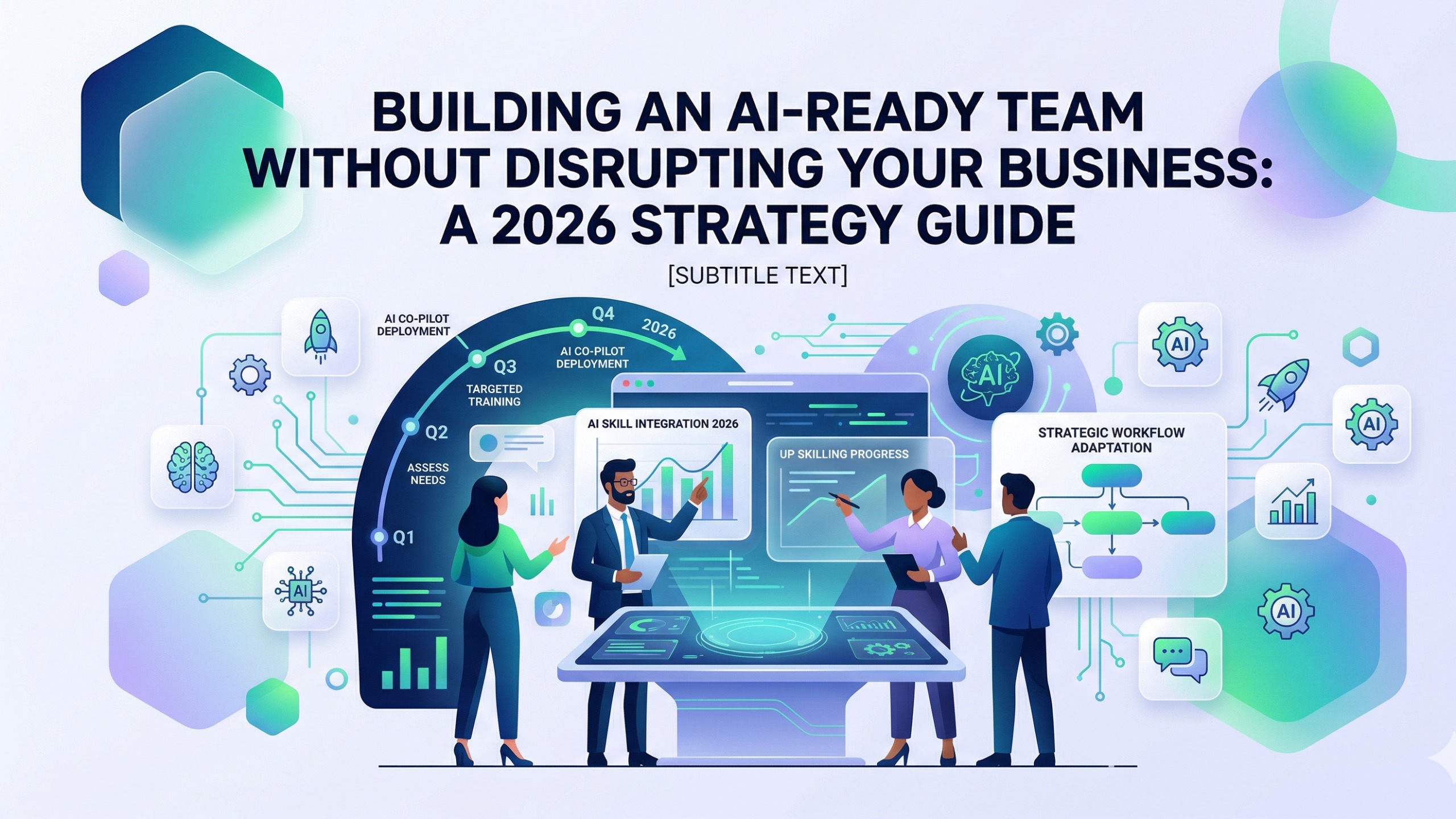
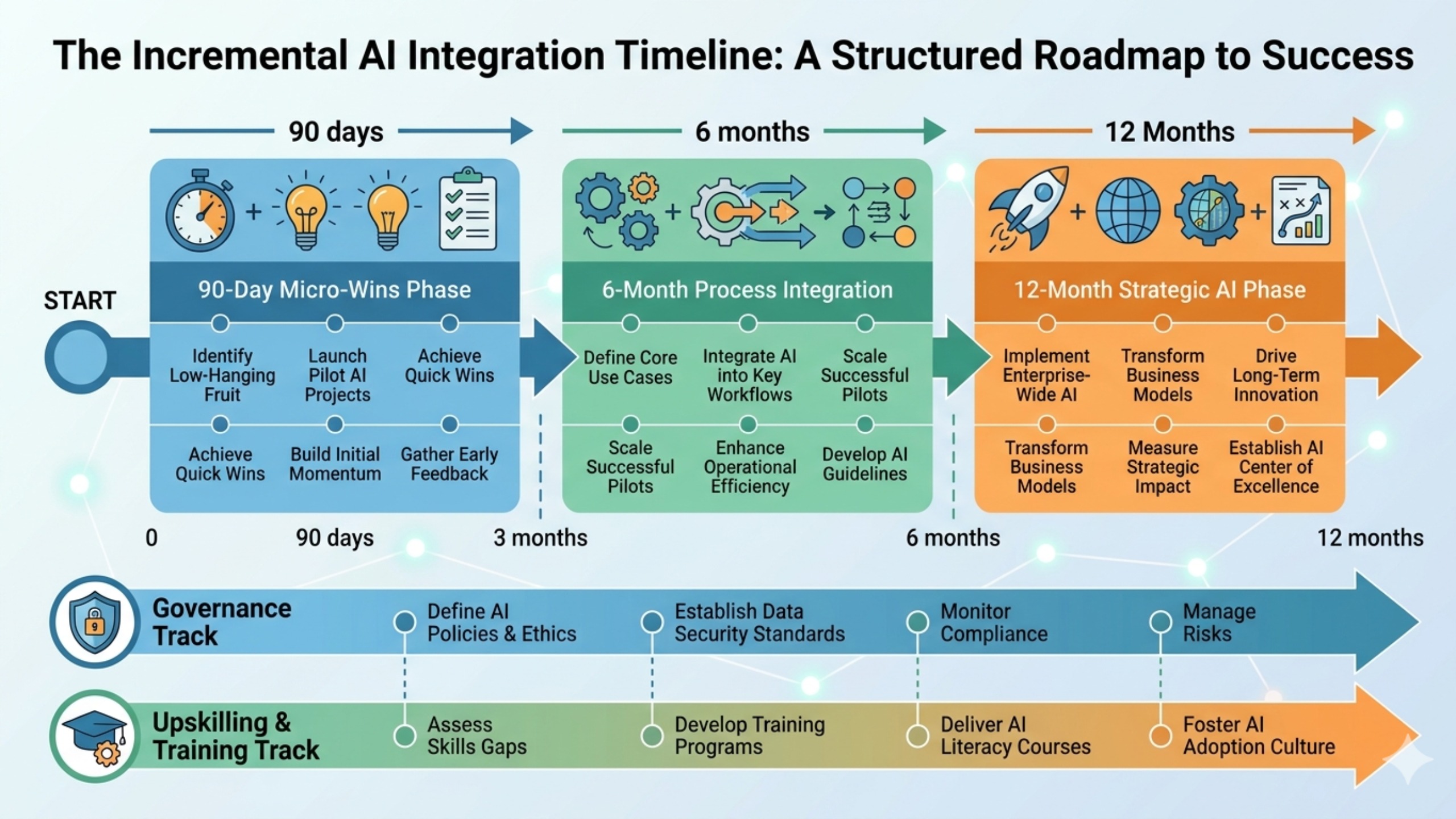
Translating the principles above into an organisational timeline requires sequencing decisions carefully. Here is the integrated 12-month roadmap that the most successful AI transitions in Mumbai's corporate sector have followed:
Phase 1 — Foundation (Months 1–3)
The goal is not deploying AI. It is preparing the organisation to deploy it.
- Conduct the 5-Step AI Readiness Audit (psychological safety baseline, process inventory and risk classification, data quality assessment, skills mapping, governance structure design)
- Run the leadership AI literacy programme — all senior managers at Tier 2 fluency within 60 days. Leadership visible engagement is the most powerful cultural signal in the entire transition.
- Identify and formally onboard internal AI champions — 1 per team or department
- Stand up the micro-wins programme: identify 5–8 low-stakes, high-frustration automation candidates, pilot one tool per team
- Assign accountability for the three new AI roles (Orchestrator, Data Steward, Ethics Lead) — even if they are 20% of someone's existing role initially
Key milestone: By Day 90, every employee has used at least one AI tool in their daily work and experienced a measurable personal benefit. The psychological relationship with AI has shifted from abstract threat to concrete utility.
Phase 2 — Integration (Months 4–6)
The goal is expanding AI into functional workflows without touching revenue-critical processes.
- Scale the micro-wins that worked in Phase 1 across the full team
- Begin Tier 2 AI fluency training for all managers and functional leads
- The AI Orchestrator role moves to dedicated responsibility: owning the tool stack, documenting best practices, managing the prompt library
- The Data Steward conducts the first formal data quality audit for AI readiness: identifying gaps in the data that will feed Phase 3 applications
- Begin designing the first moderate-stakes AI application (one per business unit) with a defined quality threshold and monitoring plan
Key milestone: At least three functional workflows are operating with AI augmentation. Quality metrics for each are being tracked and reviewed monthly. No revenue-critical workflow has been touched.
Phase 3 — Scale (Months 7–12)
The goal is extending AI to the workflows that generate competitive advantage.
- Deploy the moderate-stakes applications designed in Phase 2, with full governance documentation
- Tier 3 AI fluency training for technical leads and data teams — building internal capability to design and evaluate new AI applications without full external dependency
- The AI Ethics Lead role formalised — conducting the organisation's first internal AI audit and producing a governance report for the board
- Evaluate the first high-stakes AI application candidates: define the quality threshold, the monitoring architecture, the escalation process, and the rollback plan before any deployment begins
- Establish the organisation's AI Centre of Excellence — the internal body that reviews, approves, and governs all AI applications going forward
Key milestone: By Month 12, the organisation has a functioning AI governance structure, a measurably AI-literate workforce at Tier 1, a growing pool of Tier 2 and Tier 3 practitioners, and at least one high-stakes AI application in controlled deployment.
The Competitive Cost of Waiting
A final note for the leaders who are still weighing the urgency. In Mumbai's BFSI and FinTech market, the firms that are furthest into their AI transitions are not primarily benefiting from the productivity of their AI tools. They are benefiting from the accumulated learning curve — the organisational knowledge of what works, what fails, how to govern AI systems, and how to build AI-literate teams — that their less-advanced competitors will have to spend 18–24 months acquiring from scratch when they eventually begin.
AI readiness is not a technology state. It is an organisational capability — and like all capabilities, it compounds. The organisations that are 12 months further along the AI change management curve than their competitors will still be 12 months ahead 24 months from now, because the learning advantage perpetuates itself.
Starting deliberately is not slow. It is the foundation for moving fast without the failures that slow everyone else down.
Design Your Transition: TechPaathshala's Corporate AI Strategy Consultation
The roadmap in this guide is the framework. The decisions that make it real in your specific organisation — which workflows to automate first, which employees to develop into which AI roles, which governance structure fits your regulatory context, which tools are appropriate for your technology stack — require a level of specificity that no general guide can provide.
TechPaathshala's Corporate AI Strategy Consultation is a structured engagement for CTOs, HR Directors, and business owners in Mumbai who are ready to move from AI strategy to AI execution — with a plan that fits their organisation, their sector, and their risk tolerance, not a generic template.
The consultation covers:
- Your AI Readiness Audit — a structured assessment of where your organisation currently stands across the five readiness dimensions: culture and psychological safety, process inventory and risk classification, data quality, skills gaps, and governance structure. The audit produces a scored baseline against which your 12-month progress can be measured.
- Your Micro-Wins Priority List — the specific, immediately actionable automation candidates in your workflows that meet the three micro-win criteria, ranked by implementation ease and employee impact, with tool recommendations and prompt templates for each
- Your Upskilling Architecture — the specific Tier 1, 2, and 3 training plan for your organisation's structure, calibrated to your sector (BFSI, retail, operations, or services), your team size, and your implementation timeline
- Your Three AI Roles Roadmap — an assessment of which existing employees have the profile to develop into the AI Orchestrator, Data Steward, and AI Ethics Lead roles, and what a structured 6-month development plan looks like for each
- Your Governance Framework — the accountability structure, quality thresholds, escalation processes, and RBI/DPDP Act compliance considerations that your AI deployments require before they go live
The consultation is available as a half-day workshop (for leadership teams of 5–12) or a full-day engagement (for cross-functional teams of 12–25), and produces a written AI Transition Roadmap document that your team can use as an internal planning reference.
👉 Schedule TechPaathshala's Corporate AI Strategy Consultation — and design a custom upskilling roadmap that moves your organisation toward AI readiness without the disruption that generic AI hype ignores.
TechPaathshala is a Mumbai-based technology education platform helping organisations build genuine AI capability — through strategic consulting, structured upskilling programmes, and the kind of implementation support that turns an AI strategy slide into an AI-ready team.