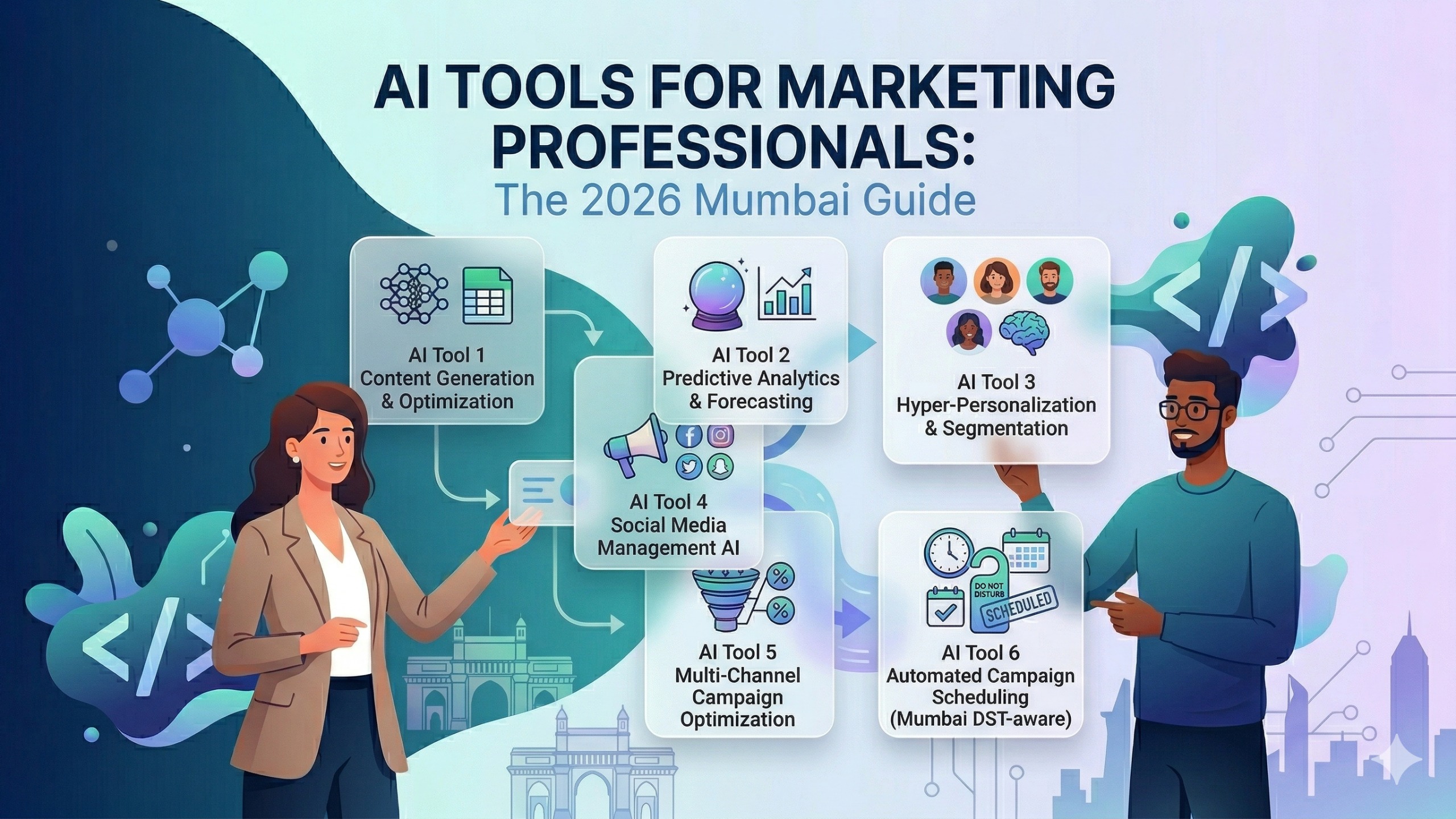
AI Tools for Marketing Professionals: The 2026 Mumbai Guide
Contents
- The Mumbai Micro-Market Reality: Why Hyper-Local Is Non-Negotiable
- The Essential AI Stack for AI Marketing Professionals in Mumbai 2026
- Content and Copy: Matching the Right Tool to the Right Task
- Hyper-Local Visuals: Generating Imagery That Feels Mumbai
- Regional Language Video: Hindi and Marathi Content Without a Full Production Team
- WhatsApp Automation: Managing the Volume Mumbai Generates
- SEO and Performance: Competing in Mumbai's Crowded Digital Space
- The "Agent-to-Machine" Shift: The 2026 Marketing Trend Mumbai Brands Must Understand
- AI Marketing Trends in Mumbai: What the Numbers Reflect
- What AI Cannot Do for Mumbai Marketers
- The Stack Is Available. The Question Is Whether You Know How to Use It.
Mumbai is not one market. It never has been.
The family in Borivali that bought their first air conditioner last summer is a fundamentally different consumer from the DINK couple in Bandra West who replaced theirs with a smart home-integrated unit. The kirana owner in Dharavi running a WhatsApp business account is operating in a different commercial reality from the D2C skincare founder in Andheri East managing a Shopify store and a 40,000-follower Instagram. The first-generation homebuyer in Navi Mumbai researching apartments on a Sunday evening is asking completely different questions than the investor in BKC looking to add a commercial property to a portfolio.
Same city. Radically different audiences. Radically different messages, languages, formats, and channels required to reach each one effectively.
This is the fundamental challenge of marketing in Mumbai—and it is the reason that AI tools, deployed correctly, deliver a disproportionate advantage in this market compared to almost anywhere else in India. The same AI stack that helps a national brand personalise at scale helps a local business punch far above its marketing budget. And in 2026, the question is no longer whether AI belongs in your marketing workflow. It is whether you know which tools to use, and how to use them for a market as layered and fast-moving as Mumbai.
This guide is for marketing managers, social media strategists, and small business owners across Mumbai, Navi Mumbai, and Thane who want a precise, practical answer to that question.
The Mumbai Micro-Market Reality: Why Hyper-Local Is Non-Negotiable
Before covering the tools, it is worth understanding why the standard national marketing playbook consistently underperforms in Mumbai—and why hyper-local targeting is not a nice-to-have but a structural requirement.
Mumbai's geography creates discrete micro-markets with different economic profiles, cultural identities, commute patterns, and consumption behaviours. A campaign targeting young professionals that uses the Bandra-Kurla Complex and sea-link imagery will resonate in South Mumbai and the western suburbs—and will feel disconnected and aspirational-to-the-point-of-alienation for audiences in Thane or Navi Mumbai, where the cultural touchstones are different and the commute reality (Thane station, not the Western Railway corridor) is different.
Language is a further dimension. Mumbai's consumer base is functionally multilingual in ways that most marketing campaigns handle clumsily. Hindi is the street language. Marathi is the political and cultural identity language. English is the aspiration and professional language. Gujarati runs through the business community. A campaign that speaks only English in a market this multilingual is leaving a significant portion of its potential audience unaddressed—sometimes by choice, often by default.
The hyper-local targeting challenge is also a content production challenge. Producing genuinely localised content—different copy angles for Thane versus Bandra, Hindi and Marathi video content alongside English, imagery that references Ganesh Chaturthi preparations rather than generic "festival season"—at the volume required for modern digital marketing used to be a resource constraint that only large agencies could overcome.
AI tools, specifically for this kind of content production and audience targeting, have changed the economics. A team of two can now produce the localised content volume that previously required a team of ten. The constraint has shifted from production capacity to strategic clarity: knowing what to produce and for whom.
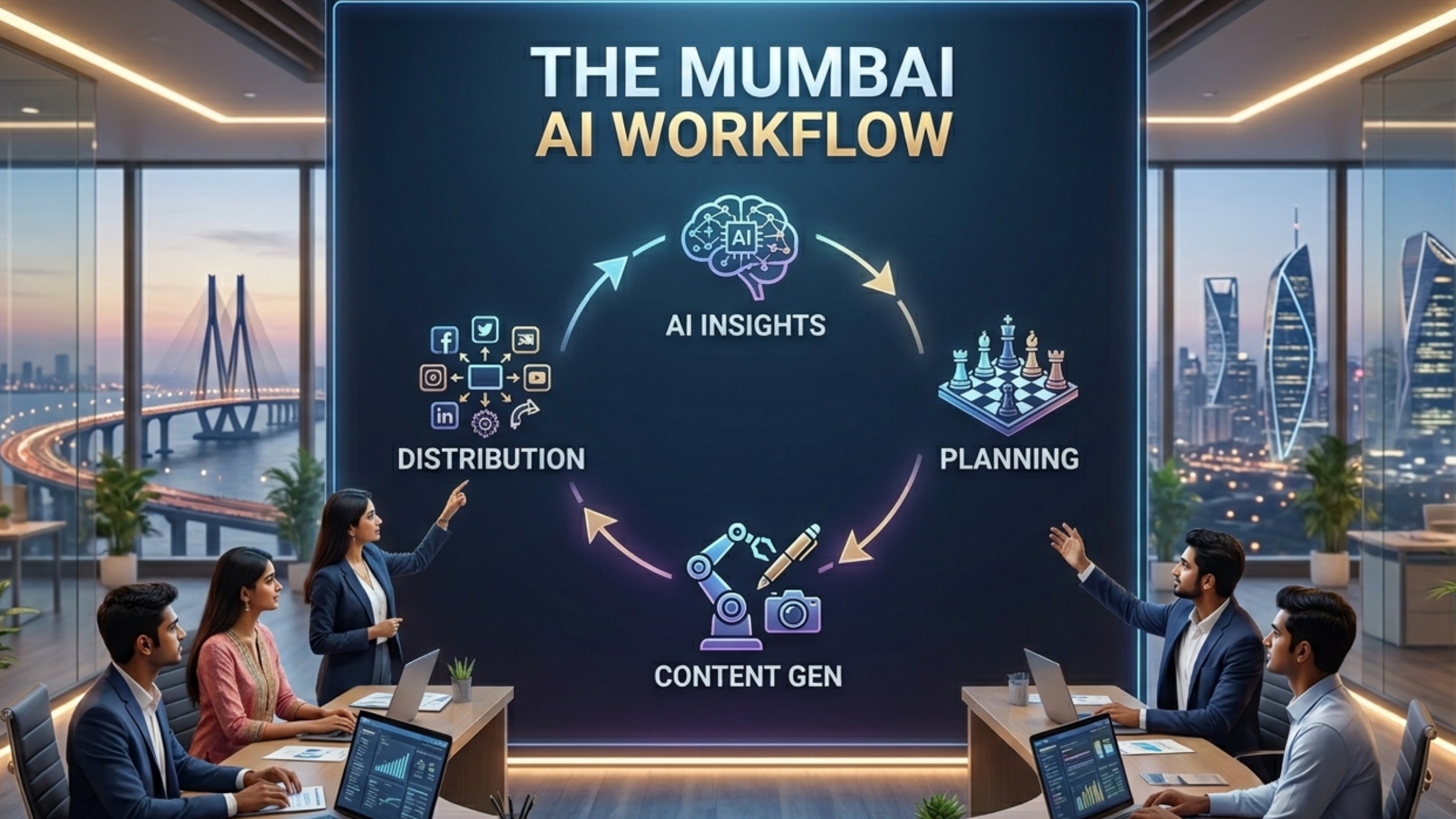
The Essential AI Stack for AI Marketing Professionals in Mumbai 2026
Content and Copy: Matching the Right Tool to the Right Task
Jasper AI for brand-consistent copy at scale
Jasper's primary value for Mumbai marketing teams is its Brand Voice feature—the ability to train the tool on your existing brand copy and have it generate new content that matches your established tone, vocabulary, and positioning without constant manual correction.
For agencies managing multiple clients, or for D2C brands maintaining consistency across product pages, ad copy, WhatsApp messages, email campaigns, and social content simultaneously, this is the capability that matters most. Inconsistent brand voice across channels is a credibility problem. Jasper's Brand Voice reduces the human review burden on consistency checks significantly.
Its campaign brief-to-copy workflow is particularly effective for Mumbai's real estate sector—one of the city's highest-volume digital advertising categories. A brief specifying the property (2BHK in Thane West, 10 minutes from the station, possession in 18 months, target buyer: first-generation homeowner from a service industry background) produces audience-relevant copy variants across formats in minutes rather than hours.
Claude for complex campaign strategy and analytical depth
Where Jasper excels at volume and consistency, Claude 3.5 Sonnet excels at the kind of structured strategic reasoning that used to require a senior strategist or a long agency brief.
Use Claude for: audience segmentation logic ("given these three audience profiles and these campaign objectives, which message hierarchy would you recommend and why?"), campaign narrative development, competitive positioning analysis when fed with existing research, and the synthesis of qualitative research into actionable creative direction.
In practical terms for a Mumbai marketing team: use Jasper to produce the volume of copy across channels, and use Claude to make the upstream decisions that determine what that copy should say, to whom, and in what sequence. The combination covers both the strategic and production layers of the content workflow.
The critical caveat: Neither tool replaces cultural intelligence. AI-generated copy that references Mumbai cultural touchstones—Ganesh Chaturthi, the dabbawalas, local train culture, Marathi pride—needs review by someone who actually knows the context. AI will produce grammatically correct and structurally sound copy. It will not reliably produce copy that feels authentic to a specific Mumbai micro-community. That editorial layer remains a human responsibility.
Hyper-Local Visuals: Generating Imagery That Feels Mumbai
The visual content challenge for Mumbai marketers is specific: stock photography consistently fails to represent the city accurately. Generic "Indian city" imagery often draws from Delhi or Bengaluru aesthetics. Authentic Mumbai imagery—the texture of a Dharavi lane, the specific light of Marine Drive at sunset, the particular chaos of a Dadar flower market—is either expensive to commission or unavailable as stock.
Canva Magic Studio has become the practical everyday standard for marketing teams that need branded visual content at speed. Its generative fill, background replacement, and image generation capabilities are directly useful for Mumbai marketers: you can start from a real Mumbai photograph and use AI to modify backgrounds, add text treatments, resize for different platforms, and maintain brand consistency across variants. For social media content calendars, where 20–30 pieces of visual content need to be produced per month, the speed advantage is significant.
Adobe Firefly offers more sophisticated generative control for teams with the design literacy to use it well. Its text-to-image model can be prompted for Mumbai-specific visual contexts ("a bustling Mumbai street market during Diwali preparations, warm evening light, street vendor stalls in foreground"), and its commercial training data means the output can be used in paid advertising without copyright concerns—a meaningful practical advantage over other generative image tools.
The realistic expectation for both tools: Generative AI imagery of specific Mumbai locations or cultural events requires careful prompting and review. The tools will generate plausible-looking "Indian urban" imagery reliably. Truly specific Mumbai imagery—the exact character of the Bandra-Worli Sea Link at blue hour, or the specific cultural iconography of a Maharashtrian Gudi Padwa decoration—requires either skilled prompting with reference images or post-generation editing. Use these tools to dramatically reduce production time; use human creative judgment to ensure the output is culturally accurate.
Regional Language Video: Hindi and Marathi Content Without a Full Production Team
Video in regional languages has historically been the most expensive and logistically complex content format for Mumbai marketing teams to produce consistently. Hiring Marathi-speaking talent, booking studio time, managing production schedules, and editing across language versions creates a resource constraint that most small and mid-size brands simply cannot sustain at content calendar scale.
Synthesia and HeyGen change this constraint materially. Both platforms generate AI avatar videos that can deliver scripted content in Hindi and Marathi with accurate lip-sync. You provide the script in the target language, select or customise an avatar, and receive a finished video in minutes. For product explainer videos, promotional announcements, customer testimonials in scripted format, and informational content, the quality is sufficient for social media and digital advertising.
Where this works well for Mumbai D2C brands: WhatsApp marketing videos in Hindi that explain a product or offer, Marathi-language content for regional campaigns around festivals like Ganesh Chaturthi or Gudi Padwa, short-form explanatory videos for Instagram Reels or YouTube Shorts that would otherwise require a videographer and talent.
Where to apply judgment: For brand flagship content, high-consideration purchase categories (real estate, financial products, healthcare), and any context where the authenticity of a human face carries commercial weight, AI avatar video is not the right tool. Consumers in these categories are making high-trust decisions. The production savings do not justify the authenticity cost. Use AI video for informational and promotional volume; use real talent for brand-defining content.
Practical language tip for both platforms: Translating your English script into Hindi or Marathi and feeding it directly produces stilted, literal output. Have a native-speaker reviewer adapt the translated script for conversational register before generating the video. AI handles the production; human cultural knowledge handles the linguistic authenticity.
WhatsApp Automation: Managing the Volume Mumbai Generates
WhatsApp is not an optional channel for Mumbai businesses. It is the primary customer communication channel across virtually every category—retail, real estate, food and beverage, services, D2C. The challenge is volume. Mumbai's consumer density means that a single promotional broadcast to a moderately-sized subscriber list can generate hundreds of inbound queries within hours. Managing that volume manually is operationally impossible at any meaningful scale.
Yellow.ai and Chatfuel are the two platforms most commonly used by Mumbai D2C brands and real estate companies for WhatsApp automation at scale. Both integrate with the WhatsApp Business API and allow you to build conversational flows that handle the first layer of customer interaction—answering product FAQs, capturing lead information, qualifying intent, scheduling callbacks, and routing complex queries to human agents.
The specific workflows most relevant for Mumbai's market:
Real estate inquiry management: A property ad generates a WhatsApp inquiry. The bot captures the lead's budget range, preferred location, possession timeline, and contact details, then routes qualified leads to a human sales agent and schedules a site visit. The human agent receives a pre-qualified lead with context rather than a raw inquiry.
D2C order and support automation: Post-purchase order status queries (extremely high volume in Mumbai's COD-heavy D2C market), return initiation flows, and product usage queries are all automatable. The bot handles the routine 70%; human agents handle the exceptions and complaints that require judgment.
Festival campaign automation: In the weeks before Ganesh Chaturthi, Diwali, or Eid—Mumbai's highest commercial intensity periods—inbound query volume spikes dramatically. A well-configured automation layer means your team's human capacity is not the bottleneck during peak periods.
The integration consideration: Both platforms work best when connected to your CRM and order management system. A WhatsApp bot that cannot look up a specific customer's order status or appointment history provides generic responses. A bot with CRM access provides specific, contextual responses that actually resolve queries. The technical integration is a one-time investment; the operational benefit is ongoing.
| AI Tool | Category | Use Case (Real Estate & Retail) | Key Benefit | Example in Mumbai Context |
|---|---|---|---|---|
| ChatGPT | Conversational AI | Customer support, lead qualification, property queries | 24/7 automated interaction & faster responses | Handling buyer queries for Navi Mumbai projects instantly |
| Haptik | Chatbot & Automation | WhatsApp chatbots, customer engagement, booking assistance | Scales customer communication across platforms | Real estate firms using WhatsApp bots for site visit bookings |
| Housing.com | Property Search AI | AI-powered recommendations, chatbots, listings | Personalized property suggestions | Suggests homes based on commute (e.g., BKC, Panvel growth areas) |
| MagicBricks | Data & Analytics | AI-driven pricing, sentiment analysis, CRM tools | Better pricing insights & demand trends | Helps identify undervalued properties in Mumbai |
| Google Ads AI | AI Marketing | Smart bidding, lead generation, audience targeting | Higher ROI on ad spend | AI-driven ads reduce cost-per-lead in Mumbai campaigns |
SEO and Performance: Competing in Mumbai's Crowded Digital Space
Mumbai's digital advertising market is one of the most competitive in India by cost-per-click, particularly in real estate, financial services, insurance, and consumer electronics. Organic search performance—ranking for the right local and category keywords—is a meaningful competitive advantage for businesses that can build it.
Surfer SEO is the tool that has achieved the widest adoption among Mumbai's digital marketing agencies for content-driven SEO strategy. Its content editor provides real-time guidance on keyword density, semantic coverage, heading structure, and content length benchmarked against the current top-ranking pages for your target keyword. For a Mumbai real estate developer targeting "2BHK flats in Thane West under 90 lakhs," Surfer tells you exactly what the content that currently ranks for that phrase looks like—and what your content needs to contain to compete.
Its most practical feature for Mumbai's hyper-local SEO context is the ability to analyse local intent keywords and their competitive difficulty simultaneously. "Flats in Thane" is extremely competitive. "2BHK flats near Thane station under 85 lakhs with parking" is lower competition and higher purchase intent. Surfer's keyword research tools make this granular, intent-driven targeting systematic rather than intuitive.
For AI marketing professionals in Mumbai managing multiple clients or content streams, Surfer's Content Planner is the most time-efficient feature: input a topic or domain, and it generates a structured content cluster—a pillar page and a set of supporting pages—designed to build topical authority across a keyword category. For a FinTech startup in BKC targeting investment-related keywords, or a real estate developer targeting Navi Mumbai residential keywords, this cluster approach outperforms individual page optimisation over a 6–12 month horizon.
The "Agent-to-Machine" Shift: The 2026 Marketing Trend Mumbai Brands Must Understand
There is a development in 2026 that most marketing guides have not yet caught up with, and it will reshape how Mumbai brands think about their digital presence over the next three years.
AI assistants—the kind that are increasingly embedded in consumer devices and apps—are beginning to act as intermediaries in purchase decisions. A consumer does not search for "best air purifier under 15,000 in Mumbai." Their AI assistant does it for them, evaluates the options, and presents a shortlist. In some categories, the AI assistant is beginning to complete the transaction directly, negotiating price and selecting a vendor based on the consumer's stated preferences and budget.
This is what is being called the shift toward "Machine Customers"—AI agents that act on behalf of their human users in commercial transactions.
The marketing implication is significant, and it runs counter to some established digital marketing intuitions. A brand optimised for human visual attention—beautiful Instagram creative, aspirational video, emotional storytelling—may perform poorly with an AI agent making a shortlist decision based on structured product data, review sentiment, delivery reliability scores, and price competitiveness.
What this means for Mumbai marketers in 2026:
Structured data is now a marketing asset. Your product pages need clean, complete, structured data—accurate specifications, standardised categories, verified reviews, consistent pricing. An AI agent parsing product information treats a page with complete structured data as a reliable source and a page with inconsistent or missing data as an unreliable one.
Review quality matters as much as review volume. AI agents evaluating products for purchase recommendations parse review content for specific signals: reliability, customer service responsiveness, delivery accuracy, product-description accuracy. Gaming review volume with generic positive reviews is becoming less effective as AI-mediated evaluation becomes more common.
Brand voice in text matters for AI discoverability. As AI assistants increasingly draw on web content to generate purchase recommendations, the clarity, specificity, and searchability of your text content—not just your visual content—becomes a marketing variable.
This shift is early in Mumbai's market but accelerating in the categories where AI assistant adoption is highest: consumer electronics, financial products, travel, and premium consumer goods. Marketing teams that build for machine-readable discoverability now will have a structural advantage as AI-mediated purchasing becomes mainstream.
AI Marketing Trends in Mumbai: What the Numbers Reflect
The adoption curve for AI marketing tools in Mumbai is steeper than the national average, driven by three structural factors:
Agency density. Mumbai has a higher concentration of marketing agencies per capita than any other Indian city. Agency adoption of AI tools for productivity—content production, SEO analysis, performance reporting—has been rapid and is now close to universal at mid-to-large agencies. Client expectations have shifted accordingly; clients now expect the turnaround times and content volumes that AI-augmented teams can produce.
D2C market maturity. Mumbai's consumer base and logistics infrastructure have made it India's most developed D2C market. D2C brands competing in this environment have adopted AI tools for personalisation, WhatsApp automation, and content production at rates significantly above the national D2C average.
Multilingual content pressure. The practical need to produce content in Hindi, Marathi, and English for the same market—a requirement that is more acute in Mumbai than in most other Indian metros—has driven faster adoption of AI tools specifically for regional language content production.
Regional content AI in India is maturing fastest in markets where the multilingual content requirement is highest. Mumbai leads this adoption curve within Maharashtra, and the tools—both global platforms and India-specific solutions—are improving their Hindi and Marathi output quality rapidly.
What AI Cannot Do for Mumbai Marketers
A guide that only covers what AI can do is an incomplete guide. These are the areas where the tools consistently underdeliver, and where human expertise remains irreplaceable:
Cultural authenticity at the micro-community level. AI can produce content about Ganesh Chaturthi. It cannot produce content that feels like it was made by someone who grew up celebrating Ganesh Chaturthi in a Maharashtrian family. The difference is perceptible to the audience it matters to, and it matters in high-trust and high-cultural-identity contexts.
Relationship-driven marketing. Mumbai's business culture, particularly in B2B and real estate, runs significantly on relationships. No AI tool replicates the trust that a salesperson builds over fifteen meetings, or the referral network that a community marketer develops over years.
Real-time cultural responsiveness. Mumbai responds quickly and intensely to cultural and news events. The brands that respond authentically and quickly to a local moment—a cricket win, a political development, a monsoon situation—do so because a human being with cultural awareness made a creative decision in real time. AI tools can execute quickly; they cannot initiate the cultural read.
Strategic judgment under uncertainty. AI tools are excellent at optimising for defined objectives. They are not good at recognising when the objective itself needs to change, or when a market shift requires a strategic pivot rather than a tactical adjustment. Strategic judgment remains a human premium skill.
The Stack Is Available. The Question Is Whether You Know How to Use It.
The AI tools available to Mumbai marketers in 2026 represent a genuine capability shift. The gap between a marketing team that uses them well and one that does not is not a small efficiency difference—it is a competitive gap that compounds over time in content volume, SEO authority, customer service capacity, and campaign personalisation.
But the tools themselves are not the advantage. Knowing which tool to use, for which part of the workflow, for which audience segment, in which language, with what cultural context—that is the advantage. The tools are available to every marketing team. The knowledge of how to apply them in Mumbai's specific market is not.
That knowledge is learnable. It is not learned from a YouTube tutorial or a feature tour. It is learned through structured practice with real campaigns, real audiences, and real feedback loops.