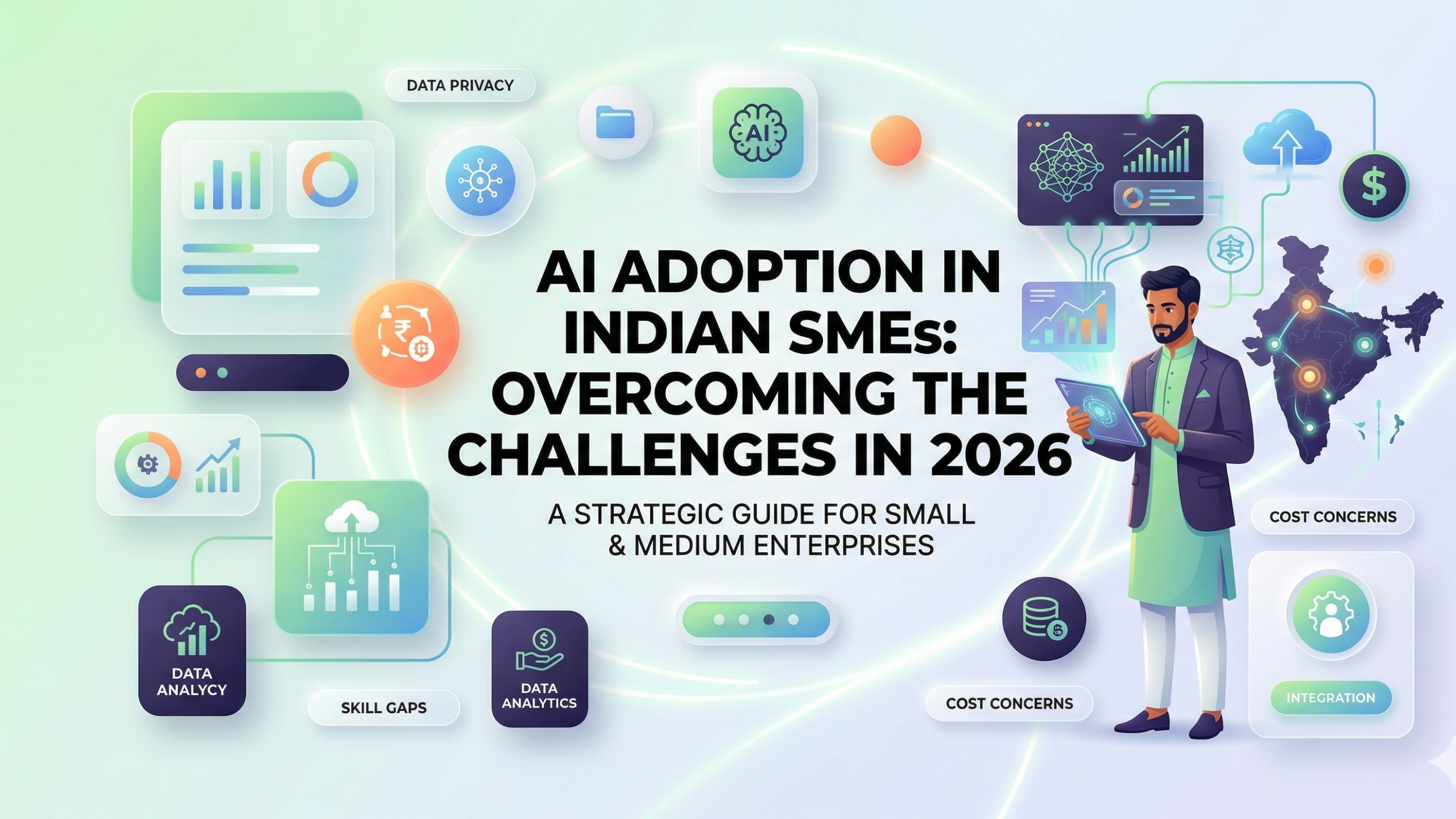
AI Adoption in Indian SMEs: Overcoming the Challenges in 2026
Contents
- The "Adapt or Perish" Reality: Why AI Is No Longer Optional for Indian SMEs
- The Four Challenges Every Indian SME Actually Faces
- Challenge 1: Cost vs. ROI — The Investment Uncertainty Problem
- Challenge 2: Data Quality and Privacy — The "Our Data Is a Mess" Problem
- Challenge 3: The Skill Gap — Finding People Who Understand Both the Business and the AI
- Challenge 4: Cultural Resistance — The "We've Always Done It This Way" Mindset
- A Practical 3-Step AI Adoption Path for Indian SMEs
- Step 1: Start With Off-the-Shelf Tools, Not Custom AI
- The Verdict
- Step 2: Focus on Efficiency Before Transformation
- Step 3: Partner and Upskill — AI Capability Is a Team Asset, Not a Technology Asset
- AI for Small Business India: The Competitive Calculus
- Identify Your SME's Best AI Entry Point
There is a version of the AI story that Indian SME owners have been told repeatedly: AI is for Infosys, for the Tatas, for Silicon Valley unicorns with GPU clusters and PhD teams. It is for companies that can absorb ₹5Cr experiments. It is not for a 35-person garment manufacturer in Dharavi, a third-generation auto-parts retailer in Pune's Budhwar Peth, or a mid-sized logistics firm in Navi Mumbai running on tight margins and Excel spreadsheets.
That version of the story was largely accurate in 2020. It is not accurate in 2026.
The ai adoption indian sme challenges 2026 conversation has fundamentally shifted. The tools that enable AI-powered customer service, inventory prediction, automated document processing, and marketing personalisation are no longer enterprise-only. They are subscription software. They run on a browser. They cost less per month than a part-time employee. And the SMEs that have adopted them — across Mumbai's western suburbs, Maharashtra's Tier-2 cities, and India's manufacturing corridors — are reporting productivity improvements that their non-AI-using competitors cannot match.
This guide is for SME owners and decision-makers who are past the "should we care about AI?" conversation and into the harder one: "what is actually stopping us, and how do we start?"
The "Adapt or Perish" Reality: Why AI Is No Longer Optional for Indian SMEs
In 2026, the competitive dynamics that make AI adoption urgent for Indian SMEs are not coming from other SMEs. They are coming from three directions simultaneously.
Large Indian corporates are using AI to enter SME markets. Reliance Retail's AI-powered inventory and pricing systems allow it to operate with margins and responsiveness that traditional neighbourhood retailers cannot match using manual processes. Zepto's demand forecasting model allows it to promise 10-minute delivery with lower waste than any kirana store's manual inventory management can achieve. SMEs that compete in any market where a large Indian corporate also operates are already in an AI-asymmetric competition.
Global digital platforms are AI-native by default. Every customer who interacts with Amazon India, Flipkart, or Meesho is receiving an AI-personalised experience — recommendations, pricing, delivery promises, and service responses that are generated by models trained on hundreds of millions of data points. A Mumbai-based homewares retailer competing for the same customer's attention with a WhatsApp catalogue and a manual order process is operating at a structural disadvantage.
Customer expectations have been recalibrated. The same customer who receives an instant, contextual, 24/7 automated response from a large e-commerce platform now brings those expectations to every business interaction — including their supplier, their local service provider, and their B2B vendor. SMEs that respond to WhatsApp inquiries in 4 hours, issue invoices manually, and manage after-sales support through a single phone number are failing a customer experience standard set by companies with AI teams.
The opportunity for Indian SMEs in 2026 is not to match the AI investments of Reliance or Amazon. It is to use affordable, off-the-shelf AI tools to close the customer experience and operational efficiency gap enough to compete effectively — without the headcount cost that used to be the only alternative.
The Four Challenges Every Indian SME Actually Faces
Understanding the real barriers is more productive than generic "AI is transforming business" optimism. Here are the four challenges that come up consistently when SME owners in Mumbai, Pune, Surat, and Ahmedabad are asked directly why they have not adopted AI.
Challenge 1: Cost vs. ROI — The Investment Uncertainty Problem
The fear: "I don't know what this will actually cost, I don't know what it will actually save, and I can't afford to guess wrong."
This is the most rational objection and the one most frequently dismissed by AI proponents who underestimate the financial reality of SME operations. An SME owner running on 8–12% net margins, managing 35 employees, and carrying ₹80L of inventory has a fundamentally different risk profile for a ₹5L software investment than a venture-backed startup with 18 months of runway.
The 2026 reality: The cost structure of AI tools has changed dramatically. The tools that deliver the highest ROI for most Indian SMEs are not custom-built platforms costing ₹5L–₹15L per year. They are:
- Tier-1 AI subscriptions (₹800–₹2,500/user/month): ChatGPT Plus, Claude Pro, Microsoft Copilot — tools that handle content generation, customer communication drafting, document summarisation, and research tasks across any role in the business
- Vertical AI tools (₹3,000–₹15,000/month for the business): AI-powered chatbots (Yellow.ai, Freshdesk Freddy), AI bookkeeping (Zoho Books with Zia), AI inventory management (Increff, Unicommerce with AI features) — tools built for specific functions with clear, measurable output
- Free tiers with paid upgrades: Many tools offer meaningful free tiers that allow SMEs to validate ROI before committing to subscription costs
The ROI calculation that convinces most SME owners: if one ₹2,000/month AI subscription saves one employee 2 hours per day of repetitive work, the cost of that time at ₹25,000/month employee cost is ₹7,500/month in reclaimed productivity. That is a 3.75x return before any revenue impact is counted.
The action: Start with a single tool, for a single function, with a clear measurement of time saved over 30 days. Do not try to calculate the ROI of "AI" as a category. Calculate the ROI of this specific tool for this specific task. The numbers will justify themselves.
Challenge 2: Data Quality and Privacy — The "Our Data Is a Mess" Problem
The fear: "Our customer data is in multiple spreadsheets, WhatsApp messages, and a 2015 version of Tally. Our supplier data is half in notebooks. We don't have the clean, organised data that AI needs."
The 2026 reality: This concern is partly valid and partly a misconception about what different AI tools require.
The misconception: most high-value AI tools for SMEs do not require you to have a clean data warehouse. LLM-based tools (ChatGPT, Claude, Copilot) work on whatever text you give them — a messy email thread, a rough call transcript, a poorly formatted inventory list. They do not require pre-existing data infrastructure. You can start using them today with the data you have.
The valid concern applies to the more advanced use cases: if you want to build a machine learning model for demand forecasting or customer churn prediction, you do need reasonably clean, historical, structured data. But these are not the right first-step AI applications for most SMEs. The right first steps — customer communication automation, document summarisation, meeting notes, first-draft content — all work with unstructured data that you already produce daily.
On the privacy front: India's Digital Personal Data Protection Act (DPDP Act) is now operational. For SMEs handling customer personal data, the relevant questions are:
- Are you using a tool that stores your customer data on servers outside India? (Most major AI platforms have data residency options — check and document your choice.)
- Are your terms of service with AI tools compatible with your obligations to customers under the DPDP Act?
- For BFSI and healthcare SMEs: additional sector-specific data handling requirements apply — consult a compliance advisor before deploying AI on customer data.
For most retail, manufacturing, and services SMEs, the practical answer is: use AI tools for internal efficiency tasks first (content drafting, meeting notes, internal research), where customer personal data is not involved. Expand to customer-facing AI only after reviewing your data handling obligations.
Challenge 3: The Skill Gap — Finding People Who Understand Both the Business and the AI
The fear: "I can't afford to hire an AI specialist, and my existing team doesn't know how to use these tools."
The 2026 reality: This is the challenge with the most actionable near-term solution. The AI for small business India movement is real — the skills needed to use AI tools productively in most SME contexts are not the skills of an ML engineer or data scientist. They are the skills of a confident tool user with good business judgment: knowing what to ask, how to evaluate the output, and when to override it.
These skills are teachable to existing employees in 20–40 hours of structured learning. The investment is not a hire; it is a training programme for the two or three employees whose roles involve the highest volume of the tasks AI can assist with.
The specific profiles who typically become an SME's most effective AI early adopters:
- The admin or operations coordinator who handles vendor communication, invoice processing, and internal scheduling — high-volume, repetitive tasks that are immediately automatable
- The sales or customer service lead who drafts client communication, follows up on leads, and manages inquiry responses — where AI-assisted drafting has the highest daily time saving
- The owner themselves — in most Mumbai SMEs, the owner is also the strategic communicator, investor pitch writer, and business development lead. These tasks are among the highest-ROI applications of LLM tools.
Challenge 4: Cultural Resistance — The "We've Always Done It This Way" Mindset
The fear: Not usually expressed directly, but lived as: "Our people are going to resist this, it's going to create conflict, and I have enough operational challenges without a team management crisis."
The 2026 reality: Cultural resistance to AI in SMEs has a different character than in large corporations. In a 35-person manufacturing firm, the concern is rarely abstract — it is personal. The accountant who has been with the company for 12 years worries that AI-assisted bookkeeping makes her role redundant. The customer service representative who handles incoming orders worries that an AI chatbot removes the relationship she has built with clients.
The approach that works is the same one outlined in the larger AI adoption guide above: name the fear directly, provide specific clarity about what will and will not change, and demonstrate early wins that make the personal benefit visible before the personal threat feels concrete.
One additional principle applies strongly in SME contexts: involve the most resistant employee in the pilot. The accountant who is most worried about AI in the finance function is, paradoxically, the best person to pilot the AI bookkeeping tool — because she will test it hardest, identify its real limitations, and if she concludes it saves her time on the tasks she finds most tedious while keeping the judgment work she values, her endorsement carries more credibility than any management communication.
A Practical 3-Step AI Adoption Path for Indian SMEs
Step 1: Start With Off-the-Shelf Tools, Not Custom AI
Custom AI development — building a model trained on your specific data, with features designed for your specific workflow — is appropriate for large enterprises with significant data infrastructure and dedicated technology teams. It is almost never appropriate for an Indian SME as a first AI investment.
Off-the-shelf AI tools — software products that already have AI capabilities built in — deliver value faster, at lower cost, and with lower implementation risk than custom development. The relevant tools for Indian SMEs in 2026:
Is Your SME Ready for AI? The 8-Point Audit
Before you invest in expensive licenses or custom builds, run your business through this checklist to see if you’re standing on a solid foundation.
- 1. Data Organization Level AI is only as good as the data you feed it. Is your business information trapped in scattered spreadsheets and physical files, or is it centralized in a clean, searchable CRM or cloud database? Garbage in, garbage out.
- 2. Communication Volume If your team spends 4+ hours a day answering repetitive questions like "Where is my order?" or "What are your hours?", you are a prime candidate for an AI agent. High-volume, low-complexity tasks are where AI wins.
- 3. Staff Capacity for Upskilling AI doesn't replace people; it replaces tasks. However, it requires a mindset shift. Does your team have the mental bandwidth and the willingness to transition into "Human-in-the-loop" roles, or will they resist the change?
- 4. Budget for Tools & Maintenance The "hidden cost" of AI isn't just the subscription; it’s the implementation. Do you have a dedicated budget for SaaS tokens (like OpenAI or Claude API) and the occasional developer "tune-up"?
- 5. Compliance & Security Requirements Do you operate in a highly regulated industry (like Finance or Healthcare)? You need to know exactly where your data goes. If you can’t answer where your data is stored, you aren't ready for third-party AI integration.
- 6. Primary Pain Point Identification "Doing AI" isn't a goal. You need a specific problem to solve. Can you point to one bottleneck—be it lead qualification, content creation, or inventory forecasting—that is currently costing you money?
- 7. Customer Data Handling How sensitive is your client info? If your business relies on high-touch, confidential human relationships, you’ll need a "Privacy-First" AI approach rather than using public, "out-of-the-box" tools.
- 8. Existing Digital Tech Stack Does your current software (Email, CRM, Accounting) have an API? AI works best when it can "talk" to your other tools. If you’re still using legacy software from 2010, you’ll need to modernize your stack first.
The Verdict
Score 7-8: You are an AI-First SME. It’s time to scale and automate your entire workflow.
Score 0-3: Focus on digitization. Clean up your data before adding AI.
Score 4-6: You’re ready for Pilot Programs. Start with one small department.
For customer communication and support: Yellow.ai and Freshdesk Freddy offer AI-powered chatbots with WhatsApp integration, Indian regional language support (Hindi, Marathi, Gujarati, Tamil, Telugu), and pre-built templates for common SME customer service scenarios. Both offer SME-appropriate pricing tiers.
For finance and bookkeeping: Zoho Books with Zia AI automates GST invoice generation, expense categorisation, payment reminders, and provides basic sales trend analysis — directly within India's compliance framework. The learning curve for most small business accountants is measured in days, not weeks.
For content and communication: ChatGPT Plus or Claude Pro at ₹1,600–₹2,000/month per user handles email drafting, proposal writing, marketing content generation, meeting notes, and business research across any function in the business.
For inventory and supply chain: Unicommerce and Increff (both Indian platforms built for the Indian retail and manufacturing context) have added AI-powered demand forecasting and inventory optimisation features that integrate with existing Tally, SAP, or ERP data.
Step 2: Focus on Efficiency Before Transformation
The SMEs that succeed with AI in the first 12 months are those that use it to do what they currently do — better, faster, and with less manual effort — rather than immediately attempting to transform their business model around AI.
The efficiency target: Identify the task in your business that consumes the most human time relative to the value it generates. In most Indian SMEs this is one of:
- Manual invoice and GST compliance processing: A 15-person Pune textile exporter reduced their GST filing preparation time from 3 days per month to 4 hours using AI-assisted document processing and Zoho Books automation — with the same accuracy standard and full RBI compliance.
- Customer inquiry handling: A Mumbai-based D2C skincare brand reduced their WhatsApp inquiry response time from 4 hours to under 5 minutes using a Yellow.ai chatbot configured for their 150 most common customer questions — while routing the complex or sensitive inquiries to their human team.
- First-draft content creation: A Surat garment manufacturer cut their catalogue and B2B pitch preparation time by 60% using AI to generate product descriptions, client proposal drafts, and trade fair materials — reviewed and edited by their sales manager before publishing.
Each of these is an efficiency gain, not a transformation. The business model is unchanged. The competitive position has improved. The team is more productive. The investment was under ₹5,000/month.
Step 3: Partner and Upskill — AI Capability Is a Team Asset, Not a Technology Asset
The SMEs that sustain AI adoption past the initial enthusiasm phase are those that treat AI capability as a team skill — something their people know how to use and improve — rather than a technology they purchased and are waiting to work.
This requires two investments beyond the tool subscription:
Structured upskilling for the AI-adjacent roles: The two or three employees who will use AI tools most heavily need more than a YouTube tutorial. They need structured learning that covers their specific use cases, with practice on real work tasks and someone to troubleshoot when the output is not what they expected. Local training partners — TechPaathshala's AI for Business programmes, for example — offer SME-specific cohorts in Mumbai that cover practical tool use rather than theoretical AI.
A feedback loop: Designate one person (often the owner or operations lead) as the internal AI learning hub — the person who tries new features, documents what works, and shares findings with the team. A monthly 30-minute "what worked this month" conversation keeps adoption momentum going after the initial novelty has faded.
AI for Small Business India: The Competitive Calculus
| Tool | Primary Use Case | Pricing (India-friendly) | Compliance / Data Notes | WhatsApp Integration |
|---|---|---|---|---|
| Zoho Zia | CRM automation, sales insights, workflow AI | Included in Zoho ecosystem (Zoho Desk starts free; paid tiers scale affordably) | Strong data privacy (India-friendly) since Zoho owns full tech stack (no external AI dependency) | ✅ Via Zoho CRM / Zoho Desk integrations |
| Yellow.ai | AI chatbots (customer support, voice bots, omnichannel automation) | Free tier + enterprise pricing (custom, usage-based scaling) | Enterprise-grade compliance (SOC2, GDPR, ISO) | ✅ Native WhatsApp Business API support |
| ChatGPT Plus | Content generation, coding, internal productivity | ~$20/month (~₹1.6K/month) | Data handled via OpenAI cloud (needs caution for sensitive SME data) | ⚠️ No native WhatsApp (needs API/tools like Twilio) |
| Freshdesk Freddy AI | Customer support automation, ticket resolution | Free plan available; paid plans scale per agent | GDPR-ready; widely used in SaaS support environments | ✅ WhatsApp integration available via Freshdesk ecosystem |
| Canva Magic Studio | Marketing creatives, social media design, presentations | Free + Pro (~₹500/month) | Standard SaaS compliance; low-risk for non-sensitive design use | ❌ No direct WhatsApp automation |
Here is the competitive calculus that every Indian SME owner eventually has to confront:
Your competitors are already evaluating — and some are already deploying — the tools described in this guide. The SME three doors down from you at the Dharavi MIDC, or the competitor exhibiting next to you at the India International Trade Fair, or the supplier competing for the same corporate client you are pitching — they are having the same "should we adopt AI?" conversation you are having.
The first movers in every market segment are accumulating learning curves that their later-adopting competitors will have to close under competitive pressure rather than at their own pace. The garment manufacturer who deploys AI-assisted design briefs and client communication today builds 12 months of operational knowledge by the time their competitor starts. That advantage is real, measurable, and compounding.
The cost of starting is lower than you think. The cost of waiting is higher than it looks.
Identify Your SME's Best AI Entry Point
The specific, right first step for AI adoption is different for a 15-person Mumbai retail distributor, a 50-person Pune auto-parts manufacturer, and a 25-person Mumbai professional services firm. The principles are the same; the implementation is different.
TechPaathshala's "AI for Small Business" Consultation is a structured 90-minute session designed for SME owners and decision-makers who want a clear, specific answer to "where should we start?" — not a generic AI strategy, but a prioritised action plan built around their specific business, their specific pain points, and the affordable tools available in 2026 that fit their operational context and compliance requirements.
In the consultation, you will:
- Complete the 8-Point AI Readiness Audit — identifying where your business currently stands and which AI applications are immediately viable vs. which require preliminary groundwork
- Identify your two highest-ROI first steps — the specific tasks, tools, and implementation approach that will deliver measurable value within 30–60 days at your budget level
- Understand your compliance requirements — how the DPDP Act, GST data handling, and sector-specific requirements (BFSI, healthcare, FMCG) affect your AI tool choices and data practices
- Get a 90-day adoption roadmap — a simple, realistic plan that your team can execute without external dependency after the consultation
The consultation is available for Mumbai-based SMEs as an in-person session or remotely for businesses across India.
👉 Book TechPaathshala's "AI for Small Business" Consultation — and leave with your specific starting point, your tool shortlist, and a 90-day plan your team can begin next week.
TechPaathshala is a Mumbai-based technology education platform helping Indian SMEs navigate the AI transition practically and affordably — with programmes designed for the real operational, financial, and compliance context of small and medium businesses across India.