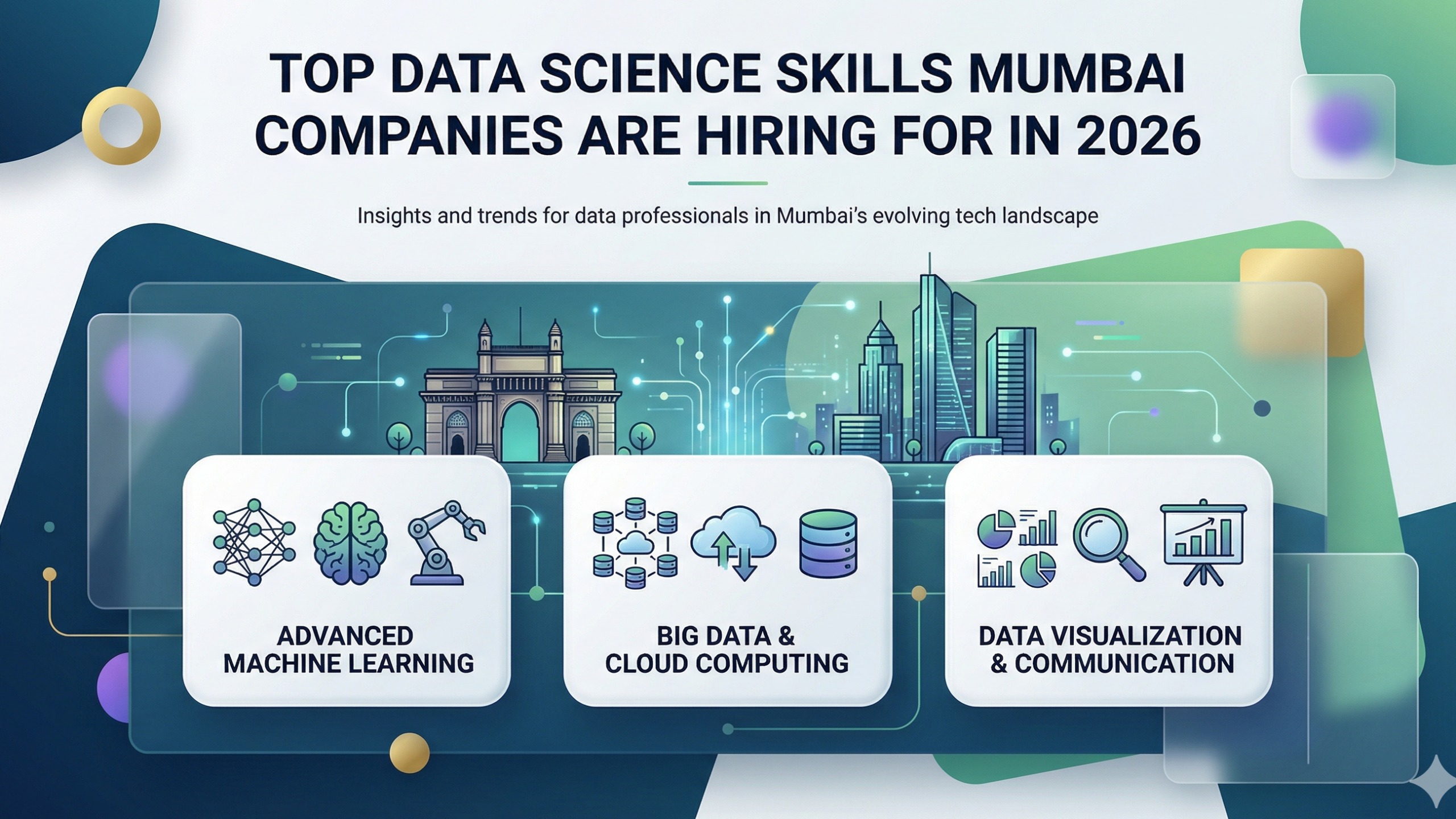
Top Data Science Skills Mumbai Companies Are Hiring For in 2026
Contents
- The Mumbai Market Shift: Applied AI, Not Research AI
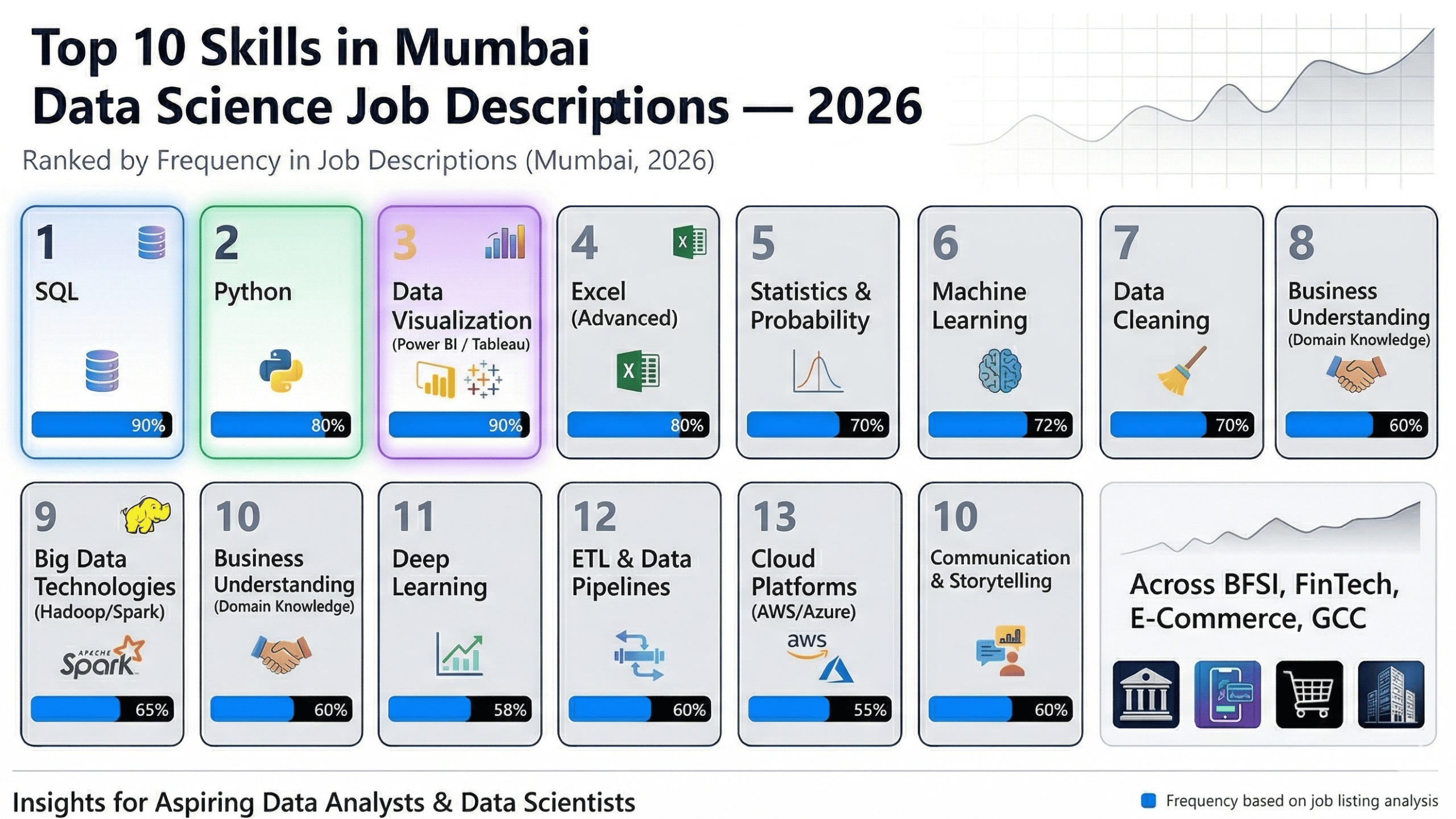
- The Top 5 High-Demand Data Science Skills in Mumbai 2026
- Skill 1: Generative AI and LLM Ops — The Highest-Premium Skill of 2026
- Skill 2: Advanced SQL and Modern Data Warehousing — The Unglamorous Non-Negotiable
- Skill 3: Machine Learning Operations (MLOps) — The Production Separator
- Skill 4: Financial Domain Knowledge — The Moat That Lasts Decades
- Skill 5: Data Storytelling for Executives — The Skill That Drives Promotions
- The Hiring Hubs: Powai vs. BKC — Different Priorities
- Skill-Based Salary Multipliers: The 30–50% Premium
- Your 2026 Data Science Portfolio Checklist
- The 5 Portfolio Projects
- What Your Portfolio Must Also Show
- Agentic AI: The Highest-Premium Addition of 2026
- Cloud Deployment: The Baseline That Has Become a Differentiator
- The 2026 Portfolio Checklist: What Mumbai's Top Employers Want to See
- Data Science Jobs Mumbai: Don't Apply with an Outdated Resume
Here is what Mumbai's recruiters see every day: hundreds of applications from data scientists who can build a gradient boosting model, cross-validate it, and cite its AUC score to three decimal places. Here is what they are not finding enough of: professionals who can take that model, connect it to a real financial system, deploy it to production, keep it accurate as the world changes, and walk a BKC boardroom through what the model found in plain language.
The gap between what Mumbai's data science job market is supplying and what it is demanding is not a gap in theoretical knowledge. It is a gap in applied, production-oriented, domain-grounded skills — and the professionals who close that gap are collecting the salary premiums and the Lead titles while everyone else waits for callbacks.
This guide maps the exact data science skills mumbai companies 2025 are hiring for at the top of the compensation range — not the generic "know Python and ML" advice that is everywhere, but the specific, Mumbai-market-calibrated skills that separate a ₹22L offer from a ₹38L one at the same experience level.
The Mumbai Market Shift: Applied AI, Not Research AI
Mumbai's data science market has always been distinct from Bengaluru's. While Bengaluru's tech ecosystem includes a large concentration of product R&D roles — building new ML architectures, publishing research, pushing the frontier — Mumbai's market is overwhelmingly applied AI.
The question Mumbai's employers are asking is not "can you build something novel?" It is: "can you solve this specific, high-stakes business problem reliably, at scale, and in a regulated environment?"
The specific problems that drive this demand:
Risk and compliance in BFSI: HDFC Bank, ICICI, Axis, Kotak, and every NBFC in BKC are running ML models that influence credit decisions for millions of customers. These models must be accurate, auditable, explainable to RBI examiners, fair across demographic groups, and monitored continuously for drift. The skill requirements are sharply different from a Kaggle competition.
Fraud detection at transaction scale: NPCI processes 15+ billion UPI transactions monthly. Paytm, Razorpay, and PhonePe each process hundreds of millions. The fraud models running against these flows cannot afford to be retrained manually quarterly — they need automated, monitored, production-grade MLOps infrastructure. And they need to work in milliseconds.
Customer experience at FinTech scale: Groww, Zepto, Nykaa, and BharatPe are building AI-powered recommendation, personalisation, and support systems that interact with tens of millions of customers daily. The failure mode is not a wrong prediction on a test set — it is a wrong recommendation that costs a customer their savings or a merchant their revenue.
This is the context in which data science jobs Mumbai are being filled. Applied, production-grade, regulated, high-stakes. The skills that thrive in this environment are the focus of the rest of this guide.
The Top 5 High-Demand Data Science Skills in Mumbai 2026
Skill 1: Generative AI and LLM Ops — The Highest-Premium Skill of 2026
Every major BFSI and FinTech firm in Mumbai is now building or evaluating AI applications powered by Large Language Models. The most common use cases in the city's financial sector:
- RAG (Retrieval-Augmented Generation) for secure financial data: Customer service agents that can answer account-specific queries by retrieving and synthesising information from internal knowledge bases — without sending sensitive customer data to public LLM APIs. The RAG architecture keeps the LLM as a reasoning engine while the sensitive data stays in the organisation's secure infrastructure.
- Document intelligence pipelines: Extracting structured information from loan applications, account statements, compliance documents, and regulatory filings using LLMs as the parsing and understanding layer
- Internal productivity tools: Code assistants for data engineering teams, policy Q&A systems for compliance officers, meeting summarisation and action item extraction for relationship managers
The skill set Mumbai's employers are paying a premium for is not just "I have used ChatGPT." It is:
- RAG pipeline architecture: LangChain or LlamaIndex for orchestration, Pinecone or ChromaDB or pgvector for vector storage, document chunking and embedding strategy design, hybrid search combining semantic and keyword retrieval
- LLM evaluation and quality assurance: RAGAS for faithfulness and relevance scoring, building evaluation datasets, measuring hallucination rates and designing system prompts that minimise them
- LLM Ops in production: Managing LLM API costs (token counting, caching, batching), implementing rate limiting and fallback logic, monitoring LLM output quality in production, fine-tuning with LoRA/QLoRA for domain adaptation
- Agentic AI workflows: LangGraph and CrewAI for multi-step AI workflows, tool-using agents that can query databases, run code, and take actions — not just generate text
AI skills for finance: the BFSI-specific requirements
Mumbai's BFSI employers add a compliance layer to GenAI requirements that other cities' employers do not. Data scientists in BFSI GenAI roles must understand:
- How to architect RAG systems that never expose customer PII to external LLM APIs
- Model cards and documentation requirements for AI systems subject to RBI scrutiny
- Bias detection in LLM outputs for customer-facing financial applications
- Human-in-the-loop designs that satisfy audit requirements while maintaining automation efficiency
Salary impact: Mid-level professionals with strong GenAI and LLM Ops skills are commanding ₹28L–₹42L in Mumbai's 2026 market — 40–60% above the baseline for their experience tier.
Skill 2: Advanced SQL and Modern Data Warehousing — The Unglamorous Non-Negotiable
Every senior data scientist at every Mumbai company that interviewed for this post cited the same surprise: SQL is the most consistently undertested and undervalued skill at the entry and mid-levels, and its absence is the most common reason mid-level candidates fail to advance.
Basic SQL — SELECT, GROUP BY, JOIN — is table stakes. The advanced SQL that Mumbai's large-scale BFSI and FinTech operations require is a different standard:
Window functions for financial analytics:
-- Calculate each customer's 90-day transaction velocity and rolling average
-- compared to their own historical baseline
SELECT
    customer_id,
    txn_date,
    txn_amount,
    SUM(txn_amount) OVER (
        PARTITION BY customer_id
        ORDER BY txn_date
        ROWS BETWEEN 89 PRECEDING AND CURRENT ROW
    ) AS rolling_90d_spend,
    AVG(txn_amount) OVER (
        PARTITION BY customer_id
        ORDER BY txn_date
        ROWS BETWEEN 364 PRECEDING AND CURRENT ROW
    ) AS rolling_365d_avg,
    txn_amount / NULLIF(AVG(txn_amount) OVER (
        PARTITION BY customer_id
        ORDER BY txn_date
        ROWS BETWEEN 364 PRECEDING AND CURRENT ROW
    ), 0) AS spend_vs_historical_avg
FROM transactions
WHERE txn_date >= '2026-01-01'
ORDER BY customer_id, txn_date;
Modern data warehouse platforms:
Mumbai's enterprise data ecosystem has shifted significantly toward cloud-native data warehouses in the past 24 months:
- Snowflake is the platform of choice at several BFSI firms and analytics consulting companies in BKC. The ability to write optimised Snowflake SQL, manage Snowflake's virtual warehouse compute tiers, and use Snowpark for Python-based transformations is a differentiator.
- Google BigQuery is dominant at FinTech startups and e-commerce companies in Powai. Understanding partitioning, clustering, and BigQuery ML for in-warehouse model training is increasingly expected.
- Databricks (built on Apache Spark) is the platform for large-scale data engineering and ML pipelines at several GCCs. PySpark proficiency and Delta Lake understanding are valuable at the mid-senior level.
Why this matters beyond "more SQL": Modern data warehouses change the architectural patterns of analytics. A data scientist who can build a dbt (data build tool) model in Snowflake to create a feature table that feeds both dashboards and ML training pipelines — without needing a data engineer to do it — adds a level of autonomy and speed that organisations with overloaded data engineering teams desperately need.
Skill 3: Machine Learning Operations (MLOps) — The Production Separator
The ability to move a model from a Jupyter notebook to a monitored, auto-retraining, cloud-deployed production system is the single clearest line between mid-level and senior data science compensation in Mumbai's 2026 market.
The full MLOps skill set is covered in depth in our MLOps guide, but the specific tools Mumbai employers test for most frequently:
Docker and containerisation: Can you take your model and its dependencies, package them into a Docker container, and guarantee it runs identically in development and production? This is the minimum. Data scientists who cannot containerise their models are dependent on a DevOps engineer at every deployment step — which slows down shipping significantly.
Cloud ML platforms: AWS SageMaker (dominant in BFSI), Azure ML (common at Axis, HDFC, Kotak due to Microsoft enterprise relationships), Google Vertex AI (common at Fintech and analytics-heavy firms). The skill is not just knowing the platform exists — it is having actually deployed a model to one, configured auto-scaling, and set up performance monitoring.
MLflow or Weights & Biases for experiment tracking: Mumbai interviewers at mid-to-senior level frequently ask candidates to walk through how they tracked experiments in a previous project. Candidates who answer "I kept notes in a spreadsheet" signal that their modelling work is not reproducible. Candidates who can demonstrate a disciplined MLflow setup signal production-readiness.
Monitoring tools: Evidently AI for drift detection, custom alerting logic, and the conceptual understanding of what data drift is, why it matters, and how it specifically manifests in BFSI contexts (macroeconomic shifts, new product launches, regulatory changes).
Salary impact: As covered in our MLOps guide — 30–50% above baseline for data scientists who add this skill set to strong modelling foundations.
Skill 4: Financial Domain Knowledge — The Moat That Lasts Decades
Mumbai is not Bengaluru. The dominant buyers of data science talent in Mumbai are financial institutions — banks, NBFCs, insurance companies, asset managers, FinTech payments companies, and their technology partners. The data scientists who thrive in this environment are the ones who understand the business logic of the problems they are solving, not just the technical implementation.
Credit scoring and NPA prediction: Understanding the mechanics of credit risk — how CIBIL scores work, what drives NPA formation, the difference between PD (Probability of Default), LGD (Loss Given Default), and EAD (Exposure at Default), how Indian banks provision for NPAs under RBI's Income Recognition and Asset Classification norms. A data scientist who builds a credit risk model without this context will build a technically correct model that the risk team cannot use because it optimises the wrong objective.
Fraud detection in Indian payment systems: Understanding UPI's transaction architecture, the specific fraud patterns prevalent in peer-to-peer vs. merchant payments, the velocity-based heuristics that trigger genuine vs. false-positive fraud flags, and the regulatory reporting requirements for suspicious transaction reports under PMLA. A fraud model built without this context will either catch very little or flag so many genuine transactions that it creates customer experience disasters.
Algorithmic trading and quantitative finance: For roles at GCCs (JP Morgan, Goldman Sachs, HSBC) and financial analytics firms, understanding market microstructure, execution costs, Sharpe ratio, drawdown, factor models, and how trading signals are evaluated in the context of transaction costs and market impact is the difference between a candidate who can engage meaningfully in problem formulation and one who can only execute tasks they are handed.
Insurance analytics: Actuarial concepts — frequency-severity models, loss ratios, reserving, IBNR (Incurred But Not Reported) claims — for roles at LIC, HDFC Life, ICICI Prudential, and SBI Life's analytics teams.
Domain knowledge is the hardest skill to fake and the longest to build — which is exactly why it generates a durable salary premium.
Skill 5: Data Storytelling for Executives — The Skill That Drives Promotions
Every data science director and VP at every Mumbai firm in our research cited the same gap in their teams: the inability of technically strong data scientists to communicate their findings to non-technical stakeholders in a way that drives decisions.
A model with AUC 0.89 means nothing to the CFO of HDFC Bank. "Our new credit risk model correctly identifies 89% of customers likely to default within 90 days, with a false positive rate that means we decline only 8 additional creditworthy applications per 1,000 reviewed" — that is a number the CFO can use to approve the model for deployment.
What executive data storytelling actually requires:
- Leading with the business insight, not the methodology. Start with "we found that customers who use the app more than 4 times per week have 70% lower churn probability" — not with "we ran a random forest model with 200 estimators and obtained feature importances."
- Quantifying business impact. "If we prioritise retention efforts on the 15,000 customers our model identifies as high-churn risk, and retain 30% of them, we preserve approximately ₹4.2Cr in annual recurring revenue."
- Acknowledging uncertainty clearly. "The model's confidence is highest for customers in the 25–45 age group with 2+ years on the platform. Its predictions for newer customers carry more uncertainty, and we recommend human review for that segment."
- Dashboard design for decision-makers. Building Power BI or Tableau dashboards that a senior executive can navigate in 90 seconds — not 15-chart data dumps that require a guided tour.
In Mumbai's BFSI environment, where data scientists regularly present to risk committees, credit committees, and board-level AI governance panels, storytelling is not a "soft skill add-on." It is a core job requirement at every level above Junior.
The Hiring Hubs: Powai vs. BKC — Different Priorities
Mumbai's two primary data science hiring hubs have meaningfully different skill emphasis, and tailoring your application accordingly improves your conversion rate significantly.
BKC (Bandra-Kurla Complex) — BFSI, GCCs, MNCs
BKC employers — HDFC Bank, ICICI Bank, JP Morgan, Goldman Sachs, HSBC, NSE, Fractal Analytics — emphasise:
- Regulatory compliance and explainability: Models must be auditable. SHAP values, LIME, and model cards are expected components of any deployed model's documentation.
- Domain depth over tool breadth: A BKC interviewer cares more about your understanding of credit risk or fraud detection mechanics than whether you know LangGraph.
- Structured data and SQL mastery: Transactional and customer relational data dominates. Advanced SQL and data warehouse skills (Snowflake, BigQuery) are tested rigorously.
- Formal MLOps and governance: CI/CD pipelines, model registries, and monitoring dashboards are evaluated at mid-to-senior level hiring.
Powai (Hiranandani Business Park) — Startups, FinTech, E-Commerce
Powai employers — Nykaa, Zepto, Groww, Smallcase, and funded FinTech startups — emphasise:
- GenAI and LLM fluency: RAG pipelines, agentic workflows, and LLM evaluation are actively tested. "Have you shipped a GenAI feature?" is a common Powai screening question.
- Speed and breadth: The expectation is that a single data scientist can move from data extraction to model to API to monitoring without handoffs. Full-stack data science capability is valued over depth in a single domain.
- Product intuition: Understanding user behaviour, conversion funnels, engagement metrics, and the connection between ML model outputs and product KPIs is more valued than regulatory compliance knowledge.
- Equity appetite: Powai roles often include ESOP components. Candidates who only compare base salaries are evaluating these offers incorrectly.
Skill-Based Salary Multipliers: The 30–50% Premium
Your 2026 Data Science Portfolio Checklist
5 projects every serious DS candidate must have — and why recruiters care about each one.
The 5 Portfolio Projects
01 — RAG Pipeline Must-have
Build a Retrieval-Augmented Generation system using LangChain + FAISS or Chroma. Include chunking strategy, vector retrieval, and eval metrics (faithfulness, answer relevance). This is the #1 skill hiring managers ask for in 2026 LLM roles.
02 — Deployed Model API Must-have
Train a model and deploy it as a live API — FastAPI or Flask, containerized with Docker, hosted on AWS/GCP or HuggingFace Spaces. A GitHub repo alone is not enough; recruiters want a live link they can hit.
03 — Drift Monitoring Dashboard Important
Use Evidently AI or Alibi Detect to track data drift and prediction drift post-deployment. Build a visual dashboard with alerts. Shows you understand that ML doesn't stop at model training — production monitoring is a core MLOps skill.
04 — MLflow Experiment Tracker Important
Log your model experiments with MLflow — parameters, metrics, artifacts, and the model registry. Include screenshots or a hosted MLflow UI in your portfolio. Proves you work like a real ML engineer, not just a notebook hacker.
05 — Domain Case Study Must-have
End-to-end: business problem → data collection → model → measurable impact. Pick a real domain — healthcare, fintech, EdTech, or retail. Quantify the outcome ("reduced churn by 18%"). This is what separates candidates who understand business from those who only know code.
What Your Portfolio Must Also Show
✓ A clean GitHub README for every project
Problem statement, architecture diagram, setup instructions, and a demo GIF or live link. Recruiters spend 90 seconds on a repo — make every second count.
✓ Tools stack clearly listed
LangChain, FAISS, FastAPI, Docker, MLflow, Evidently, Streamlit — list them on your portfolio page and LinkedIn. ATS systems and recruiters scan for these keywords.
✓ Build in this order if you're starting out
Domain Case Study → MLflow Tracker → Deployed API → Drift Dashboard → RAG Pipeline. Each one builds the skills the next one needs. Don't start with RAG if you haven't deployed a model yet.
The salary impact of skill additions in Mumbai's 2026 market is not evenly distributed. These two additions produce the largest, most consistent premiums:
Agentic AI: The Highest-Premium Addition of 2026
Agentic AI — the ability to design and build AI systems that can plan, use tools, and execute multi-step tasks autonomously — is the most scarce and most compensated skill in Mumbai's data science market right now. The combination of LangGraph or CrewAI proficiency, tool-use agent design, and production deployment of agentic workflows commands a 40–60% premium above baseline for mid-level candidates.
Why it is so valued: Banks and FinTech companies are building AI agents that can autonomously handle merchant onboarding queries, process compliance documentation, generate regulatory reports, and flag risk events — with human review only for exceptions. The data scientists who can architect and deploy these systems are solving problems that no other hire profile can solve as efficiently.
The portfolio signal: A GitHub repository with a working, documented, LangGraph-based multi-step agent that solves a financial services use case (document extraction, compliance Q&A, risk monitoring) is among the most distinctive portfolio items a Mumbai data science candidate can present in 2026.
Cloud Deployment: The Baseline That Has Become a Differentiator
The ability to deploy a model to AWS SageMaker, Azure ML, or Google Vertex AI — not in theory but in practice, with a live endpoint, monitoring, and auto-scaling — adds 25–40% to base salary offers at mid-level because it eliminates the handoff to a separate ML Engineering team.
The portfolio signal: A deployed model with a publicly accessible API endpoint (even a demo-scale one) proves this capability more convincingly than any certification. Document the deployment architecture, the monitoring setup, and the cost estimate per 1,000 predictions — this level of production thinking is what hiring managers at BKC firms are looking for.
The 2026 Portfolio Checklist: What Mumbai's Top Employers Want to See
A data science portfolio that gets callbacks from Mumbai's top employers in 2026 includes at least five of the following:
1. A production-deployed model — Docker-containerised, served via FastAPI or Flask, hosted on a cloud platform, with an API endpoint that actually works. The deployment documentation should include architecture decisions, cost estimates, and scaling considerations.
2. A RAG pipeline project — A working retrieval-augmented generation system built with LangChain or LlamaIndex, connected to a vector database, with a RAGAS evaluation report documenting faithfulness and relevance scores. Bonus points for a BFSI or compliance use case.
3. A drift monitoring dashboard — An Evidently AI or custom monitoring implementation that tracks feature drift on a historical dataset and generates an automated report. Demonstrates MLOps awareness.
4. A domain-specific case study — A detailed write-up of a project using real financial, e-commerce, or healthcare data from Mumbai's context — explaining the business problem, your methodology, the model's findings, and the business recommendation you would make based on the results. This is the document that demonstrates the data storytelling skill.
5. A SQL showcase — A GitHub repository or Observable notebook showing advanced SQL — window functions, CTEs, multi-table joins, optimisation — on a realistic financial dataset. More valuable to BKC employers than any ML notebook.
6. An agentic AI project — A multi-step agent using LangGraph or CrewAI that completes a non-trivial task (financial report extraction, document classification pipeline, compliance monitoring workflow). Even a well-documented proof-of-concept demonstrates capability that few candidates are showing.
Data Science Jobs Mumbai: Don't Apply with an Outdated Resume
The skills outlined in this guide are not future requirements. They are the current hiring standards at Mumbai's top BFSI and FinTech employers in 2026. The candidates getting the ₹35L+ offers are the ones whose profiles map directly to this list. The candidates receiving ₹18L offers for the same years of experience are the ones whose profiles stopped evolving in 2023.
The gap is closable — but closing it requires a skills audit that is honest about where you actually are, not where you would like to be.
TechPaathshala's Skill-Mapping Workshop is a structured, one-on-one session designed for data science professionals in Mumbai who want an honest assessment of how their current profile maps to what the market is paying for — and a concrete plan to close the gaps that are costing them salary.
In the workshop, you will:
- Complete a structured skills audit across all five high-demand skill areas — GenAI/LLM Ops, Advanced SQL/Data Warehousing, MLOps, Financial Domain Knowledge, and Data Storytelling — benchmarked against what Mumbai's top employers test at your target experience level and salary band
- Identify your highest-ROI skill gaps — the specific additions that would most directly and immediately increase your market value, based on your target role type (Powai startup vs. BKC BFSI vs. GCC) and your current profile
- Get a personalised 90-day portfolio plan — specific projects to build, specific skills to demonstrate, and specific ways to position your existing experience to maximise your appeal to Mumbai's top employers
- Leave with a calibrated salary target — knowing exactly what the market should pay for your updated profile, and how to make the case for it in a negotiation
👉 Join TechPaathshala's Skill-Mapping Workshop — and align your profile with what Mumbai's top employers are actually hiring for in 2026.
TechPaathshala is a Mumbai-based technology education platform helping data science professionals close the gap between their current skills and what Mumbai's BFSI and FinTech market is paying premium salaries for in 2026.

You Might Also Like