Frontend to Full Stack: How to Make the Switch and Double Your Salary in Mumbai (2026)
Contents
- The 2026 Frontend Plateau: Why Mumbai's UI Market Has Hit a Wall
- The 4-Step Technical Bridge: Your Frontend to Full Stack Switch in Mumbai
- Step 1: The Runtime Shift — From the Browser to Node.js
- Step 2: The Data Layer — From Fetching APIs to Designing Them
- Step 3: System Architecture — Beyond Components to Engineering
- Step 4: The Cloud Leap — Docker and AWS/Azure Are No Longer Optional
- The Mindset Shift: From "How It Looks" to "How It Scales"
- The Mumbai "Product" Advantage: Why Full Stack Ownership Wins Here
- Your Next Step: Cross the Bridge in 90 Days
- Ready to Cross the Bridge?
If you're a frontend developer in Mumbai with 1–3 years of experience, you've probably felt it—that invisible ceiling. You've shipped beautiful UIs, optimised render cycles, and maybe even built a component library from scratch. But your salary band hasn't moved much, your interviews keep hitting the same wall, and somewhere in your gut you know: the React specialist role isn't the endgame.
This guide is for you. It's not a list of YouTube tutorials. It's a structured, honest map of the technical and mental bridge you need to cross to move from frontend specialist to full stack engineer—and into the ₹18L–₹25L+ salary bracket that Mumbai's product companies are paying right now.
The 2026 Frontend Plateau: Why Mumbai's UI Market Has Hit a Wall
The Mumbai tech market in 2026 has a paradox. There is no shortage of React and Angular developers—but there is a severe shortage of engineers who can own a feature end-to-end.
Here's what's happening on the ground:
The supply-demand mismatch is real. Hundreds of bootcamp graduates and self-taught developers enter the Mumbai frontend job market every quarter. The talent pool for pure UI roles has grown significantly faster than the number of senior UI positions available at companies like Razorpay, Groww, and Meesho. This compression has squeezed frontend salaries in the ₹8L–₹14L band.
Product companies are reorganising around feature ownership. Mumbai's most competitive employers—BrowserStack, Nykaa, BillDesk—have started restructuring their engineering teams away from siloed frontend/backend squads toward small, full-ownership pods. In these pods, a developer is expected to touch the database, write the API, and build the UI for a single feature. A "frontend only" profile simply doesn't map cleanly to this model.
The ₹18L–₹25L bracket is gatekept by backend literacy. Look at any senior Software Engineer or SDE-2 job description in Mumbai right now. The minimum bar consistently includes: Node.js or a similar runtime, SQL query writing, REST API design, and at least basic familiarity with cloud deployment. These aren't bonus skills. They're the entry ticket.
The good news? If you're already a JavaScript developer, you are far better positioned to make this switch than a Java or Python developer pivoting into full stack. You already speak the language of the web. You just need to learn the other rooms in the house.
The 4-Step Technical Bridge: Your Frontend to Full Stack Switch in Mumbai
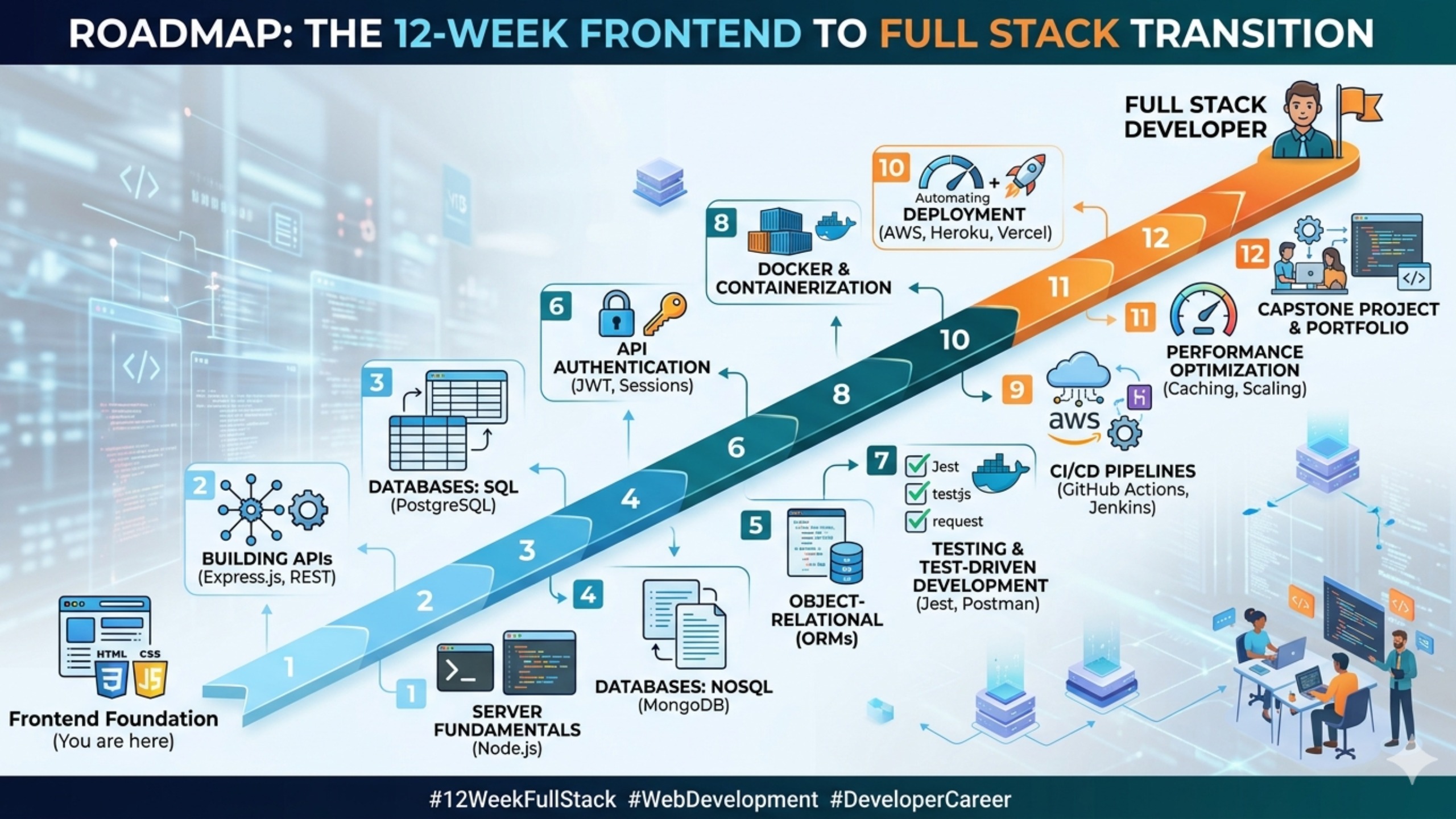
Step 1: The Runtime Shift — From the Browser to Node.js
This is where most frontend developers discover they have a massive head start that they didn't know about.
The home advantage. You already know JavaScript—its event loop, promises, async/await, array methods, and module system. Node.js is not a new language. It's JavaScript running on V8 outside the browser. Every fetch() call you've written, every Promise.all() you've chained—that knowledge transfers directly. The mental model you need to rebuild is smaller than you think.
What actually changes. In the browser, JavaScript is reactive: it waits for user events. In Node.js, JavaScript is a server: it handles incoming HTTP requests, reads from databases, calls external APIs, and sends responses. The shift is from reacting to the user to serving the user.
What to focus on first:
- Express.js for building REST APIs (request, response, middleware pipeline)
- The
fsandpathmodules for file system operations - Environment variables and
dotenvfor configuration management - Understanding
package.jsonscripts and Node module resolution
The MERN stack transition begins here. Once you can write a Node/Express server that receives a POST request, validates the body, and sends back a JSON response, you've crossed the first bridge.
Practical milestone: Build a REST API for a simple task manager—POST to create, GET to list, PUT to update, DELETE to remove. No database yet. Just in-memory arrays. This exercise alone will solidify the server-side mental model.
Step 2: The Data Layer — From Fetching APIs to Designing Them
As a frontend developer, you've consumed APIs all your professional life. You know what a good API response looks like (clean JSON, consistent error shapes, sensible HTTP codes). That consumer intuition is genuinely valuable when you switch to designing APIs. You know exactly what not to do because you've cursed at bad API design from the other side.
SQL vs. NoSQL: A Mumbai FinTech Perspective
Mumbai is India's financial capital, and this shapes the data layer decisions you'll encounter here more than anywhere else in the country.
PostgreSQL (SQL) is the dominant choice in FinTech, lending, and payments companies. When BillDesk processes a transaction or a lending platform calculates EMI eligibility, they need relational integrity—guaranteed joins, ACID transactions, foreign key constraints. You cannot have a loan disbursement record that points to a non-existent user. SQL enforces these rules at the database level.
What you need to learn: SELECT with JOIN, GROUP BY, and WHERE clauses; writing INSERT, UPDATE, DELETE safely (always parameterised—SQL injection is the #1 backend security mistake frontend devs make when they switch); understanding indexes and when a query is too slow.
MongoDB (NoSQL) appears more in product catalogues, recommendation engines, and user activity tracking—areas where the data shape varies per document and write speed matters more than relational integrity. Nykaa's product catalogue, for instance, has beauty products with wildly different attribute sets. A flexible document model suits this better than rigid SQL columns.
What you need to learn: Collections and documents, find() and aggregate(), schema design with Mongoose, and understanding when denormalisation is intentional (not a mistake).
The honest take: For the Mumbai market in 2026, SQL literacy is non-negotiable. NoSQL is a strong secondary. Start with PostgreSQL. Learn to write real queries by hand before touching any ORM.
Step 3: System Architecture — Beyond Components to Engineering
This is the step where many frontend developers stall—not because it's too hard, but because nobody explained it clearly.
When you build a React component, you think about: What props does it receive? What state does it manage? What does it render? That's component architecture.
When you build a backend system, you think about: Who is allowed to make this request? What happens when 10,000 people make it at once? How do I make sure this expensive operation doesn't run every time? That's system architecture.
Authentication: JWT and OAuth
As a frontend dev, you've used tokens—you've stored them in localStorage, sent them in Authorization headers, and handled 401 responses. Now you need to understand the other side:
- JWT (JSON Web Tokens): How to generate them on login, verify them on every protected route, and rotate refresh tokens. The critical security detail: store JWTs in
httpOnlycookies, notlocalStorage. This prevents XSS attacks from stealing tokens. - OAuth 2.0: How "Login with Google" actually works under the hood—the authorisation code flow, callback URLs, exchanging codes for access tokens. When you implement this yourself, it stops being magic and becomes a tool you can debug.
Caching with Redis
Imagine your Mumbai-based app has a dashboard that runs an expensive SQL query—joining 5 tables, aggregating 6 months of data. If 500 users open this dashboard simultaneously, you'll hit the database 500 times with the same query. Redis solves this: you run the query once, store the result in Redis with a 5-minute TTL (time-to-live), and serve the cached result to the next 499 users. Database load drops by 99%. Response time drops from 800ms to under 10ms.
Redis is used extensively at scale-ups across Mumbai's tech corridor—Andheri, BKC, Powai—precisely because read-heavy operations are the most common performance bottleneck.
Middleware
In Express.js, middleware is a function that sits between the request and the response. You've already seen this concept: Redux middleware sits between dispatching an action and the reducer. Express middleware works the same way—request comes in, passes through a chain of functions (logging, authentication check, rate limiting, body parsing), and finally reaches your route handler.
Understanding middleware is understanding how real backend systems are structured—not as monolithic route handlers, but as composable, reusable processing pipelines.
Step 4: The Cloud Leap — Docker and AWS/Azure Are No Longer Optional
In 2022, knowing Docker was a differentiator. In 2026 Mumbai, not knowing Docker is a liability.
Why this matters for you right now:
Mumbai's startups and mid-size tech companies have standardised on containerised deployments. When you join as a full stack engineer, you will be expected to write a Dockerfile, understand docker-compose for local development, and not be confused when a DevOps engineer asks you to check the container logs for your service.
What you actually need to know (not everything, just enough):
- Docker: Containers vs. images, writing a
Dockerfilefor a Node.js app, usingdocker-composeto run your app + database + Redis together locally - AWS basics: EC2 (virtual servers), S3 (file storage), RDS (managed databases), and Elastic Beanstalk or App Runner for deploying Node.js apps. Many Mumbai companies run on AWS—understanding the console and basic CLI commands is the minimum.
- Azure: Growing in adoption, particularly at companies with Microsoft enterprise agreements. Azure App Service and Azure Database for PostgreSQL are the key entry points.
The hiring reality: SDE-2 job descriptions across Mumbai's top employers explicitly list "experience with containerisation (Docker/Kubernetes)" and "familiarity with cloud platforms (AWS/Azure)" as requirements. These are not stretch goals. They are baseline expectations at the ₹18L+ level.
The Mindset Shift: From "How It Looks" to "How It Scales"
This is the most underrated part of the transition—and the part nobody puts on a roadmap.
The frontend mindset asks: Does this render correctly? Is the animation smooth? Does it work on mobile? Is the colour accessible?
These are valid, important questions. But they are fundamentally about the experience of one user at one moment.
The full stack mindset asks: What happens when 10,000 users do this simultaneously? How does this query perform against a million rows? If this third-party API goes down, does our entire app break? How do I know this is failing in production right now?
Full stack thinking is systems thinking. It's asking about failure modes before they happen. It's writing code with the awareness that it will be called in ways you didn't anticipate, at volumes you didn't plan for.
The practical implication: When you write your first Node.js API, don't just make it work. Ask: What happens if the database is slow? What if the request body is missing a required field? What if the same user calls this endpoint 100 times per second? Adding try-catch blocks, input validation, and basic rate limiting from day one is the mindset difference.
This shift is what separates a frontend developer who learned Node.js from a full stack engineer. The code might look similar; the thinking is completely different.
The Mumbai "Product" Advantage: Why Full Stack Ownership Wins Here
Mumbai is not Bangalore. The tech ecosystem here is shaped by three dominant verticals: FinTech (Razorpay, BillDesk, Zerodha's backend teams), E-commerce (Nykaa, Meesho), and Developer Tools/SaaS (BrowserStack, Postman's India office).
What these companies share is a product engineering culture. They are not outsourcing shops that want specialists to execute tickets. They are building products that compete globally. And in this environment, the developers who rise fastest—and earn most—are the ones who can take ownership of an entire feature.
Feature ownership means:
- You write the database migration
- You design the API contract
- You implement the business logic
- You build the UI
- You write the tests
- You deploy it
- You monitor it
Companies like BrowserStack, Nykaa, and BillDesk don't just value this breadth—they hire for it. Their engineering interviews increasingly include system design rounds where you're expected to talk through the entire stack. If you can only discuss the frontend layer, you're immediately at a disadvantage against a candidate who can walk through the database schema, the caching strategy, and the API design before touching the UI.
The Mumbai product advantage is real. But it's only available to developers who've made the full stack switch.
| Factor | Frontend Specialist (React, UI) | Full Stack Engineer (MERN / Java FS) |
|---|---|---|
| Fresher Salary (0–2 yrs) | ₹3 – ₹6 LPA | ₹4 – ₹7 LPA |
| Mid-Level (2–5 yrs) | ₹6 – ₹12 LPA | ₹7 – ₹15 LPA |
| Senior (5+ yrs) | ₹12 – ₹20 LPA | ₹12 – ₹30+ LPA |
| Average Salary (Mumbai) | ₹5 – ₹8 LPA | ₹6 – ₹14 LPA |
| Top Product Companies | ₹10 – ₹20 LPA | ₹15 – ₹30+ LPA |
| Salary Growth Rate | Moderate | Fast (due to multi-skill demand) |
| Freelancing Income | High (UI projects, landing pages) | Medium (complex backend needed) |
| Remote Opportunities | High | High |
| Skill Premium | UI/UX + Performance | Backend + DevOps + System Design |
| Market Value | Good | Higher (25–40% more in many cases) |
Your Next Step: Cross the Bridge in 90 Days
The frontend to full stack switch in Mumbai is not a multi-year odyssey. With the right structure and guidance, developers with a strong frontend base can become job-ready full stack engineers in 12 weeks. The technical knowledge is learnable. The MERN stack transition is well-trodden. The Mumbai market is hiring.
What most developers lack is not ability—it's a clear path and a cohort who's making the same journey.
Ready to Cross the Bridge?
Join TechPaathshala's Full Stack Engineering Program—specifically designed for Frontend devs to master the backend in 90 days.
Built for React, Angular, and Vue developers who want to move into core engineering roles, our program covers Node.js, Express, PostgreSQL, MongoDB, Redis, Docker, and cloud deployment—with real-world projects drawn from Mumbai's FinTech and product ecosystem.
Apply for the Full Stack Engineering Program→

You Might Also Like