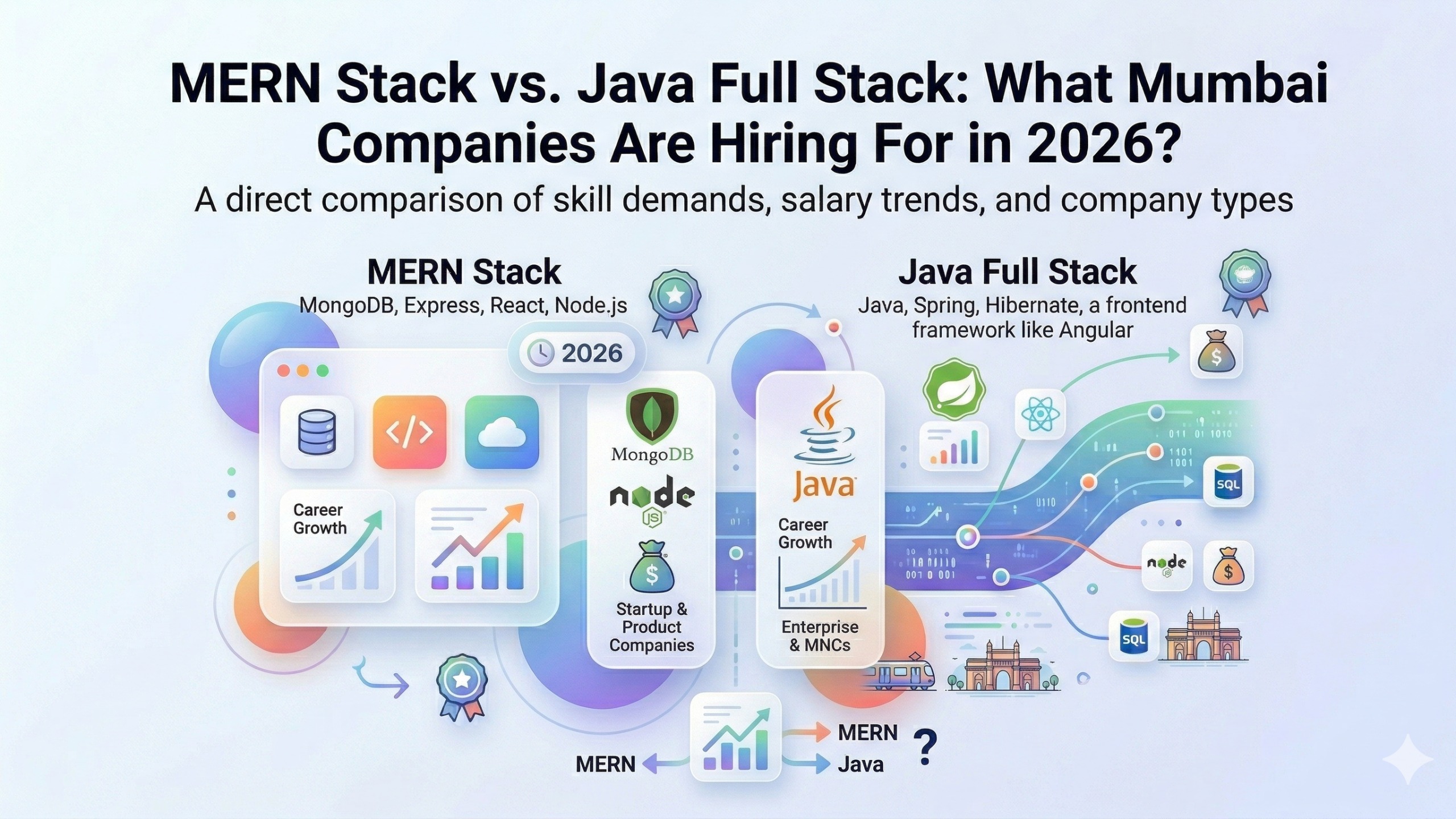
MERN Stack vs. Java Full Stack: What Mumbai Companies Are Hiring For in 2026?
Contents
- The Decision That Will Shape Your First Five Years
- Mumbai's Two-World Reality: Why This City Is Different
- The Startup Engine — Andheri, Powai, and Lower Parel
- The Enterprise Engine — BKC, Fort, and Navi Mumbai's SEEPZ
- The MERN Stack: Mumbai's Hustle Stack for 2026
- Why JavaScript End-to-End Changes Everything
- MongoDB's Flexibility and PostgreSQL's Rise
- Who the MERN Stack Suits in Mumbai's Market
- Java Full Stack: The Enterprise Gold Standard
- Why Java Has Not Been Replaced — And Will Not Be
- Spring Boot and the Microservices Architecture
- Multithreading, Security, and the Java Advantage
- Who the Java Full Stack Suits in Mumbai's Market
- Salary and Demand: The Mumbai Numbers for 2026
- Fresh Graduate Starting Salaries
- Navi Mumbai Specifically: Where Does the Demand Sit?
- Remote-Friendly Opportunities: MERN Leads Significantly
- The 2026 X-Factor: How GenAI Is Reshaping Both Stacks
- GenAI in the MERN World: Building AI-Driven UIs and Features
- GenAI in the Java World: AI-Assisted Refactoring and Enterprise AI Pipelines
- The Best Full Stack Course in Mumbai: Stack-Specific Recommendations
- The Honest Summary: MERN vs. Java in One Paragraph Per Stack
The Decision That Will Shape Your First Five Years
If you are an engineering student or a BCA/MCA graduate in Mumbai trying to choose your technical direction, you will eventually confront a version of this question: MERN or Java?
Ask this in an online forum and you will get a hundred contradictory answers, most of them written by people in Bangalore or Hyderabad describing a job market that is not Mumbai's. Ask it of a college professor and you will likely get an academic answer that has not been updated for the 2026 hiring climate. Ask it of a recruiter and you will get whichever answer matches the three roles they are currently trying to fill.
This guide gives you the Mumbai-specific, data-grounded answer that the question actually deserves. The honest answer is not "MERN is better" or "Java is better" — it is that Mumbai has two genuinely distinct hiring engines running in parallel, and the right choice depends entirely on which engine you want to work inside.
Understanding those two engines is the only useful starting point.
Mumbai's Two-World Reality: Why This City Is Different
Most Indian tech markets are dominated by one paradigm. Bangalore is largely product-startup-driven, Hyderabad skews toward enterprise and GCC (Global Capability Centre) work, Pune is heavily services-oriented.
Mumbai is the only major Indian tech hub with two fully developed, fully competitive hiring ecosystems running simultaneously at scale — and they want almost completely different things from a developer.
The Startup Engine — Andheri, Powai, and Lower Parel
The first engine runs on speed, iteration, and JavaScript. This is the world of Zepto, Nykaa, Meesho's Mumbai teams, Haptik, GoKhana, and the hundred growth-stage B2B SaaS companies clustered in Andheri East, the Powai corridor, and the co-working hubs of Lower Parel.
These companies are competing on product velocity. Their engineering teams are small, their release cycles are measured in days or weeks, and their stack choices reflect a single overriding priority: how quickly can a small team build, ship, test, and iterate? The answer to that question, in 2026, is almost universally JavaScript end-to-end. React on the frontend, Node.js and Express on the backend, MongoDB or PostgreSQL for data. The MERN stack and its close variants are the dominant choice because they minimise context-switching, allow engineers to move freely across the entire codebase, and have the richest ecosystem of open-source tooling for rapid feature development.
A junior developer joining this world will touch frontend, backend, and database work within their first month. They will deploy code to production within their first week. They will feel the direct connection between what they build and what thousands of users experience. The ceiling for growth is limited more by individual speed and curiosity than by organisational hierarchy.
The Enterprise Engine — BKC, Fort, and Navi Mumbai's SEEPZ
The second engine runs on reliability, security, and Java. This is the world of HDFC Bank, ICICI Bank, Axis Bank, JP Morgan's Mumbai GCC, Morgan Stanley, Deutsche Bank's technology centre, NPCI, and the dozens of enterprise software companies and fintech infrastructure players clustered in BKC, the Fort area, and Navi Mumbai's SEEPZ and Airoli tech parks.
These organisations are not competing on velocity. They are competing on trust. A single security vulnerability in a banking application can expose millions of customers and trigger regulatory action. A performance bottleneck in a payment processing system can mean crores of rupees in failed transactions per hour. These companies have chosen Java and the Spring Boot ecosystem because that ecosystem has a decades-long track record of enterprise reliability, security tooling, and multithreading performance. The tooling around Java — for testing, monitoring, compliance, and formal code review — is unmatched in any other language ecosystem.
A junior developer joining this world will have a more gradual onboarding. Codebase exposure will be more structured and more supervised. The scale of what they are working on — applications used by millions of users with zero tolerance for downtime — creates a different kind of professional gravity than a startup environment. The organisational structure is more defined, the compensation structures are more standardised, and the career progression is more predictable.
Neither world is superior. They are different environments producing different developer archetypes. The choice between MERN and Java is, in large part, a choice about which of these two worlds you want to build your career inside.
The MERN Stack: Mumbai's Hustle Stack for 2026
| Factor | MERN Stack (MongoDB, Express, React, Node) | Java Full Stack (Java, Spring Boot, Angular/React) |
|---|---|---|
| Demand in Mumbai | High (Startups, SaaS, EdTech) | Very High (Banking, Enterprise, MNCs) |
| Fresher Salary (₹) | ₹3 – ₹6 LPA | ₹3.5 – ₹7 LPA |
| Experienced Salary (₹) | ₹8 – ₹18 LPA | ₹10 – ₹25+ LPA |
| Hiring Companies | Startups, Product-based, Agencies | TCS, Infosys, Accenture, Banks |
| Learning Curve | Easier (JavaScript everywhere) | Moderate (Java + Spring ecosystem) |
| Development Speed | Fast (Rapid prototyping) | Structured & slower (enterprise-level) |
| Project Type | Startups, MVPs, dashboards | Large-scale enterprise systems |
| Job Stability | Medium (depends on startup health) | High (long-term enterprise projects) |
| Freelancing Opportunities | High | Low–Medium |
| Remote Opportunities | High | Medium |
| Best For | Quick job, startups, freelancing | Stable career, MNCs, long-term growth |
Why JavaScript End-to-End Changes Everything
MERN's foundational advantage is cognitive and organisational: a single language — JavaScript, or its typed superset TypeScript — runs from the React component in the browser all the way to the Node.js server and the MongoDB queries in the backend. For a small startup team, this means any developer can context-switch across the entire stack without a language shift. For a solo developer building a side project or a portfolio, it means one mental model covers the whole system.
In 2026, TypeScript has become effectively mandatory in serious MERN projects. The combination of TypeScript's static typing, React's component model, and modern tooling — Vite for builds, Prisma or Mongoose for data access, Zod for runtime validation — has closed many of the reliability gaps that critics of the JavaScript ecosystem once pointed to. The "JavaScript doesn't scale" argument was always more nuanced than its critics admitted, and today it is largely obsolete for the application sizes that Mumbai startups are building.
MongoDB's Flexibility and PostgreSQL's Rise
MongoDB remains the NoSQL default for MERN projects where document-style data and flexible schemas are genuinely advantageous — user-generated content, product catalogues with variable attributes, real-time event logging. Its integration with Node.js through Mongoose is mature and developer-friendly.
But the more significant shift in the Mumbai MERN ecosystem is the rising adoption of PostgreSQL as a relational alternative within MERN-adjacent stacks. Fintech-adjacent startups, B2B SaaS companies that need data integrity guarantees, and any application where complex relational queries matter are increasingly choosing PostgreSQL over MongoDB. A MERN developer in 2026 who is only comfortable with MongoDB is leaving opportunities on the table — knowing both, and being able to articulate when you would choose one over the other, is the mark of a thoughtful engineer.
Who the MERN Stack Suits in Mumbai's Market
The MERN stack in Mumbai is the right choice if you are drawn to fast-paced product environments, you want broad ownership of the full stack from day one, you are targeting companies in the Andheri–Powai–Lower Parel startup corridor, you prefer flexibility and breadth over deep specialisation in your early career, and you want the highest concentration of freelance and remote-work opportunities in the near term. Remote-friendly MERN roles are significantly more common than remote Java enterprise roles — the distributed team model maps more naturally onto JavaScript ecosystems where the deployment target is the browser and a cloud server, not a complex enterprise infrastructure.
Java Full Stack: The Enterprise Gold Standard
Why Java Has Not Been Replaced — And Will Not Be
Every few years, a new technology emerges with headlines predicting Java's obsolescence. Java has outlasted them all. The reason is less about the language itself and more about the institutional momentum it has accumulated: decades of battle-tested frameworks, a tooling ecosystem built explicitly for enterprise requirements, JVM performance characteristics that are extremely well understood at scale, and an enormous global talent pool.
For Mumbai's BFSI sector, this institutional momentum is not inertia — it is a rational choice. When JP Morgan's Mumbai engineering team makes a technology decision, they are not just choosing a framework. They are choosing a framework whose security implications are understood by their compliance team, whose performance characteristics are documented in their SLA agreements, and whose vendor support relationships are formalised in contracts. Switching the core technology stack of a banking application is not a weekend project — it is a multi-year programme. Java's stability is a feature, not a limitation.
Spring Boot and the Microservices Architecture
Spring Boot is the dominant Java framework for enterprise full stack development in Mumbai's market, and understanding it deeply is the entry point to software developer jobs in BKC and Navi Mumbai's enterprise tech corridor.
Spring Boot's power lies in its convention-over-configuration philosophy applied to enterprise-grade requirements: dependency injection, transaction management, security configuration, and REST API construction that would require significant boilerplate in vanilla Java are handled through annotations and auto-configuration. The result is that developers can build production-ready enterprise APIs at a speed that would not have been possible with Java a decade ago.
Microservices architecture — breaking a large application into independently deployable services — is the structural pattern that defines how these enterprise systems are built in 2026. Understanding how Spring Boot services communicate via REST or messaging queues like Apache Kafka, how they are containerised with Docker, and how they are orchestrated with Kubernetes is the genuine senior-level Java skill set that commands the upper end of Mumbai's salary brackets.
Multithreading, Security, and the Java Advantage
Two areas where Java's technical superiority is not a matter of opinion: multithreading and enterprise security tooling.
Java's concurrency model — threads, executors, locks, and the more recent virtual threads introduced in modern JVM versions — is more mature and more expressive than Node.js's event-loop concurrency model for applications that require fine-grained control over parallel execution. In a payment processing system handling thousands of simultaneous transactions, this matters in ways that are directly measurable.
The Java security ecosystem — Spring Security with OAuth2 and JWT, integration with enterprise identity providers, built-in support for encryption standards required by banking regulators — is the most comprehensive in any framework ecosystem. For HDFC's digital banking team or NPCI's UPI infrastructure, these are not optional features. They are table stakes, and the Java ecosystem provides them with a depth and maturity that alternatives cannot match.
Who the Java Full Stack Suits in Mumbai's Market
Java Full Stack is the right choice if you are drawn to large-scale, high-reliability systems, you want structured career progression and well-defined seniority levels, you are targeting software developer jobs in BKC, Fort, or Navi Mumbai's enterprise tech corridor, you are interested in the BFSI sector as a long-term domain, you value organisational stability and formal mentorship structures over startup-pace autonomy, and you are targeting MNC salary structures, which tend to be more standardised and include comprehensive benefits packages.
Salary and Demand: The Mumbai Numbers for 2026
Fresh Graduate Starting Salaries
| Experience Level | MERN Stack | Java Full Stack |
|---|---|---|
| Fresher — IT Services/MNC | ₹5L – ₹7.5L | ₹5.5L – ₹8.5L |
| Fresher — Product Startup | ₹8L – ₹14L | ₹7L – ₹12L |
| Fresher — BFSI/FinTech | ₹7L – ₹11L | ₹8L – ₹14L |
| Mid-Level (2–4 yrs) | ₹15L – ₹28L | ₹18L – ₹32L |
| Senior (5+ yrs) | ₹30L – ₹60L+ | ₹35L – ₹70L+ |
Key insight: At the fresher level, the gap between stacks is narrower than most people expect. The larger differentiator is employer type — a startup hiring for any stack pays significantly more than an IT services company hiring for any stack. The Java premium becomes more pronounced at mid-level and senior levels, where enterprise organisations reward deep domain expertise with compensation that product startups at the same experience level often cannot match.
Navi Mumbai Specifically: Where Does the Demand Sit?
For freshers based in or targeting Navi Mumbai — Airoli, Mahape, Ghansoli, CBD Belapur — Java Full Stack has a meaningful concentration advantage. Navi Mumbai's tech corridor is dominated by enterprise companies, GCCs, and large IT services firms. The roster includes Cognizant's development centres, TCS Siruseri-equivalent campuses, Reliance Industries' technology teams, and numerous BFSI-adjacent technology companies. These organisations hire Java Full Stack developers in significant volume, and the geographic accessibility of these campuses from Navi Mumbai's residential areas is a real quality-of-life consideration for someone starting their career there.
MERN demand in Navi Mumbai is growing but remains secondary to the enterprise ecosystem. The dominant MERN hiring hubs — Andheri East, Powai, Lower Parel — require a commute from most Navi Mumbai locations that adds meaningful daily cost and time.
Remote-Friendly Opportunities: MERN Leads Significantly
If remote or hybrid work is a priority, the stacks are not equal. MERN and JavaScript-stack roles have significantly higher remote-friendliness in the 2026 market for two structural reasons: the startup culture that drives MERN adoption has been more open to distributed teams since 2020, and the deployment infrastructure of JavaScript applications — browser frontend, cloud-hosted APIs — does not require physical proximity to data centres or compliance-restricted environments.
Java enterprise roles in BFSI are, by contrast, often partially or fully on-site due to data security requirements, compliance mandates, and the nature of working on systems with regulatory oversight. A developer at JP Morgan or HDFC Bank is working with classified financial data under regulatory frameworks that restrict remote access. This is not going to change, regardless of broader remote-work trends.
For professionals who want geographic flexibility or are targeting international remote opportunities, the MERN ecosystem is the significantly stronger choice.
The 2026 X-Factor: How GenAI Is Reshaping Both Stacks
This is the dimension that neither the MERN-vs-Java debate nor most course curricula adequately address. GenAI is not replacing either stack — but it is changing what a developer in both ecosystems needs to know, and the changes are stack-specific in ways that matter for how you position yourself in 2026.
GenAI in the MERN World: Building AI-Driven UIs and Features
MERN developers are on the front lines of AI product integration. The consumer-facing applications built on JavaScript stacks are the interfaces through which most users experience AI features — the AI-powered search bar, the recommendation engine surfaced in the React UI, the conversational customer support widget, the automated content generation tool.
Practically, this means MERN developers in 2026 need to understand: how to integrate LLM APIs (OpenAI, Gemini, Anthropic Claude) into React applications with appropriate loading states and error handling; how to stream responses for better user experience; how to build prompt engineering logic on the Node.js backend to protect API keys and manage context; and how to design UX patterns for AI-generated content that is non-deterministic and variable in length.
The Mumbai startup ecosystem is actively hiring MERN developers who can demonstrate any of these capabilities. Even a single deployed project with a well-implemented LLM feature distinguishes a candidate meaningfully from the pool of developers who have not yet engaged with AI integration.
GenAI in the Java World: AI-Assisted Refactoring and Enterprise AI Pipelines
Java developers in enterprise settings are encountering GenAI differently. The immediate, high-impact use case is AI-assisted code refactoring and legacy modernisation. Mumbai's BFSI companies have enormous codebases — some of which have been in continuous development for twenty years — and the combination of LLM-powered code analysis with Java's strong typing makes automated refactoring suggestions significantly more reliable in Java than in dynamically typed languages.
More strategically, enterprise Java developers who understand how to build and deploy AI pipelines within regulated environments — integrating LLMs with proper data governance, PII protection, and audit logging — are positioning themselves for a set of high-value roles that are only beginning to emerge. The combination of Spring Boot's enterprise security model with RAG pipeline implementation for internal banking knowledge bases, or AI-assisted fraud detection pipelines built on Java's concurrency model, represents genuinely new and well-compensated work.
The Java developer who says "I can build you an AI feature that meets your compliance requirements" is a different conversation than the Java developer who says "I build APIs." For senior career development in the enterprise track, AI knowledge is rapidly becoming the most important differentiator.
The Best Full Stack Course in Mumbai: Stack-Specific Recommendations
Choosing the best full stack course in Mumbai is not a stack-agnostic decision. A programme that is excellent for MERN preparation may be weak on Java, and vice versa.
For MERN-focused learning, the critical indicators are: curriculum that covers React 18+, TypeScript, cloud deployment, and at least one AI integration project; a placement network that reaches Mumbai's startup corridor companies in Andheri, Powai, and Lower Parel; and a project portfolio framework that produces deployed applications rather than local-only tutorial clones.
For Java Full Stack learning, the critical indicators are: curriculum that covers Spring Boot 3+, microservices architecture, Docker, and basic Kafka or messaging; placement relationships with enterprise companies and GCCs in BKC, Fort, or Navi Mumbai; and mentors who have worked in actual enterprise environments, not just taught about them.
TechPaathshala's Full Stack programme uses the Triple 3 Model to prepare students for both tracks — with a specific Stack Fit Assessment at enrolment to determine which primary path best matches each student's career goals, industry interests, and existing background.
The Honest Summary: MERN vs. Java in One Paragraph Per Stack
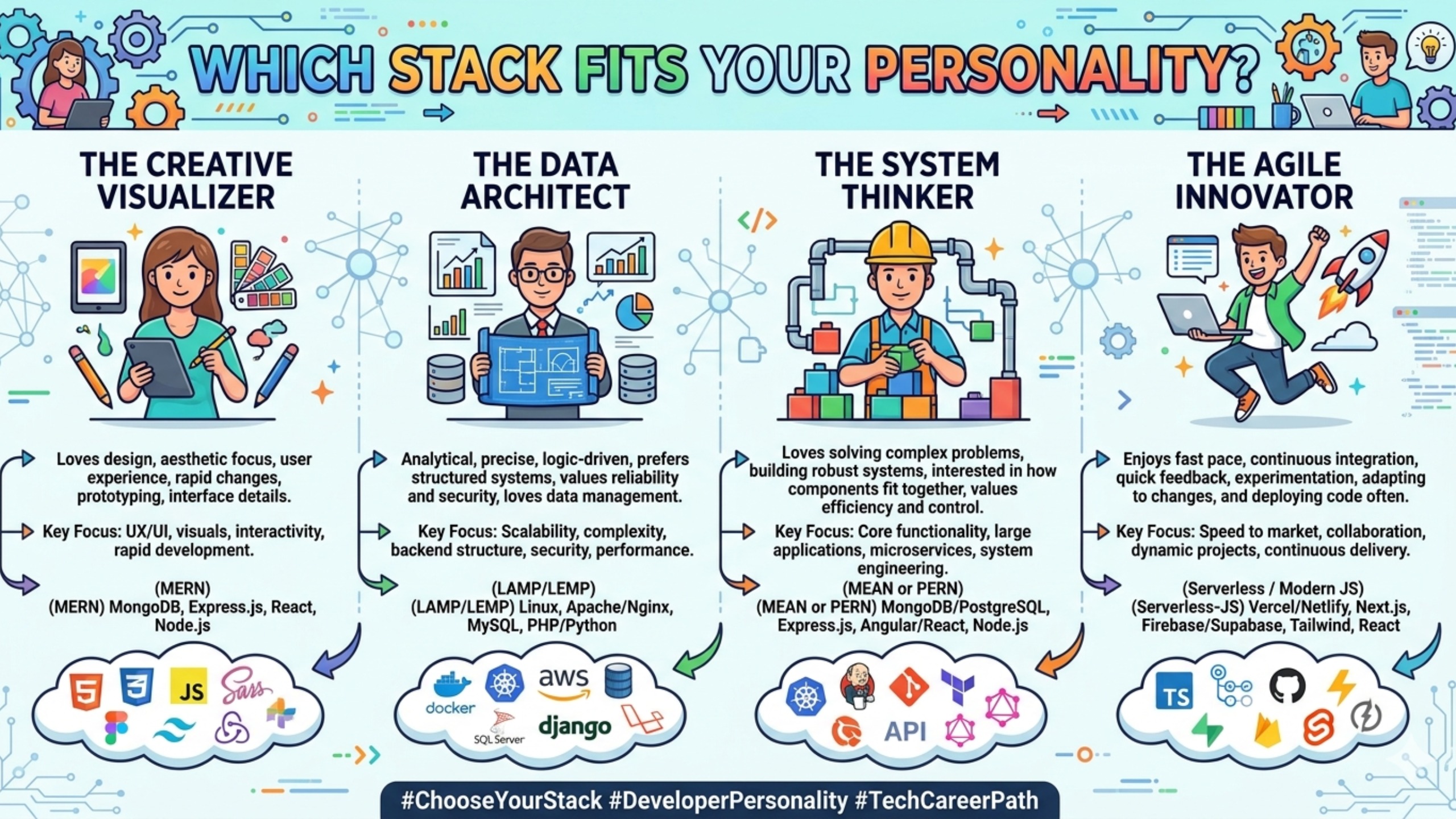
Choose MERN if: You want to join Mumbai's startup ecosystem, you value rapid iteration and broad full-stack ownership, you are drawn to consumer product companies, you want the highest probability of remote-friendly roles, and you are interested in AI product integration from the start of your career.
Choose Java if: You want to build career capital in Mumbai's BFSI and enterprise sector, you value structured progression and organisational stability, you are targeting companies in BKC, Fort, or Navi Mumbai's enterprise corridor, and you are drawn to large-scale systems where reliability and security are first-class requirements.
Both paths lead to excellent careers. The Mumbai market is large enough and diverse enough to absorb strong developers from either track. The developers who struggle are not those who chose the wrong stack — they are those who chose a stack without understanding why they chose it and then prepared for it inadequately. Clarity of choice, followed by depth of preparation, is the formula that works.

You Might Also Like