What is the Triple 3 Model? TechPaathshala’s New Way to Learn Full Stack Development
Contents
- The Uncomfortable Truth About Most Developer Education
- Introducing the Triple 3 Model Full Stack Framework — TechPaathshala's Proprietary Methodology
- Dimension 1: The 3 Pillars of Knowledge
- Dimension 2: The 3 Layers of Projects
- Dimension 3: The 3 Stages of Career Support
- Why the Triple 3 Model Works: The Cognitive Science Behind Modern Full Stack Pedagogy
- From Passive Consumer to Active Builder
- Interleaved Practice vs. Blocked Practice
- Spaced Repetition Through Project Context
- The TechPaathshala Edge: An Engineering Ecosystem for the 2026 Job Market
- What a Triple 3 Model Graduate Looks Like
The Uncomfortable Truth About Most Developer Education
Ask any hiring manager at a Mumbai startup what they actually see in interviews, and you will hear the same story repeatedly.
A candidate walks in with a certificate from a popular online platform. Six months of video lectures. A hundred hours of watching someone else code. A GitHub repository with half-finished tutorial clones. And then the interviewer opens a blank code editor and asks them to build something from scratch.
Silence.
Not because the candidate is unintelligent. Not because they did not put in the hours. But because the way they learned never required them to create anything — only to watch and replicate.
This is Tutorial Hell. And it is the defining crisis of tech education in 2026.
Tutorial Hell is the state where a student can follow along with any video lecture perfectly but freezes the moment the scaffolding is removed. They understand React when a teacher is explaining it. They cannot build a React component when no one is watching. They have consumed hundreds of hours of content and produced almost nothing of their own.
The traditional online learning model — watch a video, follow the code, move to the next video — is optimised for completion metrics, not for competence. Platforms celebrate the percentage of videos you have watched. Employers care only about what you can build.
TechPaathshala was built to solve this specific problem. The Triple 3 Model is how we solve it.

Introducing the Triple 3 Model Full Stack Framework — TechPaathshala's Proprietary Methodology
The Triple 3 Model is not a curriculum. It is not a course structure. It is an engineering pedagogy — a systematic framework for how developers should be built, not just taught.
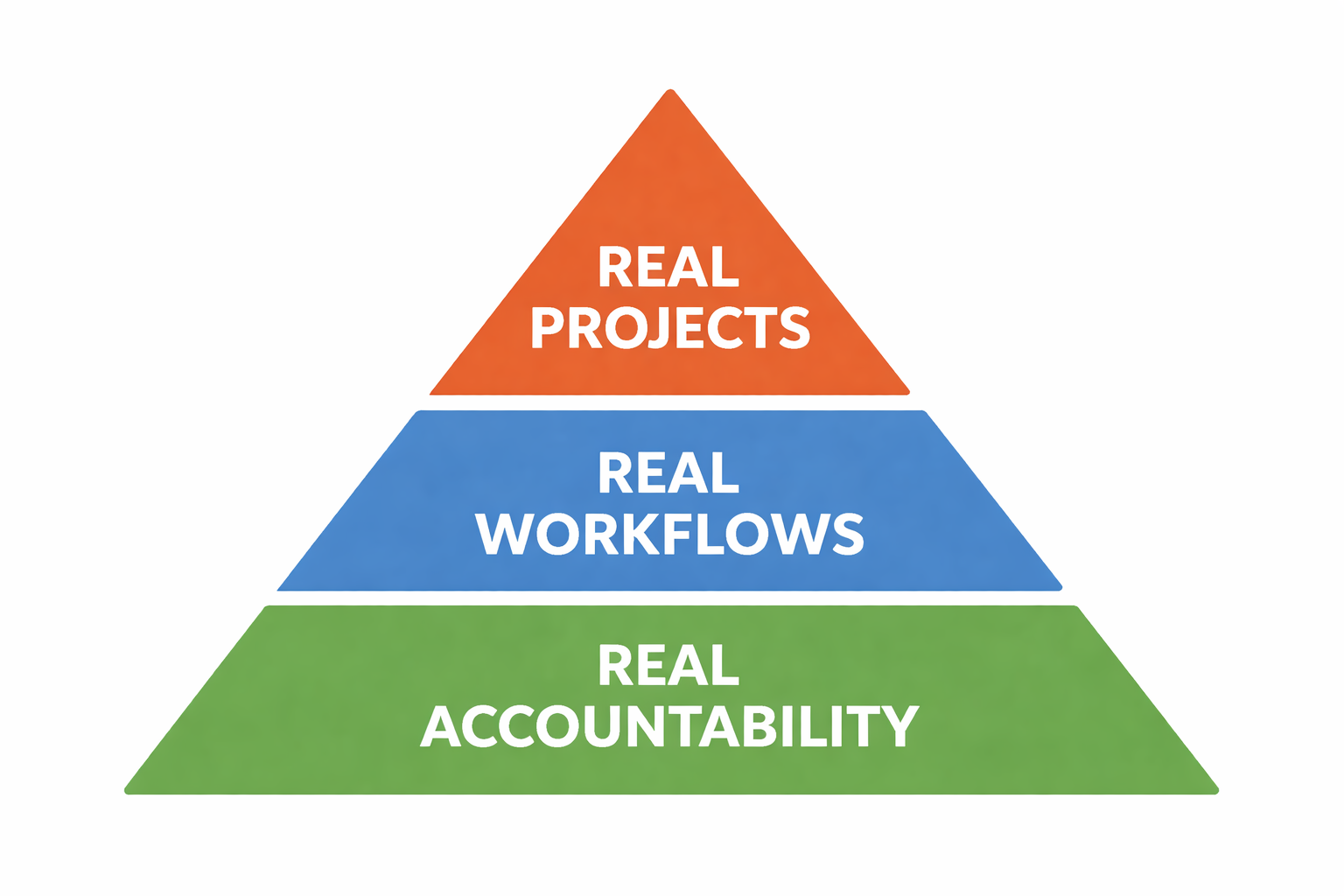
The model operates across three interconnected dimensions, each with three components. Every dimension is active simultaneously. Nothing is sequential. Nothing is siloed. This is intentional, because real software development is never sequential or siloed.
Dimension 1: The 3 Pillars of Knowledge
Most courses teach syntax. The Triple 3 Model teaches three layers of understanding that compound into genuine engineering ability.
Pillar 1 — Conceptual Clarity
Before a single line of code is written, a developer must understand why the technology exists. What problem does React solve that plain JavaScript does not? Why does a REST API need statelessness? What is the actual difference between SQL and NoSQL at a data-modelling level?
Conceptual Clarity means a developer can explain any technology decision to a non-technical stakeholder, to a senior engineer, and to themselves at 2am when something breaks in production. It is the foundation that prevents memorisation without understanding.
At TechPaathshala, every new concept is introduced with a "Problem First" session — we demonstrate the pain point that the technology was designed to solve before we introduce the technology itself. Students understand need before they understand solution.
Pillar 2 — Practical Implementation
This is where most courses spend all their time. Implementation is table stakes — you cannot be a developer without being able to write working code. But the Triple 3 Model approaches implementation differently.
Rather than implementing features in isolation, every implementation task is embedded inside a real project context. You do not learn JWT authentication as a standalone exercise. You implement it inside an application with real users, real roles, and real consequences for getting it wrong. The context is not optional decoration — it is the mechanism that makes the learning stick.
This is supported by cognitive science. Contextualised practice produces retention rates 4–6 times higher than decontextualised drill. Your brain remembers "how I secured the admin dashboard of my logistics app" far longer than "how I completed the JWT module in week four."
Pillar 3 — Architecture
Architecture is the pillar that separates developers who get hired for ₹6L roles from those who get hired for ₹18L roles. It is also the pillar that essentially no bootcamp teaches.
Architecture means: How do the pieces fit together? Why did you structure your project this way and not another way? What happens to your application when it has ten thousand users instead of ten? What breaks first, and how would you fix it?
The Triple 3 Model introduces architectural thinking from week one — not as a theoretical module, but as a lens applied to every project decision. Students learn to make architecture choices explicitly, document them, and defend them. By the time they reach a technical interview, architecture discussions are not intimidating new territory. They are familiar conversations they have been having for months.
Dimension 2: The 3 Layers of Projects
The most predictable failure in developer education is the portfolio of projects that all look identical: a Todo app, a weather dashboard, a clone of some popular website. These projects demonstrate that you can follow a tutorial. They demonstrate almost nothing else.
The Triple 3 Model structures project work across three layers of increasing complexity, authenticity, and ambition. Every student builds at all three layers across the programme.
Layer 1 — Portfolio Builders (Basic)
Portfolio Builder projects establish fundamentals and create visible proof of core competence. They are scoped to be completable in 1–2 weeks, deployed on day one, and designed to be genuinely usable — not just runnable locally.
These are not beginner projects in the pejorative sense. A well-built CRUD application with proper authentication, clean UI, and a thoughtful data model demonstrates more real skill than a rushed "advanced" project with spaghetti code. The standard is high. The scope is controlled.
Examples: A notes application with user accounts, a bookmarks manager with tagging and search, a habit tracker with streak visualisation.
What they prove: That you can ship. That you can deploy. That your code works for someone other than yourself.
Layer 2 — Industry Simulators (Medium)
Industry Simulator projects replicate the actual conditions of working in a professional development team. They introduce multi-role complexity, external API integrations, real-world data volumes, and the kind of product thinking that companies expect from mid-level engineers.
These projects are deliberately built around Mumbai's industry landscape. A FinTech dashboard with real-time market data feeds resonates with BKC recruiters. A logistics tracking system with multi-stop routing resonates with Navi Mumbai's supply chain companies. The domain knowledge you build while building the project becomes an unexpected advantage in interviews.
Examples: A full-featured e-commerce platform with Razorpay integration, a real-time delivery tracking application, a B2B SaaS dashboard with role-based access control.
What they prove: That you can handle complexity. That you understand product context. That you make architectural decisions deliberately.
Layer 3 — Scalable Production Apps (Advanced)
Production App projects are built to a standard where they could, in theory, be launched as real products. They require thinking about performance, security, scalability, observability, and maintainability — not just functionality.
These projects form the centrepiece of a student's portfolio. They are the projects that senior engineers spend the most time asking about in interviews. They are the projects that get shared on LinkedIn and generate recruiter messages without cold applications.
Building at this layer transforms how students think about software. A developer who has had to think about what happens when their database query runs 50,000 times per day thinks very differently than a developer who has only ever seen it run five times in testing.
What they prove: That you think like an engineer, not just a coder. That you are ready for a professional team without a six-month onboarding tax.
Dimension 3: The 3 Stages of Career Support
Skill without strategy is invisible. The Triple 3 Model includes a complete career acceleration system as a structural component of the programme — not an optional add-on, not a two-hour "resume tips" webinar at the end.
Stage 1 — Resume and Brand Building
A developer's professional presence is a product. Like any product, it must be designed for its audience. Mumbai HRs and hiring managers scan hundreds of profiles. They make initial judgements in seconds. Most developer resumes and LinkedIn profiles fail this test not because the underlying skills are absent but because they are not communicated in a way that registers.
Resume and Brand Building at TechPaathshala means: a one-page resume engineered for ATS systems and human readers simultaneously, a LinkedIn profile that attracts inbound recruiter interest, a GitHub profile that signals professional habits, and a portfolio site that represents genuine craft.
Every deliverable is reviewed by mentors who have been on the other side of the hiring table.
Stage 2 — Technical Interview Mastery
The Mumbai technical interview in 2026 takes three distinct forms depending on the company type, and each requires a different preparation approach.
For MNCs and large IT firms: Data Structures and Algorithms on HackerRank or HackerEarth. For product startups: Machine Coding Rounds — build a complete system in 60–90 minutes. For senior and mid-level roles: System Design discussions.
Technical Interview Mastery covers all three forms. Students practice timed Machine Coding rounds weekly, with code reviews from mentors. DSA preparation is structured around the actual problem patterns that Mumbai companies use, not generic LeetCode grinding. System Design vocabulary is built progressively through the Architecture Pillar of Dimension 1.
The goal is not to pass one interview. It is to enter every interview as the most prepared person in the room.
Stage 3 — Post-Placement Mentorship
Getting the first job is the beginning, not the destination. The first 90 days in a professional engineering role are disproportionately influential on a developer's career trajectory. How quickly you onboard, how you communicate in code reviews, how you handle your first production incident — these experiences set patterns that persist for years.
Post-Placement Mentorship provides ongoing support through this period: code review feedback, career advice, guidance on navigating team dynamics, and a community of TechPaathshala alumni to learn from. No student who graduates from the programme is left to figure out the professional world alone.
Why the Triple 3 Model Works: The Cognitive Science Behind Modern Full Stack Pedagogy
The Triple 3 Model is not an intuition or a pedagogy-of-the-month trend. It is grounded in decades of research on how skill acquisition actually works — specifically, how adults develop the kind of transferable, adaptable expertise that survives contact with novel problems.
| Aspect | Traditional Learning | The Triple 3 Model |
|---|---|---|
| Learning Approach | Theory-heavy, lecture-based | Practical + structured + outcome-driven |
| Curriculum Style | Fixed, often outdated | Industry-relevant, frequently updated |
| Focus Area | Concepts first, application later | Learn → Build → Apply simultaneously |
| Projects | Few or optional | 3 real-world projects per phase |
| Skill Development | Passive learning | Active, hands-on learning |
| Mentorship | Limited or none | Continuous mentor support |
| Feedback Loop | Delayed (exams) | Instant feedback on tasks/projects |
| Tools & Tech | Often outdated | Modern tools (Git, APIs, deployment) |
| Portfolio Building | Not prioritized | Strong portfolio focus |
| Job Readiness | Low to moderate | High (job-focused training) |
| Assessment Style | Exams & theory tests | Practical tasks + real scenarios |
| Industry Exposure | Minimal | Real-world use cases & workflows |
| Placement Support | Limited | Structured placement guidance |
| Outcome | Degree-oriented | Skill + job-oriented |
From Passive Consumer to Active Builder
Cognitive Load Theory, developed by educational psychologist John Sweller, explains why Tutorial Hell is so effective at producing the illusion of learning. When you watch an expert explain and demonstrate, your working memory is fully engaged — you feel like you are learning. But passive observation does not produce the kind of memory encoding that allows independent retrieval. The moment the scaffolding is removed, the apparent knowledge disappears.
Active construction — building something yourself, encountering errors, making decisions, debugging consequences — produces what psychologists call "desirable difficulty." The struggle is not a sign that something is wrong. It is the mechanism of learning. The Triple 3 Model is designed to maintain appropriate desirable difficulty at every stage.
Interleaved Practice vs. Blocked Practice
Traditional curricula use blocked practice: finish all the React, then start Node.js, then start MongoDB. Research consistently shows that interleaved practice — mixing topics and skills within each learning session — produces stronger long-term retention and better transfer to novel problems, even though it feels harder in the moment.
The Triple 3 Model interleaves all three knowledge pillars and all three layers of projects throughout the programme. A student working on a Portfolio Builder project in week three is simultaneously applying conceptual clarity from Pillar 1, writing implementation code from Pillar 2, and making architecture decisions from Pillar 3. This is harder than watching three separate module playlists. It is also dramatically more effective.
Spaced Repetition Through Project Context
The brain consolidates learning through repeated retrieval over time. The project-based structure of the Triple 3 Model creates natural spaced repetition: concepts introduced in Layer 1 projects re-appear in Layer 2 projects in a more complex context, and re-appear again in Layer 3 projects at production scale. Each re-encounter strengthens the neural encoding of the concept.
This is why TechPaathshala graduates can walk into a technical interview and discuss authentication implementation across three different project contexts. They have not memorised a definition — they have built the thing three times.
The TechPaathshala Edge: An Engineering Ecosystem for the 2026 Job Market
The Triple 3 Model is the methodology. TechPaathshala is the ecosystem that makes the methodology work at scale.
The 2026 job market for full stack developers in Mumbai is more demanding than it was two years ago, and it is also richer in opportunity than it has ever been. Companies are not just looking for developers who know the MERN stack. They are looking for developers who can contribute to production systems from day one, who understand the business context of their technical decisions, and who can grow into mid-level and senior roles within 18 months.
Generic courses are optimised for enrolment numbers, not employment outcomes. Every structural decision in a mass-market online course — pre-recorded videos, automated grading, discussion forums as support — is made to reduce cost per student, not to maximise the probability of a student getting hired.
TechPaathshala operates on an inverted model. We are optimised for one metric: the percentage of graduates who are working in roles that match or exceed their salary targets within 90 days of completing the programme.
This means small cohorts with individual mentor attention. It means live code reviews, not automated checkers. It means projects evaluated by engineers who hire, not algorithms that count test cases. It means a curriculum that is updated quarterly as the Mumbai market evolves, not a fixed syllabus recorded two years ago.
The Triple 3 Model gives you the framework. TechPaathshala gives you the environment in which the framework can produce the results it is designed to produce.
What a Triple 3 Model Graduate Looks Like
By the time a student completes the TechPaathshala programme, they have:
- Built nine distinct projects across all three layers — three Portfolio Builders, three Industry Simulators, and three Production Apps
- Demonstrated all three Knowledge Pillars across each project — articulating not just what they built, but why every significant decision was made
- Completed at least four timed Machine Coding rounds with mentor review
- Published a complete professional presence — resume, GitHub, LinkedIn, and portfolio site — reviewed by working engineers
- Received 30-day, 60-day, and 90-day post-placement mentorship check-ins
They are not beginners who have watched a lot of videos. They are junior engineers with the portfolio depth, interview preparation, and professional habits of developers who have already been working for a year.
This is the gap the Triple 3 Model closes.

You Might Also Like