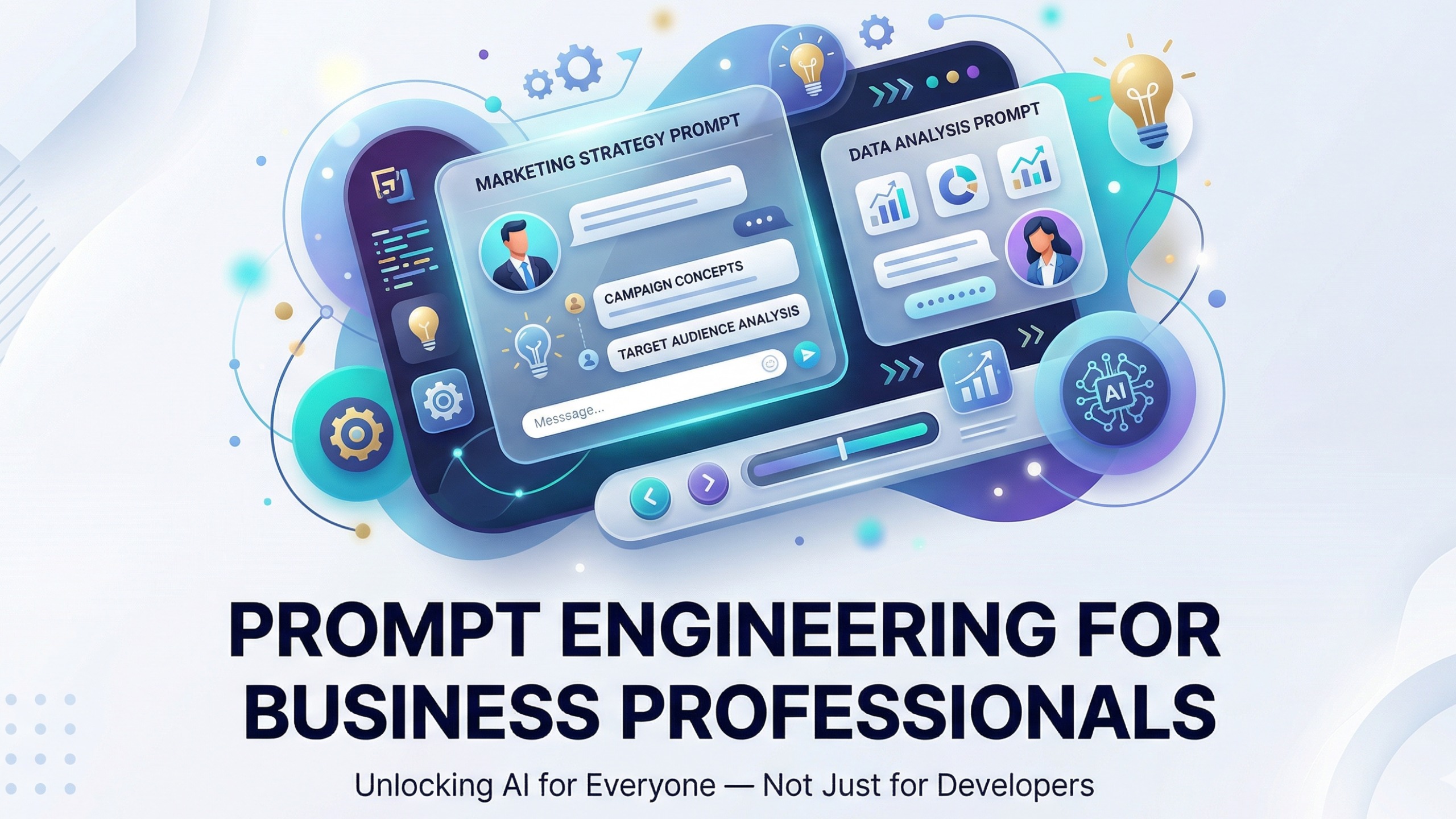
Prompt Engineering for Business Professionals — Not Just for Developers
Contents
- Why Most Professionals Get Mediocre AI Results (And What's Actually Wrong)
- The Three Frameworks Every Business Professional Needs
- Framework 1: The R-O-S-E Method — The Four-Element Prompt
- Framework 2: The Context Window Strategy — Feed the AI Your World
- Framework 3: Iterative Refinement — The Sandwich Method
- High-ROI Use Cases: Where Prompt Engineering Pays Back Immediately
- Marketing: Three Months of Content Strategy in 30 Minutes
- Sales: Hyper-Personalised Outreach at Scale
- Operations: SOPs and Performance Reviews in Minutes
- The Mumbai Competitive Edge: Why BKC and Lower Parel Professionals Are Moving Fast
- Prompt Engineering for Business Professionals: Your Next Step
Here is a myth worth dismantling immediately: prompt engineering is a technical skill for developers.
It is not. And the professionals who have internalised this most clearly — the marketing directors in Lower Parel who are producing three months of content strategy in an afternoon, the sales leads in BKC who are crafting personalised outreach at a scale that would have required a team of five, the operations managers in Andheri who are turning three hours of SOP writing into twenty minutes — none of them write code. They write clear instructions.
Prompt engineering for business professionals is, at its core, a communication skill. Specifically, it is the ability to give clear, contextual, well-structured instructions to a digital system that is extraordinarily capable when directed well and frustratingly vague when directed poorly. The professionals who get transformative results from AI tools are not the ones with the most technical knowledge. They are the ones who communicate most precisely.
This guide gives you the frameworks, the workflows, and the Mumbai-specific context to become one of them — starting today, without learning a line of code.
Why Most Professionals Get Mediocre AI Results (And What's Actually Wrong)
Before the frameworks, the diagnosis.
The most common way professionals use AI tools like ChatGPT is what could be called the vending machine approach: insert a request, receive an output, accept whatever comes out. The output is often adequate. It is rarely excellent. And after a few weeks of adequate outputs, many professionals conclude that AI is useful for simple tasks but not sophisticated enough for their real work.
The problem is not the tool. The problem is the instruction.
Consider the difference between these two requests to the same AI:
Version 1 (typical): "Write a LinkedIn post about our new product launch."
Version 2 (engineered): "You are the Head of Content for a Series B Fintech startup in Mumbai that has just launched an AI-powered expense management tool for mid-size Indian businesses. Write a LinkedIn post for our CEO announcing the launch. Tone: authoritative but conversational, no corporate jargon. Target audience: CFOs and Finance Managers at companies with 100–500 employees. Key message: this tool saves finance teams 8 hours per week on month-end reconciliation. Include one specific feature, one outcome metric, and a question to drive comments. Length: 150–180 words. End with a clear CTA to visit our website."
Both requests take the same 30 seconds to type. The second produces a post that is ready to review and likely ready to publish. The first produces something generic that requires significant rework — or prompts the professional to conclude that "AI can't write LinkedIn posts."
The difference between those two requests is prompt engineering. And it is entirely learnable.
The Three Frameworks Every Business Professional Needs
Framework 1: The R-O-S-E Method — The Four-Element Prompt
The R-O-S-E framework gives every prompt a complete structure: Role, Objective, Steps, Execution.
Each element serves a specific purpose in anchoring the AI's response to your actual needs.
Role — Give the AI a professional identity.
The Role tells the AI which domain of expertise to draw from and which communication style to adopt. This is the single most impactful improvement most professionals can make to their prompts.
Instead of: "Summarise this financial report." Use: "You are a CFO advisor preparing an executive briefing. Summarise this financial report."
The Role changes the frame of reference entirely. An AI with no role defaults to being a generic assistant. An AI with a defined professional Role brings the assumptions, priorities, and communication style of that professional to the output.
Business Role examples that work well:
- "You are a B2B sales strategist with expertise in enterprise SaaS"
- "You are an experienced HR Business Partner at a 500-person company"
- "You are a marketing director who specialises in content strategy for financial services"
- "You are an operations consultant who builds scalable processes for high-growth startups"
Objective — State the goal, not just the task.
The Objective tells the AI what success looks like — not just what to produce, but why it is being produced and for whom.
Instead of: "Write a proposal." Use: "Write a proposal that will convince a risk-averse CFO to approve a ₹15L software investment by demonstrating ROI within 12 months."
The Objective is the difference between an output that technically fulfils the request and one that is calibrated to achieve the actual business goal.
Steps — Break complex tasks into explicit sub-tasks.
For anything more complex than a simple request, list the steps you want the AI to take. This prevents the AI from making assumptions about what to include and what to omit — assumptions that often produce an output that is technically complete but structurally wrong for your purpose.
Instead of: "Help me prepare for this difficult client conversation." Use: "For this client conversation: (1) Identify the client's likely emotional state and concerns based on the context I provide. (2) Draft three opening statements that acknowledge their frustration without admitting fault. (3) List the five questions I should be prepared to answer. (4) Suggest a resolution framework that protects the relationship while maintaining our terms."
Execution — Specify the format and constraints.
The Execution element defines exactly how the output should be structured: length, format (table, bullets, prose), tone, what to include, and critically, what to exclude.
"Present the output as a one-page executive summary with bullet points. Use plain language — no jargon. Maximum 300 words. Do not include background information I already know — only include the analysis and recommendations."
R-O-S-E in action — Full example:
Role: You are a seasoned B2B marketing strategist specialising in the Indian SaaS market. Objective: Create a 90-day content strategy that generates qualified leads for a HR tech startup targeting CHROs at Indian companies with 200–2,000 employees. Steps: (1) Identify the top 5 pain points of our target buyer. (2) Map one content theme per pain point. (3) Suggest specific content formats for each theme (blog post, LinkedIn article, case study, etc.). (4) Propose a publishing cadence. (5) Identify 3 distribution channels beyond organic social. Execution: Present as a structured table. Include a 'Why this works' rationale column for each theme. Keep the entire output under 600 words.
The output from this prompt is a usable starting point for a real content strategy — not a generic blog post about content marketing.
Framework 2: The Context Window Strategy — Feed the AI Your World
The most common reason AI outputs feel generic is that the AI does not know enough about your specific context to produce something non-generic. It knows the world generally. It does not know your company, your customers, your tone of voice, your competitive position, or the specific nuance of your situation — unless you tell it.
The Context Window Strategy is the practice of front-loading your prompts with the specific contextual information that makes general AI capability relevant to your particular problem.
The four layers of business context that change everything:
1. Company and role context: "I am the Head of Sales at a Mumbai-based B2B SaaS company. We sell workforce management software to mid-size manufacturing companies in Maharashtra and Gujarat. Our average deal size is ₹8L/year. We have a 6-person sales team and a 3-month average sales cycle."
2. Audience context: "My target audience is Plant Managers and HR Directors at manufacturing companies with 500–2,000 employees. They are typically practical, cost-conscious, and sceptical of technology claims. They respond to concrete ROI evidence, peer references, and demonstrations of operational simplicity."
3. Tone and voice context: "Our company tone is: professional but not formal, clear over clever, confident without being aggressive. We avoid buzzwords. We speak plainly about business results. We never use the word 'synergy' or 'leverage' as a verb."
4. Constraint context: "This content will be published on LinkedIn and will be read primarily on mobile. Maximum 1,200 characters. Must include one call to action that directs to a case study, not our homepage."
When you provide all four layers before stating your actual request, the output shifts from "generically useful" to "specifically actionable." The AI is no longer filling in context gaps with assumptions — it is working from the same information frame you have.
Build a Context Library: The most efficient way to use the Context Window Strategy is to write your standard context blocks once, save them, and paste them at the start of any prompt that requires your company's specific voice and situation. A 200-word company context block that you reuse across every marketing prompt eliminates the need to re-explain your world in every session.
Framework 3: Iterative Refinement — The Sandwich Method
Even with an excellent R-O-S-E prompt and full context, the first output from an AI is rarely the final output. The professionals who get the best results are not the ones who write the perfect single prompt — they are the ones who iterate effectively.
The Sandwich Method is a structured approach to giving AI refinement feedback that produces improvement consistently rather than accidentally.
The sandwich: Acknowledge what works → Specify what to change → Re-state the standard.
Without the Sandwich (what most people do): "This is too formal. Make it more casual."
Result: The AI removes formality but often over-corrects or loses other qualities that were working.
With the Sandwich: "The structure and the key points are exactly right — keep those. [Acknowledge] The tone is too formal for our audience — replace corporate phrases like 'facilitating operational efficiencies' with plain language like 'helping your team work faster.' [Specify] The overall output should still feel professional and credible — just written in the way a knowledgeable colleague would talk, not the way a consultant's report reads. [Re-state standard]"
Result: The AI preserves what was working, changes precisely what you specified, and maintains the quality bar you defined.
Three Sandwich refinements that solve the most common business output problems:
For tone issues: "The content and structure are good. The tone is [too formal / too casual / too salesy / too hedged]. Keep the structure but rewrite in a tone that feels [specific description of target tone]. The goal is still [restate the objective]."
For length issues: "The key insights are correct. This is [too long / too short] for the context — cut to [X words] by removing [the background context / the examples / the caveats] while keeping [the specific elements that must stay]. The final piece should still [restate what it needs to accomplish]."
For focus issues: "The writing quality is good. The content drifts from the main point too much. Keep only the content that directly serves [specific objective]. Remove anything that is generally true but not specifically relevant to [your audience / situation / goal]. The piece should read as if written by someone who has only one job: to convince [specific reader] to [specific action]."
High-ROI Use Cases: Where Prompt Engineering Pays Back Immediately
Marketing: Three Months of Content Strategy in 30 Minutes
The traditional content strategy process: a half-day workshop with the marketing team, a week of research, three drafts of a strategy document, and four rounds of review. The result: a strategy that was relevant when you started it and is slightly outdated by the time it's approved.
The prompt-engineered equivalent:
Step 1 — Generate the audience pain map (5 minutes):
"[Company context]. You are our Head of Content. List the top 8 pain points of our target buyer — [buyer description]. For each pain point: describe it in one sentence, rate its urgency (1–10), and suggest one piece of content that addresses it directly."
Step 2 — Build the content calendar (10 minutes):
"Using the pain map above, create a 90-day content calendar. Include: 12 LinkedIn posts, 6 blog posts, 2 case study outlines, and 4 email newsletter topics. Map each piece of content to one pain point. Include a proposed title or headline for each piece. Present as a calendar table with week numbers."
Step 3 — Generate the first five pieces (15 minutes):
"Write the first 3 LinkedIn posts from the calendar above. Use [tone context]. Include one specific data point, one clear takeaway, and one question that drives comments."
In 30 minutes, you have a complete 90-day content strategy and the first three pieces written and ready for review. A process that previously required a week and multiple stakeholders now requires one person and one session.
Sales: Hyper-Personalised Outreach at Scale
Generic cold outreach converts at 1–3%. Personalised outreach — messages that reference the prospect's specific situation, recent company news, or relevant pain points — converts at 3–8x that rate. The problem has always been time: genuine personalisation is slow.
Prompt engineering collapses that trade-off.
The LinkedIn-to-Outreach workflow:
- Collect the prospect's LinkedIn profile data (copy the relevant sections of their profile)
- Find one recent company news item (a funding announcement, a product launch, a public statement from their CEO)
- Run this prompt:
"You are a B2B sales strategist. Write a personalised cold outreach email to the following prospect: Name: [Name], Title: [Title], Company: [Company] From their LinkedIn: [paste key career context and recent activity] Recent company news: [paste the news item] We are reaching out because: [your specific reason for relevance — what problem of theirs do you solve?] Our product helps [their job function] at [company type] to [specific outcome in their language]. Email constraints: Maximum 120 words. Do not pitch the product in the first email — open a conversation. Do not use clichés. End with a single specific question that is easy to answer. Do not use 'hope this email finds you well' or similar. Tone: Respectful, peer-level, brief."
The output is a genuinely personalised message that references real context about this specific prospect — not a mail-merge template with a name field. At scale, this workflow transforms outreach from a volume game into a quality game.
Operations: SOPs and Performance Reviews in Minutes
Standard Operating Procedures are the documents that keep operations running consistently — and they are almost universally out of date, incomplete, or nonexistent, because writing them is time-consuming and falls at the bottom of every manager's priority list.
"You are an Operations Manager writing a standard operating procedure for our team. Process to document: [describe the process in plain notes — rough bullet points are fine]. The team following this SOP has [experience level] and is based in [location]. Include: Process owner | Step-by-step instructions | Decision points (if X, then Y) | Common errors and how to avoid them | Success criteria. Format as a numbered steps document with clear section headers."
Performance Reviews are another documentation task that consumes disproportionate management time and produces inconsistent outputs when done manually.
"You are an experienced people manager writing a mid-year performance review. Employee context: [role, tenure, key responsibilities]. Achievements this period: [your bullet-point notes on what they delivered]. Areas for development: [your notes]. Overall assessment: [your rating and rationale]. Write a balanced, specific, constructive review of 350–400 words. Avoid vague praise and vague criticism — every point should reference a specific behaviour or outcome. Tone: professional, direct, developmental."
The output is a complete draft that a manager reviews, refines for personal accuracy, and sends. What previously took 90 minutes takes 15.
The Mumbai Competitive Edge: Why BKC and Lower Parel Professionals Are Moving Fast
Mumbai's business culture is, by Indian standards, fast. The pace at which BKC's financial services firms make decisions, the cadence at which Lower Parel's media and marketing companies turn around client deliverables, and the expectations of responsiveness at Andheri's startup belt — these are environments where the professional who can produce quality work faster has a concrete, observable advantage over the one who cannot.
The professionals in these corridors who have built prompt engineering fluency are not just doing their existing work faster — they are taking on a scope of work that was previously beyond the capacity of one person. Marketing leads who can generate and manage content at the volume of a team of three. Operations managers who can document, analyse, and optimise processes without a dedicated ops analyst. Sales leads who can personalise outreach at a volume that previously required a sales development team.
This capacity expansion, in a city where headcount growth is constrained and workloads are not, is a genuine competitive advantage — for individuals who want to advance, for companies that want to scale efficiently, and for the teams that build a reputation for producing more than everyone thought one person could.
| Aspect | Generic Prompt | Business-Engineered Prompt |
|---|---|---|
| Clarity | Vague, broad instructions | Specific, structured, outcome-driven |
| Context Provided | Little to no business context | Includes business goal, audience, constraints |
| Output Quality | Generic, surface-level response | Deep, relevant, actionable insights |
| Consistency | Inconsistent results | Repeatable and reliable outputs |
| Use Case Fit | General exploration | Tailored for real business problems |
| Example Prompt | “Analyze this data” | “Analyze this sales dataset to identify top 3 revenue drivers for Q1, highlight trends, and suggest actionable strategies to improve conversion by 15%” |
| Time Efficiency | Requires multiple retries | Faster results with fewer iterations |
| Business Impact | Low | High — directly usable in decision-making |
The 5-Element Business Prompt Checklist:
☐ Role defined: Have you given the AI a specific professional identity relevant to the task?
☐ Objective stated: Have you described not just what to produce, but why it needs to achieve a specific goal for a specific audience?
☐ Context provided: Have you given the AI your company context, audience context, and tone of voice?
☐ Steps specified: For complex tasks, have you listed the sub-tasks in the order you want them executed?
☐ Output format defined: Have you specified the format (table / bullets / prose), length, and any explicit exclusions?
A prompt that passes all five checks produces a qualitatively different output than one that passes two or three. Build this checklist into your workflow for any prompt that matters.
Prompt Engineering for Business Professionals: Your Next Step
Reading these frameworks converts them to knowledge. Using them on your actual work converts them to capability. And capability — specifically, the capability to produce consistently high-quality AI-assisted outputs that your colleagues cannot — is what converts prompt engineering from an interesting skill into a career differentiator.
The gap between knowing these frameworks and being genuinely fluent with them is closed through practice and feedback. It is closed faster with a structured environment, a cohort of peers, and an expert facilitator who can review your outputs and tell you specifically what to improve.
TechPaathshala's AI for Business Leadership Workshop is a hands-on, practical session designed for exactly this audience: managers, entrepreneurs, and business professionals in Mumbai who want to move from AI-awareness to AI-fluency.
In the workshop, you will:
- Build your personal prompt library using the R-O-S-E framework — a working set of reusable prompts for the business tasks that consume the most of your time
- Practice the Context Window Strategy with your own company and audience context — walking away with a ready-to-use context block for every major output type your role requires
- Work through the high-ROI use cases live — content strategy generation, sales outreach, SOP writing, and performance documentation — using your actual work, not generic examples
- Develop your Sandwich Method feedback vocabulary — the specific language patterns that produce consistent improvement from AI refinement rather than random variation
- Benchmark your prompts against peers — a structured peer-review exercise where workshop participants review each other's prompts and outputs, building the critical evaluation instinct that makes the skill compound over time
The workshop is for business professionals, not developers. No coding, no technical prerequisites. Just clear communication applied to the AI tools you already have.
👉 Register for TechPaathshala's AI for Business Leadership Workshop — and build the prompting fluency that turns AI from an interesting experiment into a daily competitive advantage.
TechPaathshala is a Mumbai-based technology education platform serving professionals and developers across every stage of their AI learning journey — from business prompt engineering to Full Stack AI development.

You Might Also Like