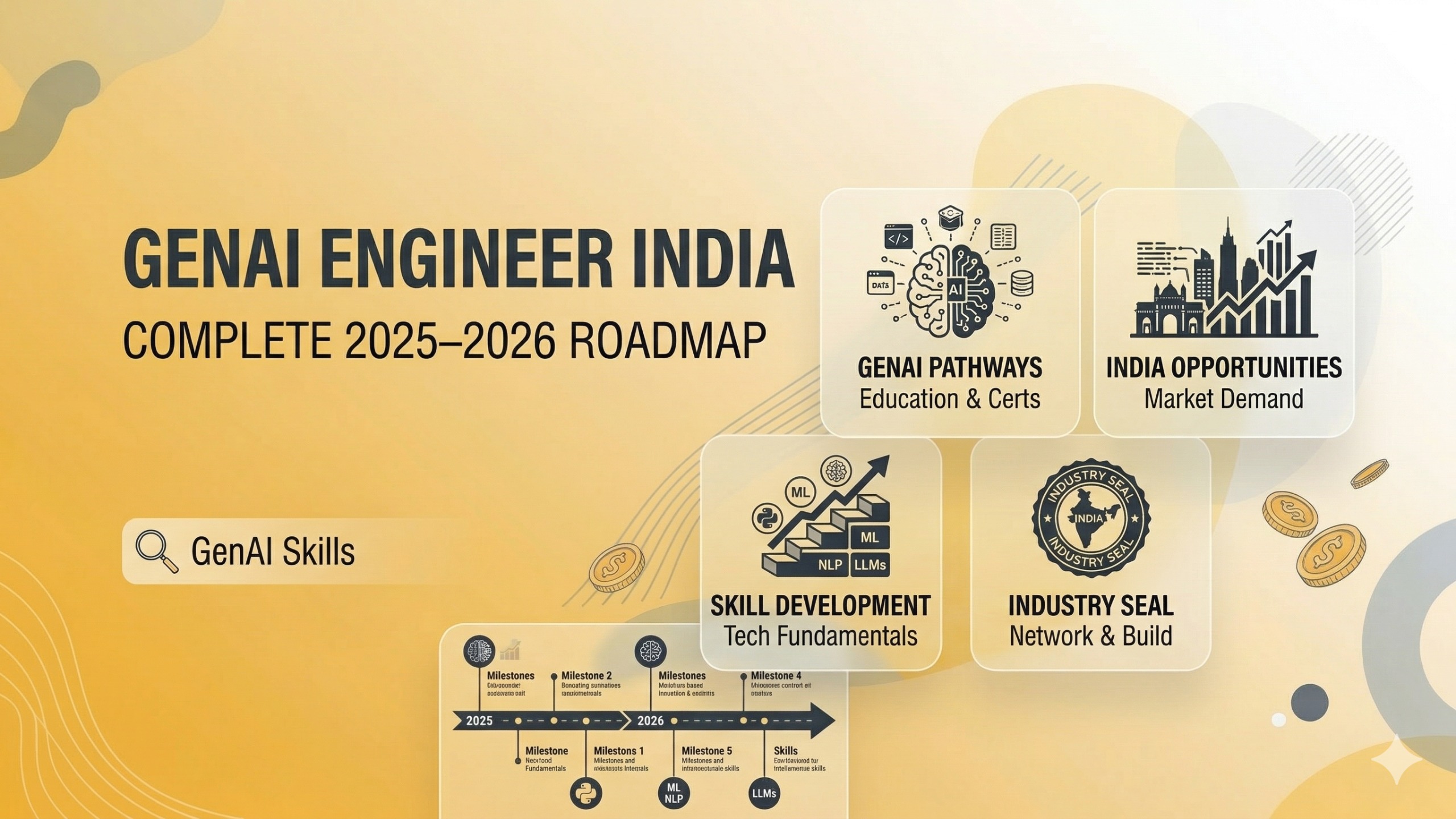
How to Become a GenAI Engineer in India — The Complete 2025–2026 Roadmap
Contents
- The State of GenAI Jobs in India in 2025–2026
- The Demand Landscape by City
- What Companies Are Actually Hiring For
- How to Become a GenAI Engineer in India 2025: The Three-Phase Roadmap
- Phase 1: The AI-First Tech Stack — Building the Foundation (Months 1–3)
- Step 1.1: Master Python — The Language of AI
- Step 1.2: API Orchestration — Working with OpenAI, Anthropic, and Google Gemini
- Step 1.3: Vector Databases — The Memory Layer of AI Applications
- Phase 2: RAG and Agentic Workflows — The Core of the GenAI Engineer Role (Months 3–7)
- Step 2.1: Retrieval-Augmented Generation (RAG) — The Most In-Demand Skill in 2026
- Step 2.2: LangChain and LlamaIndex — The Orchestration Frameworks
- Step 2.3: Building AI Agents — Autonomous Systems That Act
- Phase 3: Deployment and MLOps — Putting AI in Production (Months 7–10)
- Step 3.1: Deployment — Making AI Applications Production-Ready
- Step 3.2: LLM Evaluation Frameworks — Ensuring AI Doesn't Hallucinate in Production
- The Portfolio: 3 Projects That Get You Hired in India's GenAI Market
- Portfolio Project 1: Private Document GPT for Law Firms or Finance Companies
- Portfolio Project 2: AI Customer Support Agent for E-Commerce
- Portfolio Project 3: Multi-Agent Research Assistant for Indian Financial Markets
- The 12-Month Timeline: Where to Focus Each Month
- The AI Salary India Reality: What the Numbers Look Like in Practice
- Frequently Asked Questions
- Do I need a Machine Learning background to become a GenAI engineer?
- Is Python mandatory, or can I use JavaScript for GenAI development?
- How important is a degree for GenAI engineering roles in India?
- Which city in India has the most GenAI jobs?
- From Coder to AI Engineer in 6 Months — With the Right Support
If you want to know how to become a GenAI engineer in India 2025, start with the salary data — because it tells you everything about where the market is heading and why this is the highest-leverage career decision a developer or data scientist can make right now.
Entry-level GenAI engineers in India are commanding starting packages of ₹14–22 LPA at product companies and AI-first startups. That is 30–50% above what a traditional Full Stack developer with equivalent experience earns at the same tier of company. At the mid-level (3–5 years), GenAI engineers with strong RAG and agentic workflow experience are earning ₹28–45 LPA. Senior roles — AI architects, lead engineers on LLM product teams — are clearing ₹60–90 LPA at well-funded AI companies and the India offices of global tech firms.
These are not outlier numbers from a handful of unicorns. They are consistent market rates across Bengaluru's Koramangala and Whitefield corridors, Mumbai's BKC and Powai tech clusters, and Hyderabad's HITEC City — the three cities that collectively account for the overwhelming majority of India's GenAI hiring activity in 2025–2026.
The reason for the premium is simple: genuine demand vastly outpaces supply. Every company that uses software — which is every company — is now evaluating, building, or deploying AI-powered features. The engineers who can build those features are not a commodity. They are a constraint. And India's talent market is paying accordingly to attract and retain the ones that exist.
This roadmap is the clearest, most actionable guide available to closing that supply gap from your side — moving from where you are now to a GenAI engineering role at an Indian company that is building the AI products and features that will define the next decade of software.

The State of GenAI Jobs in India in 2025–2026
Before the technical roadmap, the market context — because understanding what companies are hiring for shapes every decision about what to learn and in what order.
The Demand Landscape by City
Bengaluru remains India's GenAI hiring epicentre. The concentration of global tech firms (Google, Microsoft, Amazon, Flipkart, Swiggy, Zepto), AI-first startups (Sarvam AI, Krutrim, Unify AI), and enterprise tech companies in Koramangala, Indiranagar, and Whitefield creates the highest density of GenAI roles in the country. The profiles in demand: LLM application developers, RAG pipeline engineers, AI product engineers, and ML platform engineers who can bridge model capabilities and production systems.
Mumbai is the GenAI hub for Fintech and enterprise AI. The city's concentration of financial services companies, insurance technology firms, and SaaS companies in BKC, Powai, and Lower Parel is generating specific demand for GenAI engineers who understand financial data — document intelligence for banking, compliance automation for SEBI-regulated entities, and AI-powered customer service for banking and insurance clients. Mumbai's GenAI roles tend to pay a domain knowledge premium on top of the base AI engineering rate.
Hyderabad is the enterprise AI hub — driven by the presence of Microsoft's India R&D centre, Amazon's Hyderabad campus, Google's HITEC City operations, and a large cluster of enterprise software companies. HITEC City and Gachibowli generate consistent GenAI hiring across AI infrastructure, model fine-tuning, and enterprise application development.
What Companies Are Actually Hiring For
The job titles that are generating the most GenAI hiring in India in 2025–2026 are worth mapping specifically, because they clarify which skills are actually in demand versus which skills are preparatory:
- LLM Application Developer / AI Application Engineer: Building production applications that use LLM APIs (OpenAI, Anthropic, Gemini) as their intelligence layer. The dominant profile across all three cities. Skills: Python, API integration, prompt engineering, RAG pipelines, vector databases, production deployment.
- RAG Pipeline Engineer: Specialised in building and optimising Retrieval-Augmented Generation systems — the architecture that enables AI applications to answer questions about proprietary data. The single most specifically requested skill in India's GenAI job market as of 2025–2026.
- AI Agent Developer: Building autonomous AI systems that use tools, navigate decision trees, and accomplish multi-step tasks without human intervention at each step. Emerging role in 2025, expected to be mainstream by 2026.
- MLOps / AI Platform Engineer: Deploying, monitoring, and maintaining AI systems in production — ensuring models perform reliably, detecting degradation, managing infrastructure costs. Bridges software engineering and AI engineering.
- AI Product Engineer: Full Stack developers who have added LLM integration to their skill set and can own AI features end-to-end — from the RAG pipeline through the React UI. The highest-demand profile at early-to-mid stage AI startups.
Understanding these profiles tells you something important about this roadmap: you do not need to become a machine learning researcher to get a GenAI engineering job in India. The dominant demand is for engineers who can build with AI — integrating LLM APIs, designing RAG architectures, deploying agentic systems — not for engineers who build the AI models themselves. This is an engineering role, not a research role. And it is a role that a strong software developer can reach with a focused 10–12 month upskilling program.
| Dimension | Traditional Full Stack Developer | GenAI Engineer |
|---|---|---|
| Primary Language | JavaScript / TypeScript (+ backend language) | Python (primary) + JavaScript for UI |
| Backend Paradigm | REST APIs, CRUD operations, database queries | LLM API orchestration, prompt pipelines, vector search |
| Data Layer | SQL / NoSQL databases (PostgreSQL, MongoDB) | SQL / NoSQL + Vector databases (Pinecone, ChromaDB, pgvector) |
| Core Architecture Pattern | MVC, microservices, serverless | RAG pipelines, agentic workflows, tool-using systems |
| Deployment Target | EC2, ECS, Vercel, Netlify | AWS Bedrock, Hugging Face Spaces, Modal, Railway |
| Testing Focus | Unit tests, integration tests, E2E tests | LLM evaluation frameworks, hallucination detection, output quality scoring |
| Key Libraries/Frameworks | React, Next.js, Express, Spring Boot | LangChain, LlamaIndex, Pydantic, FastAPI, Hugging Face Transformers |
| Monitoring | Error rates, latency, uptime | Output quality, hallucination rate, cost per query, retrieval precision |
| Starting Salary in India (2025) | ₹6–12 LPA (fresher to 2 years) | ₹14–22 LPA (fresher to 2 years) |
| 3–5 Year Salary Range | ₹15–28 LPA | ₹28–45 LPA |
| Scarcity | Moderate (large supply) | High (demand significantly exceeds supply) |
How to Become a GenAI Engineer in India 2025: The Three-Phase Roadmap
This roadmap is structured for a developer or final-year student who has basic programming experience. If you already have Python and some software development background, Phase 1 will move quickly. If you're coming from a non-Python stack (Java, JavaScript), budget 6–8 weeks for Python proficiency before the AI-specific phases begin.
Total timeline: 10–14 months to a junior GenAI engineer role. Accelerated timeline: 6–8 months with full-time focus and structured mentorship.
Phase 1: The AI-First Tech Stack — Building the Foundation (Months 1–3)
Phase 1 is about establishing the technical foundation that every subsequent AI skill is built on. This is not optional background — it is the infrastructure that determines how quickly you can learn everything in Phases 2 and 3, and how well you perform in GenAI engineering interviews.
Step 1.1: Master Python — The Language of AI
Python is not the most elegant language, and it is not the fastest. It is, however, the undisputed language of AI — with a library ecosystem that is so dominant in machine learning, data processing, and LLM orchestration that working in another language for AI development is a deliberate handicap.
What to learn, and what to prioritise:
Core Python proficiency (3–4 weeks if starting from another language, 1–2 weeks if Python-familiar):
- Variables, data types, functions, loops, conditionals — the basics. If you already know JavaScript or Java, this takes days, not weeks.
- List comprehensions and generators — Python-idiomatic patterns used constantly in data processing and AI code. Master these early; you will use them in every AI pipeline you write.
- Exception handling and context managers — AI code fails in specific ways (API timeouts, rate limits, malformed model outputs). Robust error handling is not optional in production AI systems.
- File I/O and pathlib — reading and writing text files, JSON, and CSVs is a daily task in AI engineering (loading documents, saving embeddings, processing datasets).
- The
requestslibrary andhttpx— making HTTP requests to external APIs. The foundation of all LLM API integration. jsonandpydantic— JSON parsing is how LLM API responses arrive; Pydantic is how you validate and structure those responses in production code. Pydantic is one of the most important libraries in the GenAI engineering stack.
Intermediate Python for AI (2–3 weeks):
- Classes and object-oriented programming — LangChain and LlamaIndex are class-heavy frameworks; understanding OOP is required to extend and customise them effectively.
- Decorators and closures — used extensively in FastAPI (the standard API framework for AI applications) and in many AI orchestration patterns.
- Async Python (
asyncio,async/await) — LLM API calls are I/O-bound and benefit enormously from async execution. Most production AI applications use async for concurrent API calls, and fluency here is a strong differentiator in interviews. - Type hints — Modern Python AI code is heavily typed. Fluency with type annotations (
str,list[str],Optional[str],dict[str, Any]) makes your code readable and compatible with the tooling the ecosystem expects.
The essential AI-adjacent Python libraries:
- NumPy — array operations, the mathematical foundation under most AI libraries. You do not need to be a NumPy expert, but you need to understand arrays, shapes, and basic operations.
- Pandas — data manipulation and analysis. Crucial for data preprocessing tasks that precede most AI pipelines.
- FastAPI — the dominant framework for building Python API servers. Every AI application you build will need an API layer; FastAPI is the standard choice in 2025–2026 for its performance, automatic documentation, and native Pydantic integration.
Practice recommendation: Build a data pipeline that reads a CSV of financial transactions, cleans the data, performs basic aggregations with Pandas, and exposes the results via a FastAPI endpoint. This single project covers 80% of the Python skills you need before moving to AI-specific work.
Step 1.2: API Orchestration — Working with OpenAI, Anthropic, and Google Gemini
API orchestration is the core technical skill of the LLM Application Developer profile — the art of calling language model APIs reliably, structuring the inputs correctly, parsing the outputs consistently, and handling the failure modes that real production traffic exposes.
Setting up your API access:
- OpenAI API (GPT-4o, GPT-4o-mini):
pip install openai— the most widely used API in the Indian GenAI job market - Anthropic API (Claude Opus 4.6, Claude Sonnet 4.6, Claude Haiku 4.5):
pip install anthropic— Claude's strong reasoning and large context window make it the API of choice for document-heavy use cases - Google Gemini API:
pip install google-generativeai— particularly relevant for companies with Google Workspace integration needs and multimodal (text + image) use cases
What to learn about each API:
- The messages array architecture — how system prompts, user messages, and assistant messages are structured in a conversation. This is the mental model that all LLM APIs share, with minor variations.
temperatureandmax_tokens— the two parameters you will tune most frequently.temperature=0for deterministic outputs (data extraction, classification);temperature=0.7–0.9for creative generation.max_tokenscontrols response length and directly controls API cost.- Streaming responses — receiving model output token-by-token rather than waiting for the complete response. Essential for chat interfaces and long-form generation where user-perceived latency matters.
- Function calling / Tool use — the mechanism by which you define structured functions that the model can "call" by filling in their parameters. This is the foundation of agentic AI: the model decides when to call a tool and what arguments to pass. This skill alone opens the door to the AI Agent Developer profile.
- Structured output / JSON mode — forcing the model to return valid JSON conforming to a schema you define. Critical for production AI features where the output must be machine-parseable, not human-readable prose.
- Rate limiting and retry logic — production LLM API integrations hit rate limits. Implement exponential backoff with the
tenacitylibrary; understand token-per-minute and request-per-minute limits for each API tier. - Cost management — understand how tokens translate to cost for each model tier. The difference between GPT-4o and GPT-4o-mini is a 20x cost differential for many tasks. Choosing the right model for each task in your application is an engineering discipline, not an afterthought.
Practice exercise: Build a Python script that takes a PDF document, extracts the text, sends it to three different LLM APIs with identical prompts, compares the outputs, and returns a consolidated summary. This exercise builds familiarity with multiple APIs simultaneously and surfaces the practical differences between them.
Step 1.3: Vector Databases — The Memory Layer of AI Applications
Vector databases are the infrastructure that makes AI applications capable of working with your own data — documents, knowledge bases, product catalogues, conversation histories — at scale. They are the component that transforms a general-purpose LLM into a domain-specific AI system.
The concept you must understand deeply:
Text (and images, and audio) can be converted into numerical vectors — arrays of floating-point numbers — that represent the semantic meaning of the content. Two pieces of text with similar meaning will have similar vectors, even if they share no words in common. "The agreement was signed on the first of January" and "The contract was executed on January 1st" produce vectors that are very close together in vector space.
Vector databases store these vectors and enable a specific type of query: semantic search — "find the 5 chunks of text in this database that are most semantically similar to this query." This is the retrieval mechanism that powers RAG (Phase 2).
The vector databases to learn:
Pinecone is the most widely deployed managed vector database in India's AI job market. It is cloud-hosted (no infrastructure management), scales from prototype to production without architectural changes, and has a generous free tier. Most GenAI job descriptions that mention a vector database mention Pinecone specifically.
import pinecone
from pinecone import Pinecone, ServerlessSpec

pc = Pinecone(api_key="your-api-key")
pc.create_index(
    name="document-store",
    dimension=1536,  # OpenAI text-embedding-3-small dimension
    metric="cosine",
    spec=ServerlessSpec(cloud="aws", region="us-east-1")
)
index = pc.Index("document-store")

# Upsert vectors
index.upsert(vectors=[
    {"id": "doc-001", "values": embedding_vector, "metadata": {"source": "contract.pdf", "page": 1}}
])

# Query for similar vectors
results = index.query(vector=query_embedding, top_k=5, include_metadata=True)
ChromaDB is the open-source, locally-runnable vector database that is the standard choice for development and prototyping. It runs in-memory or persists to a local folder — no API keys, no cloud account, no cost. ChromaDB is how you build and test RAG systems locally before connecting to a production vector database.
import chromadb

client = chromadb.PersistentClient(path="./chroma_db")
collection = client.create_collection("documents")

# Add documents (ChromaDB handles embedding if you provide an embedding function)
collection.add(
    documents=["text chunk 1", "text chunk 2"],
    metadatas=[{"source": "file1.pdf"}, {"source": "file2.pdf"}],
    ids=["id1", "id2"]
)

# Query
results = collection.query(query_texts=["what does the contract say about payment?"], n_results=3)
pgvector (PostgreSQL extension) is the choice for companies that want vector search without adding a new database system — extending their existing PostgreSQL database with vector capabilities. Increasingly common in enterprise environments that have invested in PostgreSQL infrastructure. Knowing that pgvector exists and how to use it is a differentiator in enterprise-focused GenAI interviews.
The embedding models to know:
- OpenAI
text-embedding-3-small(1536 dimensions): The most widely used embedding model for production RAG systems in India. Excellent quality-to-cost ratio. - OpenAI
text-embedding-3-large(3072 dimensions): Higher quality, higher cost. Use when retrieval precision is critical. - Hugging Face sentence transformers (
all-MiniLM-L6-v2,BAAI/bge-m3): Open-source embedding models that run locally — zero API cost, suitable for sensitive document handling where data cannot leave your infrastructure. TheBAAI/bge-m3model in particular has strong multilingual performance including Hindi, relevant for Mumbai-based companies with Indian-language document processing needs.
Practice exercise: Take 50 pages of publicly available legal text or financial documentation, chunk it into 500-token segments, embed each chunk with OpenAI's embedding model, store in ChromaDB, and build a simple Python function that takes a question and returns the 3 most relevant chunks. This is the core component of every RAG system — understanding it deeply is essential before Phase 2.
Phase 2: RAG and Agentic Workflows — The Core of the GenAI Engineer Role (Months 3–7)
Phase 2 is where you develop the skills that appear in every GenAI job description in India in 2025–2026 — the skills that distinguish a GenAI engineer from a developer who has made a few API calls.
Step 2.1: Retrieval-Augmented Generation (RAG) — The Most In-Demand Skill in 2026
RAG is the architecture that solves the most important limitation of language models for enterprise use: LLMs know the world generally but don't know your business specifically. They don't know your company's policies, your client contracts, your product documentation, or your internal knowledge base — because that information was not in their training data.
RAG solves this by retrieving relevant information from your data sources at query time and providing it to the model as context in the prompt. The model responds based on the retrieved information, not on its training data. The result: an AI system that can accurately answer questions about your specific data, cite the sources of its answers, and update its knowledge as your data changes — without retraining the model.
The RAG architecture, fully deconstructed:
INDEXING PIPELINE (runs once, then incrementally)
═══════════════════════════════════════════════════
Documents (PDFs, Word files, web pages, databases)
    ↓
Document Loader (extract raw text)
    ↓
Text Splitter (chunk into manageable segments, ~500 tokens each)
    ↓
Embedding Model (convert each chunk to a vector)
    ↓
Vector Store (store vectors + metadata)

RETRIEVAL PIPELINE (runs on every user query)
═══════════════════════════════════════════════════
User Query
    ↓
Query Embedding (embed the query using the same model)
    ↓
Vector Store Similarity Search (find top-k most similar chunks)
    ↓
Retrieved Chunks (the raw text of the most relevant segments)
    ↓
Prompt Construction (system prompt + retrieved chunks + user query)
    ↓
LLM API Call (GPT-4o, Claude, Gemini)
    ↓
Response (grounded in retrieved context, with citations)
The critical engineering decisions in every RAG system:
Chunk size and overlap: How you split documents into chunks dramatically affects retrieval quality. Chunks that are too large retrieve irrelevant context along with the relevant part. Chunks that are too small lose the sentence context that gives meaning to individual facts. The standard starting point: 512–1024 tokens per chunk, with 50–100 token overlap between adjacent chunks. Testing different strategies against a representative query set is one of the first optimisation tasks in any RAG project.
Retrieval strategy: Basic similarity search (top-k nearest vectors) is the starting point. For production systems, you will encounter: hybrid search (combining vector similarity with traditional keyword search for better precision), re-ranking (using a cross-encoder model to re-rank the top-k retrieved chunks based on relevance to the specific query — dramatically improves precision), and parent document retrieval (indexing small chunks for precise retrieval but returning larger parent segments for richer context).
Context window management: The retrieved chunks and the user's query must fit within the model's context window. For long documents with many relevant chunks, you may need to prioritise or compress the retrieved context. Understanding how to manage this constraint is an engineering skill that separates junior from senior RAG engineers.
Hallucination prevention in RAG: RAG-grounded models still hallucinate when they cannot find the answer in the retrieved context. Implement: citation requirements (the model must quote the specific text passage that supports each claim), confidence signalling ("I don't have enough information in the provided documents to answer this question"), and output validation that checks whether the model's answer is supported by the retrieved chunks.
Step 2.2: LangChain and LlamaIndex — The Orchestration Frameworks
LangChain is the most widely adopted LLM orchestration framework in the world. It provides abstractions for chaining LLM calls, integrating tools, managing memory, building agents, and constructing complex AI workflows — so you are building on battle-tested components rather than writing orchestration logic from scratch.
Core LangChain concepts every GenAI engineer must know:
- Document Loaders: Pre-built connectors for loading documents from dozens of sources — PDF, Word, HTML, Confluence, Notion, Google Drive, S3 buckets, SQL databases. Understanding the full catalogue tells you what RAG systems can be built against without writing custom ingestion code.
- Text Splitters: The
RecursiveCharacterTextSplitteris the standard; understand itschunk_sizeandchunk_overlapparameters and why they matter for retrieval quality. - Vector Store integrations: LangChain wraps Pinecone, ChromaDB, pgvector, Weaviate, and a dozen other vector databases in a consistent interface — swapping between them requires changing one line of code.
- Retrieval chains: Pre-built patterns for the retrieve → augment → generate pipeline.
RetrievalQAfor basic Q&A,ConversationalRetrievalChainfor multi-turn chat with memory. - LangChain Expression Language (LCEL): The declarative pipeline syntax introduced in LangChain 0.2+. Understanding LCEL is expected in 2025–2026 interviews at companies using modern LangChain.
- Memory:
ConversationBufferMemory,ConversationSummaryMemory— how to maintain conversation history across turns without blowing up your context window.
LlamaIndex is the framework optimised specifically for the data ingestion and retrieval layer of RAG systems. Where LangChain covers the entire LLM application stack broadly, LlamaIndex goes deeply into the retrieval architecture — offering more advanced indexing strategies, more sophisticated retrieval algorithms, and better tooling for complex document structures.
Core LlamaIndex concepts:
SimpleDirectoryReader: Load an entire folder of documents in one call. The fastest way to prototype a document Q&A system.VectorStoreIndex: The primary index type — processes documents, creates embeddings, stores in a vector database.QueryEngine: The interface that handles the query-retrieve-generate pipeline. One line from index to answer.RouterQueryEngine: Routes queries to different indices based on the query content — fundamental for multi-document RAG systems where different queries should search different document collections.- Sentence Window Retrieval and Hierarchical Node Parsing: LlamaIndex's advanced retrieval strategies that significantly improve retrieval precision for complex documents. Understanding these advanced strategies is a differentiator in senior GenAI engineering interviews.
When to use which: In practice, many production RAG systems use LlamaIndex for the indexing and retrieval layer and LangChain for the agent and chain orchestration layer. Knowing both, and knowing their complementary strengths, is the mark of an experienced GenAI engineer.
Step 2.3: Building AI Agents — Autonomous Systems That Act
AI agents are the frontier of GenAI engineering and the fastest-growing segment of India's AI job market. An AI agent is a system where a language model can decide which tools to use, in what order, based on the task it has been given — operating iteratively until the task is complete, without step-by-step human direction.
The conceptual shift from RAG to agents:
RAG is a retrieval system: ask a question, retrieve relevant context, generate an answer. Agents are action systems: given a goal, plan a sequence of steps, execute tools at each step, observe the results, and decide what to do next. The intelligence moves from "answer generation" to "task planning and execution."
The ReAct (Reasoning + Acting) pattern:
The dominant pattern for LLM agents is ReAct — the model alternates between reasoning (thinking about what to do next) and acting (using a tool). Each action produces an observation (the tool's output), which informs the next reasoning step.
User: "Find the best flight from Mumbai to Bengaluru on December 15th, under ₹5,000,
       and add it to my calendar if available."

Agent Thought: I need to search for flights first.
Agent Action: search_flights(origin="BOM", destination="BLR", date="2025-12-15", max_price=5000)
Observation: [{"flight": "IndiGo 6E-203", "price": 3850, "departure": "07:15", "arrival": "08:45"}]

Agent Thought: Found a flight under ₹5,000. Now I need to add it to the calendar.
Agent Action: create_calendar_event(title="Flight 6E-203 BOM→BLR", date="2025-12-15", time="07:15")
Observation: {"status": "success", "event_id": "cal-abc123"}

Agent Thought: Task complete. Flight found and calendar event created.
Agent Response: "Done! I found IndiGo 6E-203 at ₹3,850 (7:15 AM → 8:45 AM) and added it to your calendar."
Building agents in LangChain:
from langchain.agents import create_react_agent, AgentExecutor
from langchain.tools import tool
from langchain_openai import ChatOpenAI
from langchain import hub

# Define tools the agent can use
@tool
def search_documents(query: str) -> str:
    """Search the company knowledge base for relevant information."""
    results = vector_store.similarity_search(query, k=3)
    return "\n".join([doc.page_content for doc in results])

@tool
def create_jira_ticket(title: str, description: str, priority: str) -> str:
    """Create a new Jira ticket with the given details."""
    # Jira API integration
    return f"Ticket created: {title} (Priority: {priority})"

@tool
def send_email(to: str, subject: str, body: str) -> str:
    """Send an email to a specified recipient."""
    # Email API integration
    return f"Email sent to {to}"

# Create the agent
llm = ChatOpenAI(model="gpt-4o", temperature=0)
tools = [search_documents, create_jira_ticket, send_email]
prompt = hub.pull("hwchase17/react")
agent = create_react_agent(llm, tools, prompt)
agent_executor = AgentExecutor(agent=agent, tools=tools, verbose=True, max_iterations=10)

# Run the agent
result = agent_executor.invoke({
    "input": "Search our documentation for the refund policy, create a Jira ticket
               summarising the key points, and email it to the support team."
})
Multi-agent systems: The frontier of 2025–2026 GenAI engineering is multi-agent architectures — systems where multiple specialised agents collaborate, with one orchestrator agent delegating to specialist agents. LangGraph (LangChain's stateful agent framework) and CrewAI (the most popular multi-agent orchestration library in India's AI market) are the tools to know. Understanding these systems is what separates a GenAI engineer who builds simple tools from one who architects production AI systems.
Phase 3: Deployment and MLOps — Putting AI in Production (Months 7–10)
Phase 3 is where many self-taught GenAI engineers fall short — and where the professional value gap widens most sharply. Building a RAG system that works in a Jupyter notebook is a learning exercise. Deploying one that handles 10,000 queries per day, maintains consistent quality, manages API costs, and alerts you when hallucination rates increase is engineering.
Step 3.1: Deployment — Making AI Applications Production-Ready
Docker and containerisation:
Every production AI application runs in a container. The ability to write a proper Dockerfile for a Python AI application — including handling the large dependency size of ML libraries, managing environment variables securely, and building efficient layers — is a baseline expectation for any GenAI engineering role.
# Multi-stage build for a FastAPI + LangChain application
FROM python:3.11-slim as builder
WORKDIR /app
COPY requirements.txt .
RUN pip install --no-cache-dir --user -r requirements.txt

FROM python:3.11-slim as runtime
WORKDIR /app
COPY --from=builder /root/.local /root/.local
COPY . .
ENV PATH=/root/.local/bin:$PATH
ENV PYTHONUNBUFFERED=1

# Never hardcode API keys — use environment variables
ENV OPENAI_API_KEY=""
ENV PINECONE_API_KEY=""

EXPOSE 8000
CMD ["uvicorn", "main:app", "--host", "0.0.0.0", "--port", "8000"]
AWS Bedrock:
AWS Bedrock is Amazon's managed LLM service — the platform through which enterprise companies in India access foundation models (Claude, Llama, Mistral) with AWS-native security, compliance, and monitoring. For GenAI roles at enterprise technology companies, banking firms, and AWS-infrastructure-heavy startups, Bedrock familiarity is a strong differentiator.
Key Bedrock capabilities: invoking foundation models via API with AWS IAM authentication, Knowledge Bases for RAG (Bedrock-native vector store integration), Agents for Bedrock (managed agent infrastructure), and Guardrails (content filtering and policy enforcement). Understanding Bedrock's positioning — as the enterprise alternative to direct OpenAI API access, with AWS-native security and data residency — is important context for interviews at regulated Indian enterprises.
Hugging Face Spaces and Inference Endpoints:
Hugging Face is the GitHub of AI models — it hosts over 700,000 models and is the primary platform for accessing open-source LLMs (Llama 3, Mistral, Falcon, Gemma). For GenAI engineers working with open-source models:
- Hugging Face Spaces: Free hosting for AI demos and prototypes. Deploying a Gradio or Streamlit app to a Space takes minutes and produces a public URL for demonstrating AI applications — the standard way to share portfolio projects in the Indian GenAI community.
- Inference Endpoints: Dedicated, scalable API endpoints for hosting custom models — relevant for companies that need to serve a fine-tuned model at production scale without managing GPU infrastructure.
transformerslibrary: The fundamental library for working with Hugging Face models locally. Understanding how to load, run inference on, and fine-tune transformer models is the skill that opens the door to the ML platform and fine-tuning adjacent roles.
Modal and Railway: For GenAI engineers building and deploying AI applications without a dedicated DevOps team, Modal (serverless GPU compute for AI inference) and Railway (container deployment with simple pricing) are the platforms enabling production-ready deployments without infrastructure engineering overhead.
Step 3.2: LLM Evaluation Frameworks — Ensuring AI Doesn't Hallucinate in Production
This is the most underrated skill in the GenAI engineering stack — and the one that most strongly signals production maturity to interviewers at serious AI companies.
The core problem: Language models are probabilistic systems. Their outputs can be high-quality one hour and subtly wrong the next — due to model updates, prompt changes, different input distributions, or simply the inherent variability of generative systems. Without systematic evaluation, you cannot know whether your AI system is performing well, degrading over time, or silently producing incorrect outputs at a rate that has not yet caused visible problems.
Evaluation dimensions every GenAI engineer must measure:
- Faithfulness: Is the answer grounded in the retrieved context? Does it make claims that are not supported by the source documents? This is the hallucination measure for RAG systems.
- Answer Relevance: Does the answer actually address the question asked, or does it answer a related but different question?
- Context Relevance: Are the retrieved chunks actually relevant to the query? Poor retrieval quality is the most common root cause of poor RAG system performance.
- Completeness: Does the answer address all aspects of the question, or does it miss important parts?
The evaluation frameworks to know:
RAGAS (Retrieval Augmented Generation Assessment): The most widely used open-source evaluation framework specifically for RAG systems. RAGAS automates the measurement of faithfulness, answer relevance, context relevance, and answer correctness — generating scores from 0 to 1 for each dimension that can be tracked over time.
from ragas import evaluate
from ragas.metrics import faithfulness, answer_relevancy, context_precision, context_recall
from datasets import Dataset

# Your RAG system's outputs
test_data = {
    "question": ["What is the refund policy?", "How do I cancel my subscription?"],
    "answer": ["Refunds are processed within 7 days...", "To cancel, go to Settings..."],
    "contexts": [["[retrieved chunk 1]", "[retrieved chunk 2]"], ["[retrieved chunk 3]"]],
    "ground_truth": ["The correct answer for question 1...", "The correct answer for question 2..."]
}

dataset = Dataset.from_dict(test_data)
results = evaluate(dataset, metrics=[faithfulness, answer_relevancy, context_precision, context_recall])
print(results)
# Output: {'faithfulness': 0.87, 'answer_relevancy': 0.92, 'context_precision': 0.79, ...}
LangSmith: LangChain's observability platform — tracing every LLM call, every tool invocation, and every intermediate step in a LangChain application. For production debugging ("why did the agent take the wrong path on this query?") and performance monitoring ("our faithfulness score dropped from 0.89 to 0.74 this week — what changed?"), LangSmith is the standard tool in the LangChain ecosystem.
Promptfoo: An open-source LLM testing framework that lets you evaluate prompts and models systematically — running a suite of test cases against multiple prompts or multiple models and comparing the results. Essential for prompt engineering work where you need to know whether a prompt change improved or degraded overall quality.
The evaluation mindset: The GenAI engineer who can set up a RAGAS evaluation suite, integrate it into a CI/CD pipeline, and alert when quality metrics drop below a defined threshold is demonstrating a production engineering discipline that most GenAI candidates — who focus entirely on building — have not developed. This skill is specifically asked about in senior GenAI engineering interviews at Bengaluru's top AI companies.
The Portfolio: 3 Projects That Get You Hired in India's GenAI Market
Your portfolio is your proof of work. In the GenAI engineering market, it must demonstrate that you have built complete, deployed systems — not just run a tutorial notebook. Here are three projects calibrated specifically for India's hiring context.
Portfolio Project 1: Private Document GPT for Law Firms or Finance Companies
What to build: A private, secure question-answering system that allows lawyers or financial analysts to ask questions about their firm's confidential documents — case files, contracts, financial reports — without sending that data to public AI APIs.
Technical architecture:
- Document ingestion: Accept PDF, Word, and Excel files via a FastAPI endpoint. Process with LlamaIndex's document loaders.
- Local embedding model: Use
BAAI/bge-m3(Hugging Face) for embedding — generates vectors locally, no data leaves the infrastructure. - Local vector store: ChromaDB with persistence, storing vectors locally.
- Local LLM option: Ollama running Llama 3 or Mistral locally — for the "completely private" demo mode.
- Cloud LLM option: OpenAI API with a clear disclosure — for the "managed service" mode.
- Frontend: A clean React or Streamlit UI with a chat interface, source citation display, and document upload.
- Evaluation: RAGAS faithfulness and answer relevancy scores logged and displayed on an admin dashboard.
Why this project gets you hired in India:
The law firm and financial services sectors in Mumbai, Delhi, and Bengaluru are the two industry verticals most actively evaluating private RAG deployments in 2025–2026. A candidate who has built one — who can speak to the trade-offs between local and cloud embedding models, explain how they measured hallucination rates, and discuss the data privacy architecture — is immediately credible to the technical interviewers at these companies.
Deployment: Host the backend on Railway or Render. Host a demo on Hugging Face Spaces with a sample document set. Document the local deployment option in the README for privacy-sensitive clients.
Portfolio Project 2: AI Customer Support Agent for E-Commerce
What to build: A multi-turn conversational AI agent for an e-commerce platform that can autonomously handle common customer queries — order status, return requests, product information, shipping policy — by querying the relevant data sources and taking actions where authorised.
Technical architecture:
- LangChain Agent with a defined tool set:
lookup_order_status(order_id)— queries a mock orders databaseinitiate_return(order_id, reason)— creates a return request (mock)search_product_catalogue(query)— searches a vector store of product descriptionsretrieve_shipping_policy(query)— RAG search over a shipping policy documentescalate_to_human(reason)— triggers a human handoff (mock)
- Conversation memory:
ConversationSummaryMemoryto maintain context across a multi-turn conversation without growing the context window indefinitely - Guardrails: A pre-processing step that classifies the user's intent and refuses to process queries outside the defined scope (refusal to discuss competitor products, political topics, etc.)
- FastAPI backend with WebSocket support for streaming agent responses in real time
- React frontend with a chat UI, typing indicators, and source citations for policy-based answers
Why this project gets you hired in India:
Indian e-commerce (Flipkart, Meesho, Myntra, and hundreds of D2C brands) and quick-commerce companies (Zepto, Blinkit, Swiggy Instamart) are actively deploying AI customer support agents. A candidate who has built a working agent with real tool use, memory, guardrails, and a production-quality UI is demonstrating exactly the skills these companies are hiring for.
Advanced addition: Implement RAGAS evaluation on the agent's responses to shipping and return policy questions. Present the evaluation metrics on the demo page. This demonstrates the production-readiness thinking that separates strong candidates from tutorial-followers.
Portfolio Project 3: Multi-Agent Research Assistant for Indian Financial Markets
What to build: A multi-agent system that autonomously researches an Indian company — pulling from public filings, news sources, and financial data — and generates a structured investment research report.
Technical architecture (using LangGraph or CrewAI):
- Orchestrator Agent: Breaks the research task into sub-tasks and delegates to specialist agents
- Financial Data Agent: Tool-equipped to query a financial data API (mock or real — NSE India provides public data) for price history, P/E ratios, revenue, and earnings
- News Analysis Agent: Uses web search tools to retrieve and summarise recent news about the company
- Document Analysis Agent: RAG search over a corpus of SEBI filings, annual reports, and investor presentations (indexed from publicly available PDFs)
- Report Writer Agent: Synthesises outputs from all three research agents into a structured investment research report with sections: Company Overview, Financial Performance, Recent Developments, Risk Factors, Key Metrics
- Evaluation layer: Each sub-agent's output is scored for source grounding before being passed to the next stage
Why this project gets you hired in India:
Mumbai's Fintech and financial services sector is the highest-paying market for GenAI engineers in India. A multi-agent project that demonstrates familiarity with LangGraph or CrewAI, financial domain context, and production evaluation thinking is a portfolio-defining project — the kind that makes interviewers lean forward.
Deployment: Deploy the backend on Modal (for its serverless GPU capabilities if needed for local embedding models). Host a demo that lets users enter an NSE ticker symbol and receive a structured research report in 60–90 seconds. That demo, running live, is one of the most impressive things you can show in a GenAI engineering interview.
The 12-Month Timeline: Where to Focus Each Month
| Month | Phase | Focus Area | Key Deliverable |
|---|---|---|---|
| 1 | Phase 1 | Python fundamentals and data libraries | Data pipeline project with FastAPI |
| 2 | Phase 1 | LLM APIs (OpenAI, Anthropic, Gemini) | Multi-API comparison and structured output script |
| 3 | Phase 1 | Vector databases and embeddings | Document semantic search system with ChromaDB |
| 4 | Phase 2 | RAG architecture and chunking strategies | Basic RAG Q&A system over 50-page document |
| 5 | Phase 2 | LangChain — chains, retrievers, memory | Conversational RAG with multi-turn memory |
| 6 | Phase 2 | LlamaIndex — advanced retrieval | Production-quality RAG with advanced indexing |
| 7 | Phase 2 | AI agents and tool use | Single-agent system with 3+ tools |
| 8 | Phase 2 | Multi-agent systems (LangGraph / CrewAI) | Multi-agent research assistant prototype |
| 9 | Phase 3 | Docker, FastAPI, production deployment | Deployed AI application with public URL |
| 10 | Phase 3 | RAGAS, LangSmith, evaluation frameworks | Evaluation suite with tracked metrics |
| 11 | Portfolio | Portfolio Project 1 (Private Document GPT) | Deployed, documented, demo-ready |
| 12 | Portfolio | Portfolio Projects 2 & 3 + interview prep | Full portfolio live, active applications |
The AI Salary India Reality: What the Numbers Look Like in Practice
Let's be specific about what building these skills actually produces in India's 2025–2026 compensation market.
Fresher / 0–1 year experience (strong portfolio, no prior AI work experience):
- AI product companies (Bengaluru): ₹14–20 LPA
- Funded AI startups (Mumbai, Hyderabad): ₹12–18 LPA
- Enterprise tech companies (Navi Mumbai, HITEC City): ₹10–16 LPA
Junior GenAI Engineer / 1–3 years:
- AI-first product companies: ₹20–32 LPA
- Fintech with AI focus (Mumbai BKC): ₹22–35 LPA
- Global tech India offices: ₹25–40 LPA
Mid-Level GenAI Engineer / 3–5 years:
- Product companies: ₹35–50 LPA
- AI research and platform teams: ₹40–60 LPA
- Global tech / AI labs: ₹55–80 LPA
The 30–50% premium over traditional Full Stack explained: The premium is not arbitrary — it reflects a genuine scarcity of engineers who have built production AI systems. Every company that wants AI features needs at least one engineer who understands LLM APIs, vector databases, RAG pipelines, and evaluation frameworks. Very few engineers have all of these. The ones who do are, structurally, more valuable than a comparable number of traditional Full Stack engineers.
This premium will compress as supply increases — which is why the developers who build these skills now, in the 2025–2026 window, will enter the market as experienced practitioners while most of their competition is still learning.
Frequently Asked Questions
Do I need a Machine Learning background to become a GenAI engineer?
No. The majority of GenAI engineering roles in India in 2025–2026 are building with pre-trained models — integrating LLM APIs, building RAG pipelines, deploying agentic systems — not training models from scratch. A strong software engineering background (Python, APIs, databases, deployment) is a better foundation for most GenAI engineering roles than a machine learning theory background. ML theory becomes more relevant as you move toward model fine-tuning, ML platform engineering, and AI research roles.
Is Python mandatory, or can I use JavaScript for GenAI development?
Python is strongly preferred — the LLM orchestration frameworks (LangChain, LlamaIndex), the evaluation tools (RAGAS), and the ML libraries (Hugging Face Transformers) are all Python-first. JavaScript/TypeScript has LangChain.js and Vercel's AI SDK for frontend-facing AI features, and these are production-relevant, but they are supplementary to a Python-first foundation, not a replacement for it.
How important is a degree for GenAI engineering roles in India?
For GenAI engineering specifically, portfolio weight has increased relative to degree weight more rapidly than in almost any other tech discipline — because the field is new enough that there are very few developers with relevant university coursework. A deployed RAG system, a working AI agent, and RAGAS evaluation metrics are more compelling than a degree in a tangentially related field. Companies hiring for GenAI roles at Series B+ companies and large tech firms still screen for degree as a proxy in initial application screening; having a strong GitHub and deployed projects is the clearest way to overcome a credential gap.
Which city in India has the most GenAI jobs?
Bengaluru has the highest volume of GenAI roles, driven by its concentration of global tech firms and AI-first startups. Mumbai has the highest-paying GenAI roles due to the Fintech domain premium. Hyderabad has the most enterprise AI roles. For someone building their first GenAI role, Bengaluru offers the most opportunities; for someone with Fintech domain knowledge, Mumbai offers the strongest salary premium.
From Coder to AI Engineer in 6 Months — With the Right Support
The roadmap in this guide gives you the map. The question is whether you navigate it alone or with guides who have already walked the path — developers who have shipped production GenAI systems, been through the interviews, and can tell you exactly where the road narrows and what to avoid.
TechPaathshala's Applied GenAI & Agentic AI Program is the structured, mentor-led program that takes you from any developer background to a GenAI engineer portfolio in 6 months — with the technical depth, the production project experience, and the Mumbai-specific career support to compete for India's highest-paying AI roles.
The program delivers:
A Phase-by-Phase Curriculum that follows this exact roadmap — from Python for AI and API orchestration through RAG architecture, agentic systems, and production deployment — with live, mentor-led sessions every week and project reviews that mirror the standard of a real engineering team's code review.
Three Production Portfolio Projects — you will build all three projects described in this guide, with mentor guidance at every architectural decision point, code reviews that ensure your implementation meets production quality standards, and help deploying them as live demos on public URLs.
RAG and Agent Deep-Dive Labs — hands-on sessions dedicated to the specific skills that Indian GenAI interviews probe hardest: advanced RAG architectures (hybrid search, re-ranking, hierarchical indexing), LangGraph multi-agent systems, RAGAS evaluation, and AWS Bedrock deployment. These are not covered in any public tutorial at the depth required for senior interviews.
Mock Interviews with Practising AI Engineers — technical mock interviews modelled on the actual interview structure used by top GenAI hiring companies in Bengaluru, Mumbai, and Hyderabad, with specific feedback on where your answers would pass and where they would raise doubts.
Placement Network Access — direct connections to TechPaathshala's hiring partners across India's GenAI ecosystem, including AI-first startups, Fintech companies, and enterprise tech firms that are actively building GenAI teams.
The 30–50% salary premium for GenAI skills is real. The scarcity of engineers who have built production AI systems is real. The 6-month window to build those skills before the market fully saturates is finite.
Ready to build the future?
👉 Join TechPaathshala's Applied GenAI & Agentic AI Program — and go from Coder to AI Engineer in 6 months, with the portfolio, the mentorship, and the placement network to make it real.
TechPaathshala is a Mumbai-based technology education platform specialising in Full Stack development, GenAI engineering, and AI-assisted development training. Our Applied GenAI program is designed with direct input from India's GenAI hiring market to ensure our graduates arrive at interviews with the skills companies are actually hiring for in 2025–2026.

You Might Also Like