Data Analyst vs. Data Scientist: Which Career is Right for You in Mumbai?

Contents
- Mumbai's Data Economy: Why This Decision Matters More Here Than Anywhere Else
- Defining the Roles: Reporter vs. Predictor
- The Data Analyst: The Business Reporter
- The Data Scientist: The Business Predictor
- Skill Stack Comparison: What You Actually Need to Learn
- Data Analyst Skill Stack
- Data Scientist Skill Stack
- Salary and Growth in Mumbai: The Honest Numbers
- Data Analyst Salaries: Mumbai 2026
- Data Scientist Salaries: Mumbai 2026
- Which One Fits You? The Quick Career Quiz
- The Bridge Path: Starting as an Analyst, Moving to Scientist
- Mumbai's Hottest Hiring Zones: Where to Target Your Job Search
- Your Next Step: Stop Deciding, Start Mapping
Mumbai has always made careers. The city that built Bollywood, Dalal Street, and Dharavi's hustle now runs on a different kind of fuel — data. And the question every commerce student at Mumbai University, every engineering graduate from VJTI, and every early-career professional staring at a Naukri job listing is asking is the same: data analyst vs data scientist career mumbai — which one should I actually pursue?
This is not a question with a single right answer. But it is a question with a clear framework for finding your right answer — and that is exactly what this guide gives you.

Mumbai's Data Economy: Why This Decision Matters More Here Than Anywhere Else
Mumbai is not just India's financial capital. In 2026, it is the epicentre of India's data hiring surge.
Walk through BKC on any weekday and you are walking past the headquarters of institutions — HDFC Bank, ICICI Bank, Axis, Kotak, Jio — that collectively process hundreds of millions of financial transactions every day. Every transaction, every loan application, every merchant payment is a data point. The teams that turn those data points into decisions are data professionals, and those teams are growing.
Step into Powai's Hiranandani Business Park and you are in the middle of one of India's densest startup ecosystems — home to Nykaa, Zepto, Groww, and dozens of funded B2B SaaS companies. These companies scale through data, personalise through data, retain customers through data.
Head to Andheri's MIDC corridor or the Lower Parel commercial belt, and you find consulting firms, media companies, and e-commerce operations that have moved from "we should probably use data" to "we cannot operate without data professionals."
The result: Mumbai's demand for data professionals is at its highest point in history, and it is not concentrated in a single sector. BFSI, Fintech, E-Commerce, Healthcare, Media, and SaaS are all hiring — and they are hiring for both roles we are discussing. But they are hiring for different reasons, at different salary points, and with different growth expectations.
Understanding the difference is not academic. It is the difference between spending 12 months building the wrong skill set and arriving at the interview table under-prepared for what the role actually requires.
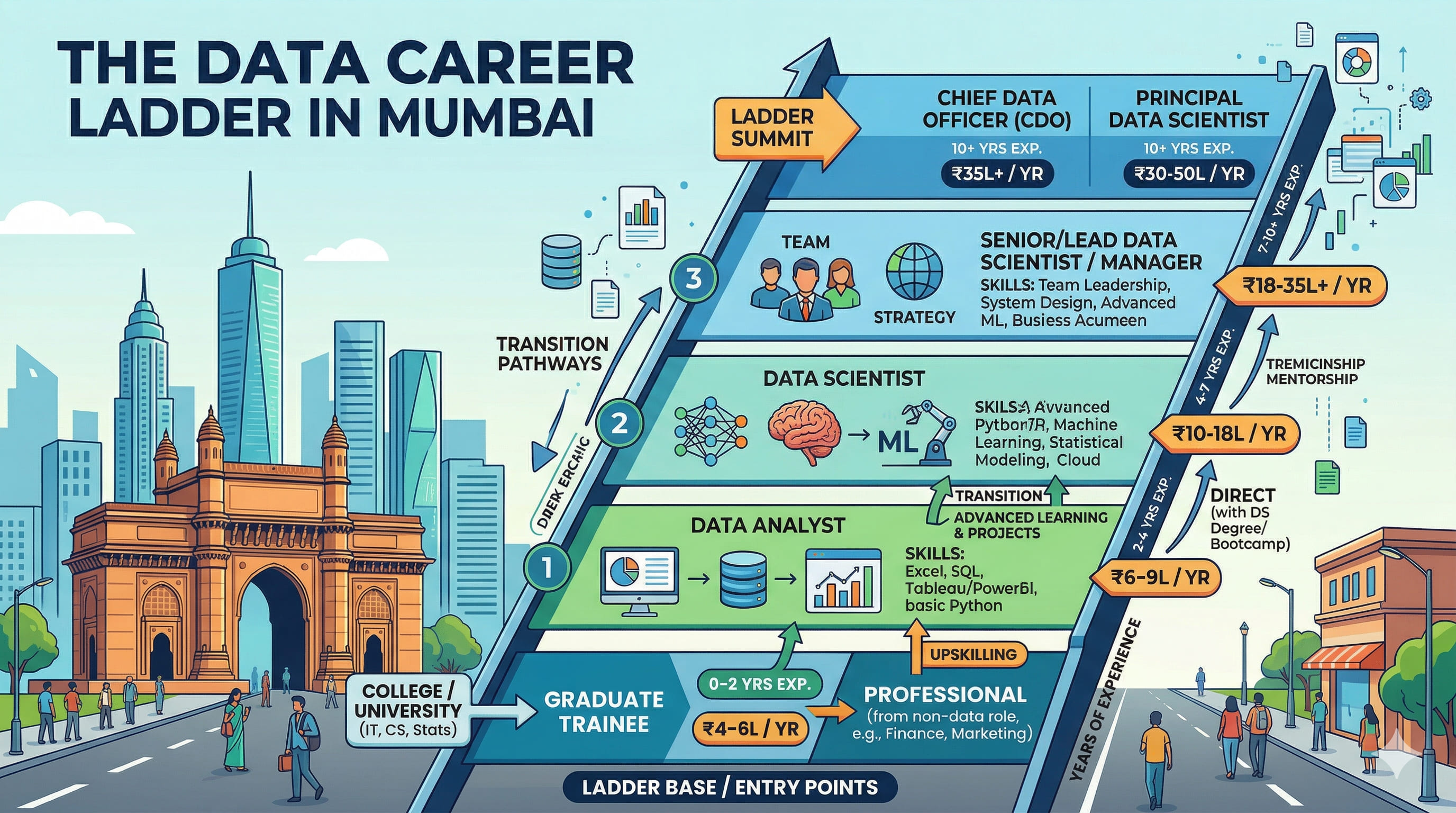
Defining the Roles: Reporter vs. Predictor
Before comparing salaries or skill stacks, you need a mental model that actually sticks. Here is the clearest one:
The Data Analyst: The Business Reporter
A Data Analyst's job is to answer the question: "What happened?"
They are the professional who looks at last quarter's sales numbers and explains why revenue dipped in October. They are the person who builds the dashboard the CEO looks at every Monday morning. They are the analyst who tells the marketing team that campaign A outperformed campaign B by 23% — and here is the breakdown by customer segment.
The Data Analyst's superpower is clarity — taking messy, raw data and turning it into a story that a business person can understand and act on. They do not need to predict the future. They need to explain the present and recent past with precision and visual elegance.
A typical week for a Data Analyst at an HDFC Bank subsidiary in BKC:
- Pull last week's credit card transaction data using SQL
- Clean and validate the dataset (removing duplicates, fixing nulls)
- Build a Tableau dashboard showing spend patterns by geography and customer segment
- Present findings to the product team in a Tuesday review meeting
- Answer ad hoc questions: "Can you tell me how many customers used the contactless feature for the first time this month?"
The output is always a report, a dashboard, a chart, or a recommendation — communicated clearly, grounded in data that already exists.
The Data Scientist: The Business Predictor
A Data Scientist's job is to answer the question: "What will happen next?"
They are the professional who builds the model that predicts which loan applicants are likely to default before the bank approves the application. They are the engineer who creates the recommendation algorithm that decides what Nykaa shows you the moment you open the app. They are the analyst who builds a churn prediction model that flags customers likely to cancel their subscription — a week before they do it.
The Data Scientist's superpower is foresight — using statistical models and machine learning to make predictions about the future that are reliable enough to drive business decisions.
A typical week for a Data Scientist at a Fintech startup in Powai:
- Review model performance logs — did the fraud detection model maintain its precision/recall threshold?
- Run feature engineering experiments: does adding the customer's transaction velocity over 48 hours improve the churn model's AUC score?
- Train an updated version of the credit risk model on fresh data
- Present model performance to the risk team: "Here is the confusion matrix, and here is the estimated annual savings from reduced defaults"
- Debug a data pipeline issue that is causing feature values to drift
The output is always a model, a prediction, a probability score — something that does not exist in the raw data but is created by applying mathematics to it.
Skill Stack Comparison: What You Actually Need to Learn
This is where the rubber meets the road for anyone planning their next 12–18 months of skill-building.
| Category | Data Analyst | Data Scientist | Transition Gap |
|---|---|---|---|
| Primary Role | Analyze past data, create reports & dashboards | Build predictive models and intelligent systems | Shift from reporting → predicting |
| Core Skills | SQL, Excel, basic Python | Advanced Python, Machine Learning, Statistics | Deep technical + mathematical skills |
| Programming Level | Beginner to Intermediate | Intermediate to Advanced | Writing optimized, production-level code |
| Statistics | Descriptive stats, basic testing | Probability, inferential stats, Bayesian methods | Strong statistical foundation required |
| Machine Learning | Limited or none | Regression, Classification, Clustering, NLP | Core requirement for DS roles |
| Mathematics | Basic algebra | Linear algebra, calculus | Needed to understand ML algorithms |
| Data Handling | Structured data (SQL, Excel) | Structured + unstructured + big data (Spark, Hadoop) | Handling scale & complexity |
| Visualization Tools | Tableau, Power BI, Excel | Matplotlib, Seaborn, Plotly + storytelling | More technical + narrative-driven |
| Tools & Tech Stack | Excel, SQL, BI tools | Python, R, TensorFlow, Scikit-learn, Git, Docker | Expanded ecosystem |
| Business Focus | KPIs, reporting, dashboards | Problem-solving, experimentation, product impact | Strategic thinking required |
| Model Deployment | Not required | APIs, Flask/FastAPI, cloud (AWS, GCP) | Turning models into real products |
| AI / Deep Learning | Rarely used | Neural networks, NLP, deep learning | High-demand specialization |
| End Output | Reports, dashboards, insights | Predictive models, AI systems, automation | Output becomes actionable systems |
| Learning Timeline (2026) | 3–6 months (entry-ready) | 6–12+ months (job-ready transition) | ~6–9 months upskilling gap |
| Salary (India) | ₹3–8 LPA (avg) | ₹8–25+ LPA (avg) | 2x–3x growth potential |
Data Analyst Skill Stack
Foundation (must-have from Day 1):
- Microsoft Excel / Google Sheets — The industry's universal language. Pivot tables, VLOOKUP/INDEX-MATCH, conditional formatting. Every analyst in every company in Mumbai uses this.
- SQL — Non-negotiable. Writing queries to extract, filter, join, and aggregate data from relational databases. Window functions (RANK, LAG, LEAD, PARTITION BY) separate junior analysts from mid-level ones.
- Tableau or Power BI — The visualisation tools that turn your SQL output into a dashboard a CEO can read. Most Mumbai BFSI firms use Power BI; Fintech and startups lean toward Tableau or Looker.
- Basic Python (or R) — Specifically: pandas for data manipulation, Matplotlib/Seaborn for visualisation. You do not need to build models; you need to be able to automate your data prep and handle datasets too large for Excel.
Growth skills (for mid-level and senior analyst roles):
- Advanced SQL (query optimisation, CTEs, stored procedures)
- Python automation for reporting workflows
- Business intelligence tools: Looker, Metabase, Google Data Studio
- Statistical basics: distributions, correlation, A/B test interpretation
- Domain knowledge: understanding the business metrics that matter in your sector (BFSI, E-Commerce, SaaS)
Soft skills that determine your promotions:
- Data storytelling — the ability to build a narrative around numbers, not just a table of them
- Stakeholder communication — explaining technical findings to non-technical business leaders
- Business acumen — understanding why a number matters, not just what it is
Estimated learning timeline to job-ready: 4–6 months for a motivated learner with a Commerce or Engineering background.
Data Scientist Skill Stack
Foundation (must-have from Day 1):
- Advanced Python — NumPy, pandas, scikit-learn, and the ability to write clean, production-quality code. Python is not a tool you use occasionally; it is your primary work environment.
- Statistics and Probability — Probability distributions, Bayes' theorem, hypothesis testing (t-tests, chi-square, ANOVA), p-values, confidence intervals. This is the mathematical backbone of every model you will build.
- Machine Learning — Supervised learning (regression, classification, decision trees, random forests, gradient boosting, SVMs), unsupervised learning (clustering, dimensionality reduction), model evaluation (cross-validation, AUC-ROC, precision/recall, F1 score, RMSE).
- SQL — Same as analysts. You cannot be a Data Scientist without strong SQL; the data still lives in databases.
- Data Wrangling — Handling missing values, encoding categorical variables, feature scaling, outlier detection. Real-world data is never clean, and 60–70% of a Data Scientist's time is spent here.
Growth skills (for mid-level and senior Data Scientist roles):
- Deep learning frameworks: TensorFlow, PyTorch (for computer vision, NLP, time series)
- Big data tools: Apache Spark, Databricks, PySpark
- Cloud ML platforms: AWS SageMaker, Google Vertex AI, Azure ML
- MLOps: model deployment, monitoring, versioning with MLflow and Docker
- Experiment design: A/B testing at scale, multi-armed bandits
- R (in academic, pharmaceutical, or finance-heavy environments)
Soft skills that determine your impact:
- Research mindset — the ability to approach a business problem as a structured hypothesis and design experiments to test it
- Communication — translating model output into business language. "Our model's AUC is 0.87" is useless to a business stakeholder. "Our model correctly identifies 87% of customers likely to churn, with a 12% false alarm rate" is actionable.
- Intellectual humility — models are wrong in interesting ways. The best Data Scientists are the ones who probe their own models' failures hardest.
Estimated learning timeline to job-ready: 10–18 months for a motivated learner. The mathematics foundation takes time that cannot be shortcut.
Salary and Growth in Mumbai: The Honest Numbers
Mumbai's data job market in 2026 offers strong compensation at both ends of the spectrum — but with meaningful differences in trajectory and ceiling.
Data Analyst Salaries: Mumbai 2026
| Experience Level | Salary Range (LPA) | Typical Employer |
|---|---|---|
| Fresher (0–1 yr) | ₹3.5L–₹6.5L | Mid-market BFSI, Analytics agencies, E-Commerce ops |
| Junior (1–3 yr) | ₹6L–₹11L | HDFC, ICICI subsidiaries, Startups |
| Mid-Level (3–6 yr) | ₹11L–₹18L | Fintech, Consulting, E-Commerce |
| Senior Analyst / Analytics Manager (6+ yr) | ₹18L–₹30L | GCCs, BFSI, MNCs in BKC |
Growth ceiling: A Data Analyst who does not upskill toward Data Science or Analytics Engineering typically tops out around ₹22–28L as a Senior Analyst or Analytics Manager. Those who add data science skills, or move into analytics leadership, can reach ₹35–50L+ in senior management roles.
Data Scientist Salaries: Mumbai 2026
| Experience Level | Salary Range (LPA) | Typical Employer |
|---|---|---|
| Fresher (0–1 yr) | ₹6L–₹12L | Startups, Analytics firms, IT services |
| Junior (1–3 yr) | ₹12L–₹20L | Fintech, BFSI CoEs, Product companies |
| Mid-Level (3–6 yr) | ₹20L–₹35L | Nykaa, Razorpay, Zepto, GCCs in Vikhroli/Airoli |
| Senior Data Scientist / Lead (6–10 yr) | ₹35L–₹60L | JP Morgan GCC, HDFC AI CoE, Jio Platforms |
| Principal / Head of Data Science (10+ yr) | ₹60L–₹1Cr+ | Large BFSI, Product unicorns |
Growth ceiling: Significantly higher than Data Analyst, and the path from mid-level to senior moves faster for Data Scientists who stay current with ML advances and build domain expertise in high-value sectors like BFSI or Fintech.
The entry-level gap is real but temporary. A fresher Data Analyst at ₹4.5L and a fresher Data Scientist at ₹8L are separated by roughly 6–12 additional months of learning investment. By mid-career (5–7 years), that gap widens to ₹10–20L annually — a compounding difference that adds up significantly over a career.
Which One Fits You? The Quick Career Quiz
Stop comparing job descriptions and answer these questions honestly. Circle the option that resonates more:
1. When you get a dataset, what is your first instinct?
- A) "Let me visualise this and see what story it tells." → Data Analyst
- B) "Let me build a model and see what it predicts." → Data Scientist
2. Which of these problems sounds more exciting to you?
- A) Building a dashboard that helps a sales manager understand their team's weekly performance → Data Analyst
- B) Building a model that predicts which sales leads are most likely to convert, ranked by probability → Data Scientist
3. How do you feel about mathematics?
- A) Comfortable with statistics and spreadsheets; not looking to do heavy calculus or linear algebra → Data Analyst
- B) I enjoy mathematical problem-solving and am willing to spend months building a statistics foundation → Data Scientist
4. Which career story sounds more like you?
- A) "I want to be the person in the room who explains the data and helps the team make better decisions." → Data Analyst
- B) "I want to be the person who builds the intelligence layer that makes the product smarter." → Data Scientist
5. What is your current background?
- A) Commerce / BMS / BAF / BCom, or Engineering without strong Mathematics → Data Analyst is the faster, more natural entry
- B) Engineering with Maths/Statistics, BSc Mathematics, MSc Statistics → Data Scientist path is more accessible
6. What is your timeline to getting a job?
- A) I want to be job-ready in 4–6 months → Data Analyst
- B) I am willing to invest 12–18 months for a higher-paying entry → Data Scientist
Score: Mostly A's → Start with Data Analyst. Mostly B's → Target Data Science. An even split → Read the next section.
The Bridge Path: Starting as an Analyst, Moving to Scientist
Here is something the internet rarely tells you: the Data Analyst → Data Scientist transition is one of Mumbai's most well-trodden career paths — and it is often smarter than trying to become a Data Scientist directly from zero.
Why? Because:
- Analysts build domain knowledge fast. Two years inside HDFC's analytics team teaches you more about BFSI data than any textbook. That domain expertise makes you a better Data Scientist than a pure-ML engineer who has never worked in banking.
- Analysts learn the data landscape. You understand where data lives, how it is collected, what is messy, and why — knowledge that every Data Scientist needs and that most new graduates lack entirely.
- The income bridge is immediate. Rather than spending 18 months learning data science with no income, you earn ₹5–8L as a junior analyst while building your ML skills on the side — then transition to a ₹14–18L Data Scientist role 24–30 months in.
Many of Mumbai's best Data Scientists at Razorpay, Zepto, and Groww started as Data Analysts at smaller firms in Andheri or Navi Mumbai, built their fundamentals, added Python and ML skills deliberately, and transitioned within 2–3 years.
The bridge requires intentionality: you cannot coast as an analyst and accidentally become a scientist. You need to be building your ML foundation in parallel — dedicating 1–2 hours daily to structured learning while you work.
Mumbai's Hottest Hiring Zones: Where to Target Your Job Search
Knowing the geography of Mumbai's data job market helps you target your efforts and tailor your applications.
BKC (Bandra-Kurla Complex): The BFSI heartland. HDFC Bank, ICICI Bank, Axis, Kotak, NSE, BSE, and multiple insurance firms are headquartered here. Heavy demand for both Data Analysts (dashboards, reporting, regulatory analytics) and Data Scientists (credit risk, fraud detection, customer analytics). Roles here tend to be stable, well-structured, and domain-rich.
Powai (Hiranandani Business Park): Mumbai's startup hub. Nykaa, Zepto, Groww, and a dense cluster of VC-funded startups operate here. Data roles are faster-moving, more product-adjacent, and often offer equity. Data Scientists with product analytics or growth modelling experience are highly valued.
Andheri (MIDC / Marol): A mix of mid-market IT services, media companies, and e-commerce operations. Strong entry-level market for Data Analysts. Good stepping stone before moving to BKC or Powai roles.
Lower Parel: Consulting firms (Deloitte, EY, Accenture), media and entertainment companies, and financial services firms. Strong demand for Data Analysts with strong presentation and stakeholder communication skills.
Vikhroli / Airoli / Navi Mumbai (GCC Belt): JP Morgan, Goldman Sachs, Deutsche Bank, HSBC, and other global banks operate GCCs here. Strong demand for both roles, with premium salaries and global exposure. Competitive to enter but highly rewarding.
Your Next Step: Stop Deciding, Start Mapping
The analyst vs. scientist decision is less a one-time choice and more a starting point. What matters most is not making the perfect choice — it is making a deliberate choice, building toward it with structure, and having expert guidance when you hit the inevitable walls.
TechPaathshala's Data Career Path Workshop is a hands-on session designed for exactly where you are right now: a Commerce student, Engineering graduate, or early-career professional in Mumbai who knows data is the direction but does not yet have a clear, personalised roadmap.
In the workshop, you will:
- Take a structured skills assessment mapped against both the Data Analyst and Data Scientist role requirements — so you know exactly where you stand, not just where you want to go
- Get a personalised 6–12 month learning roadmap tailored to your current background, your target role, and the specific companies and sectors in Mumbai you want to work in
- Learn which Mumbai employers are hiring right now — for entry-level data roles in BKC, Powai, Andheri, and the GCC belt — and what they actually screen for in interviews
- Walk away with a decision — not a list of "it depends" factors but a clear answer: this role, this skill sequence, this timeline, these companies
The workshop is free. Seats are limited because the sessions are small and personalised — not a hundred-person webinar where no one gets a real answer.
👉 Register for the Data Career Path Workshop at TechPaathshala — and arrive at your next interview with a roadmap, not a guess.
TechPaathshala is a Mumbai-based technology education platform helping students and early-career professionals navigate the data, full stack, and AI career landscape — from first fundamentals to first offer.

You Might Also Like