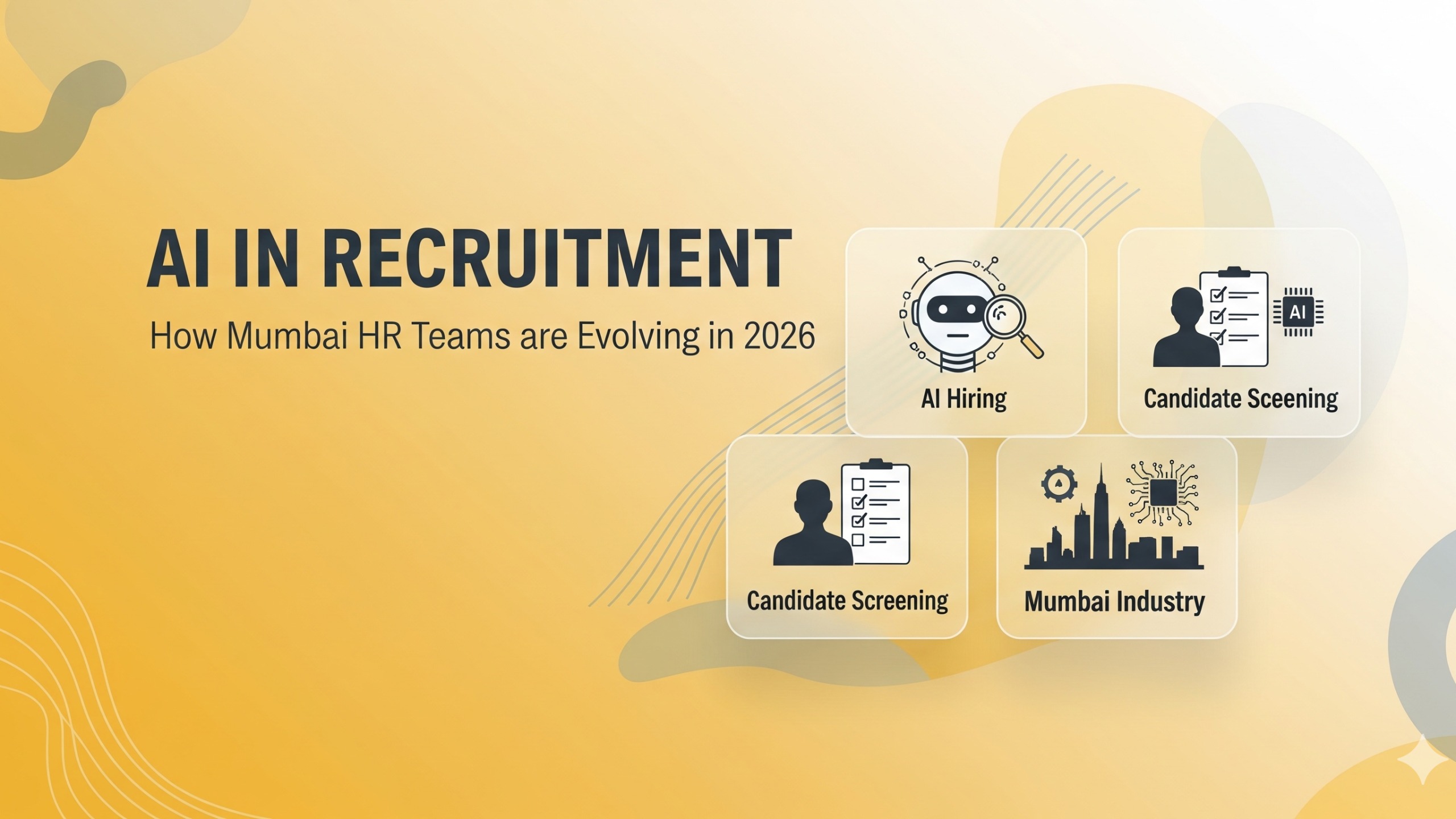
How HR Teams in Mumbai Are Using AI for Recruitment in 2026
Contents
- Why Mumbai HRs Are Pivoting to AI: The Numbers Behind the Urgency
- The Mumbai Recruitment Challenge: Unique Pressures That Demand Smarter Solutions
- The Volume-Quality Paradox
- The Degree Bias Problem in a Skills Economy
- The Candidate Experience Gap
- Key AI Use Cases: What Is Actually Being Deployed in Mumbai's Hiring Teams
- Use Case 1: Autonomous Resume Screening Agents — Skills Over Degrees
- Use Case 2: Conversational AI Chatbots — The 24/7 Talent Engagement Layer
- Use Case 3: AI-Powered Video Assessments — Structured Soft Skills Evaluation
- Why Mumbai HRs Are Pivoting to AI: The "Admin Hell" Problem
- The Mumbai Fintech Case Study: 60% Reduction in Time-to-Hire
- Top AI Recruitment Tools for 2026: A Mumbai HR Leader's Reference
- For Resume Screening and Talent Intelligence
- For Candidate Engagement and Scheduling
- For Assessment and Evaluation
- The "Human + AI" Partnership: What Mumbai Recruiters Must Own
- Ready to Lead Mumbai's AI Recruitment Transformation?
Mumbai has always been India's most competitive hiring market. The city that concentrates the headquarters of India's largest banks, the offices of its most-funded Fintech startups, the engineering hubs of every major global technology firm with an India presence, and the corporate corridors of BKC and Powai — this city generates a volume of recruitment activity that stretches even well-resourced HR teams to their limits.
The ai hr recruitment Mumbai 2025 challenge is specific and well-documented: a mid-size Fintech company in Andheri posting a Senior Backend Developer role will typically receive 400–600 applications within 72 hours. A banking technology firm in BKC hiring for a product management role will generate 1,200+ resumes before the job posting is two weeks old. A Series B startup in Powai filling five engineering positions simultaneously will have talent acquisition leads manually reviewing thousands of applications across a six-week hiring cycle — while also managing candidate communication, coordinating interview panels, negotiating offers, and trying to prevent the best candidates from accepting competing offers that arrived three days earlier.
This volume is not a temporary spike. It is the structural baseline of Mumbai's talent market in 2026. And the HR teams that are winning — that are hiring faster, hiring better, and burning out less — are the ones that have stopped trying to solve a volume problem with human bandwidth alone and have started deploying AI as a first-line operational partner.
This post is for the CHRO who knows AI is coming but wants a clear-eyed view of what it actually does in practice. For the Talent Acquisition manager who is tired of hearing vendors claim AI will "transform hiring" without explaining precisely how. And for the HR generalist who wants to know which tools are worth evaluating and which are hype.
Why Mumbai HRs Are Pivoting to AI: The Numbers Behind the Urgency
The case for AI in Mumbai recruitment is not philosophical — it is arithmetic.
A senior Talent Acquisition professional in Mumbai can meaningfully evaluate approximately 80–100 resumes per day before the quality of their assessment degrades. Against an average application volume of 600+ per role, this means a three-week screening backlog before the first interview is scheduled — even before accounting for the rest of the TA team's workload.
The consequences are not just operational. They are competitive.
The best candidates — specifically, the software developers, product managers, and data scientists that Mumbai's most aggressive employers are competing to hire — are typically in active consideration by three to five companies simultaneously. The average time-to-offer for a strong candidate in Mumbai's tech market is 18–22 days from initial application. The average time a highly competitive candidate will wait before accepting another offer: 12–14 days.
The arithmetic is brutal: if your process takes longer than the competition's, you lose the candidates you most wanted to hire, and you are left selecting from the ones everyone else passed on.
AI in recruitment does not solve the talent shortage. It solves the process gap — the administrative and operational overhead that sits between a qualified candidate applying and a human recruiter having a meaningful conversation with them. That gap, in Mumbai's 2026 market, is where most hiring opportunities are lost.
The Mumbai Recruitment Challenge: Unique Pressures That Demand Smarter Solutions
Before examining the tools, it is worth being specific about what makes Mumbai's hiring environment distinctly challenging — because the AI solutions that matter most are the ones that address Mumbai's specific pressure points, not generic hiring challenges from a US market context.
The Volume-Quality Paradox
Mumbai generates enormous application volumes that are disproportionately broad in quality range. The city's competitive job market means that many candidates apply to roles outside their genuine experience range, hoping the volume of applications will produce results. The practical consequence for TA teams: a 600-application pipeline for a senior role may contain 40–60 genuinely qualified candidates, with the remaining 540+ requiring time to triage but ultimately being unsuitable.
Manual screening at this ratio is not just inefficient — it actively harms hiring quality, because screeners under volume pressure develop shortcuts that miss good candidates in favour of obvious ones.
The Degree Bias Problem in a Skills Economy
Mumbai's hiring market has historically leaned heavily on degree credentials — IIT, IIM, or top-tier engineering college affiliations — as first-pass screening proxies. This creates a structural disadvantage for the large cohort of skilled developers, data analysts, and product professionals who have built genuine expertise through bootcamps, self-directed learning, or non-tier-one institutions.
In a market where a developer from a second-tier engineering college with an excellent GitHub portfolio and two production apps deployed may be genuinely more capable than a tier-one graduate with weaker hands-on skills, degree-first screening is a costly inefficiency — for both companies and candidates. AI screening that assesses skills rather than credentials directly addresses this structural problem.
The Candidate Experience Gap
Mumbai's most competitive candidates have high expectations for responsiveness and respect. A candidate who submits a strong application and receives no acknowledgement for five days, or who cannot find out the status of their application without chasing a recruiter three times, is a candidate who has already mentally moved on.
The volume pressures that slow down human response create a candidate experience problem that compounds the competitive disadvantage — the candidates most worth hiring are the ones most likely to withdraw from a slow process.
Key AI Use Cases: What Is Actually Being Deployed in Mumbai's Hiring Teams
Use Case 1: Autonomous Resume Screening Agents — Skills Over Degrees
The most impactful and most widely adopted AI recruitment tool in Mumbai's 2026 market is the autonomous screening agent — software that processes hundreds or thousands of applications, evaluates candidates against a defined skills and experience framework, and produces a ranked shortlist for human review.
Modern screening agents (tools like Eightfold AI, Paradox's Olivia, Greenhouse, and Lever's AI screening features) have moved well beyond keyword matching. They evaluate:
- Skills mentioned in context, not just listed — distinguishing between "familiar with Kubernetes" mentioned in an online course section and "led migration of 12 microservices to Kubernetes EKS" in an experience description
- Career trajectory signals — whether a candidate's progression suggests genuine growth rather than lateral title changes
- Portfolio and project evidence — parsing GitHub links, portfolio URLs, and project descriptions for concrete evidence of the skills being claimed
- Culture and fit indicators — company types, team sizes, and industry exposure patterns that suggest alignment with the role's environment
The skills-over-degrees shift in practice: A Mumbai Fintech company using AI screening can now explicitly deprioritise degree as a ranking factor and upweight GitHub activity, project complexity, and relevant technology experience. The result: shortlists that include candidates the previous process would never have surfaced — developers who taught themselves, built production applications, and developed genuine expertise through non-traditional paths.
Why this matters specifically in Mumbai: The city's talent pool is more diverse in its development pathways than tier-one cities in other markets. A screening system that rewards demonstrated skill regardless of educational credential accesses a significantly larger portion of that talent pool — and produces better hires.
Implementation consideration: AI screening agents are only as unbiased as their training data and the criteria they're given. HR teams implementing these tools should audit their shortlists periodically for demographic patterns — ensuring that the efficiency gain does not inadvertently encode existing biases at scale. The tool is a force multiplier for good criteria and for bad ones equally.
Use Case 2: Conversational AI Chatbots — The 24/7 Talent Engagement Layer
Mumbai's candidate pool includes a significant proportion of professionals who are job-searching actively while employed — sending applications in the evening, checking status on their commute, and unable to call an HR line during business hours. For this majority, the gap between "application submitted" and "first human contact" is where candidate interest erodes most rapidly.
Conversational AI chatbots deployed on career pages and applicant tracking systems address this gap by maintaining active, contextual communication with every candidate in the pipeline — simultaneously and around the clock.
What these tools actually do:
Paradox (Olivia) is one of the most widely deployed conversational recruitment AI systems globally, and is gaining adoption among Mumbai's larger employers and staffing firms. Olivia handles:
- Immediate application acknowledgement and status updates (eliminating the 48-hour black hole that currently follows most applications)
- Initial screening conversations — asking structured questions about availability, notice period, salary expectations, and specific role requirements, and recording responses into the ATS automatically
- Interview scheduling — coordinating panel availability, sending calendar invites, and managing reschedule requests without human involvement
- FAQ responses — answering the 15–20 candidate questions that TA teams answer identically hundreds of times per month (work-from-home policy, benefits overview, interview process structure)
Leena AI is a prominent Indian AI platform that includes recruitment chatbot functionality alongside HR operations capabilities. For Mumbai-based companies that want a product developed with Indian market context — including Hindi-language support and familiarity with Indian employment norms — Leena AI offers practical advantages over global alternatives.
The operational multiplier: A TA team that deploys a conversational chatbot effectively can manage 4–5x the number of active candidates without proportional headcount growth. More significantly, it can maintain a candidate experience quality that previously required a large, dedicated candidate relations function — improving offer acceptance rates and employer brand perception simultaneously.
Use Case 3: AI-Powered Video Assessments — Structured Soft Skills Evaluation
The evaluation of soft skills, communication style, and cultural fit has historically been one of the most time-intensive and least reliable stages of the recruitment process. It is time-intensive because it requires senior recruiters or hiring managers to conduct live interviews — typically 30–45 minutes each — with a large candidate cohort before shortlisting for final rounds. It is unreliable because unstructured conversational interviews are subject to well-documented human cognitive biases: affinity bias, confirmation bias, and halo effects that favour candidates who are similar to the interviewer regardless of actual capability.
AI-analysed video interviews are addressing both problems — at scale, with structured consistency.
How it works: Candidates at a defined pipeline stage receive a link to an asynchronous video interview platform. They record responses to a standardised set of questions (typically 3–6 questions, 2–3 minutes per response). The AI analyses both the verbal content (answer quality, relevance, structure) and — in more advanced implementations — non-verbal signals (speech clarity, organisation of thought, confidence indicators).
HireVue is the most prominent platform in this category globally and is being adopted by several of Mumbai's larger banking technology employers and multinational firms operating in BKC. The system generates a structured assessment report for each candidate that can be reviewed by a human recruiter in 5–8 minutes rather than the 45-minute live interview it replaces.
The critical caveat that serious HR leaders must understand: AI video assessment of non-verbal signals (facial expression analysis, tone of voice scoring) remains a scientifically contested area. The evidence that these signals predict job performance reliably is not settled, and the potential for bias — against candidates with non-native accents, atypical communication styles, or neurodivergent presentation — is real. Mumbai's diverse talent pool makes this consideration particularly important.
The most defensible implementation: use AI video tools primarily for structured content analysis (the quality and relevance of verbal answers) rather than non-verbal signal scoring, and treat the AI output as a structured reference document for human review rather than a pass/fail filter. The time saving is real and substantial even without relying on the contested non-verbal layer.
| Recruitment Stage | Traditional Process | AI-Augmented Process | Time Saved |
|---|---|---|---|
| Job Description Writing | 2–3 hours per JD, manual research | AI drafts from role framework in 15 minutes; TA refines | 75–80% |
| Resume Screening | 3–5 minutes per resume × 600 = 30–50 hours | AI scores and ranks shortlist in minutes; TA reviews top 50 | 85–90% |
| Initial Candidate Outreach | Manual emails to 50+ candidates per role | Chatbot sends personalised, contextual messages to all | 90%+ |
| Interview Scheduling | 2–4 hours of calendar coordination per role | Chatbot handles scheduling and reminders automatically | 85–90% |
| First-Round Screening Interview | 30–45 min per candidate × 20 candidates = 10–15 hours | Async video interview reviewed in 5–8 min per candidate | 75–80% |
| Candidate Status Communication | Manual email/call updates, frequently delayed | Chatbot provides real-time status to all candidates | 95%+ |
| Post-Interview Feedback Compilation | Manual collection from panel members | AI aggregates panel scores and comments into summary report | 60–70% |
| Overall Time-to-Hire | 6–10 weeks average for technical roles | 2–4 weeks with full AI-augmented funnel | 40–60% |
Why Mumbai HRs Are Pivoting to AI: The "Admin Hell" Problem
There is a conversation happening in Mumbai's HR community that does not make it into vendor presentations or LinkedIn posts, but that is real and widespread: talented recruiters are leaving the profession because the administrative burden has become professionally crushing.
A senior TA professional in Mumbai who joined their company to build relationships, develop market intelligence, and make strategic talent decisions finds themselves spending 60–70% of their time on tasks that require no judgment: sending application acknowledgements, answering identical candidate questions, chasing hiring managers for feedback, scheduling and rescheduling interviews, updating ATS records, and formatting screening notes.
This is not a resource allocation problem that can be solved by hiring more recruiters. The administrative overhead scales with hiring volume — and Mumbai's hiring volumes are not decreasing. The only structural solution is automating the judgment-free layer, which is precisely what AI recruitment tools are designed to do.
What happens when TA teams get their time back:
Deeper talent market intelligence. Senior recruiters who are not consumed by scheduling and correspondence have time to track competitor hiring patterns, identify passive candidate pools, and develop the market knowledge that turns good hiring into great hiring.
Relationship-led candidate engagement. The best candidates — passive candidates who are not actively applying, highly competitive candidates who are weighing multiple offers, candidates who need to be persuaded that this role is the right career move — require human relationship-building. No AI tool closes a strong candidate who is 60% committed. A skilled recruiter who knows the hiring manager, understands the team culture, and can make a compelling personal case for the opportunity does.
Strategic talent advisory. HR leaders who can advise on workforce planning, build talent pipeline strategies, and make the business case for people investments rather than just filling roles are significantly more valuable to their organisations. This work requires the time and cognitive bandwidth that administrative overload currently consumes.
The accurate framing for AI in Mumbai recruitment is not "AI is replacing HR." It is "AI is finally freeing HR professionals to do the work they were hired to do."
The Mumbai Fintech Case Study: 60% Reduction in Time-to-Hire
A mid-size Fintech company based in BKC — a payments infrastructure startup with 200+ employees and an aggressive 2026 hiring plan — faced a specific version of the Mumbai recruitment problem: a 70-person engineering headcount expansion required in 9 months, with a talent market where strong backend developers with payments domain experience receive 4–5 competitive offers simultaneously.
Their previous hiring process had an average time-to-hire of 52 days for technical roles. At that pace, with that competitive landscape, they were consistently losing their top candidates by Day 35.
The implemented changes:
Phase 1 — Screening automation: Deployed an AI screening layer that processed applications using a custom skills framework prioritising Spring Boot experience, payment protocol knowledge, and production system ownership over educational credentials. Shortlist generation time: 4 hours instead of 3 weeks.
Phase 2 — Chatbot engagement: Implemented a conversational AI (Paradox) for immediate candidate acknowledgement, initial qualification screening, and interview scheduling. Candidate response-to-interview-scheduled time: reduced from 5–7 days to 4–6 hours.
Phase 3 — Async video screening: Introduced structured video interviews at the 50-candidate stage. Reviewing time: 6 minutes per candidate versus 45 minutes for a live screen.
Phase 4 — Panel coordination automation: Used calendar AI integration to reduce the scheduling overhead between screening and panel interviews from 5–7 days to 24–36 hours.
The result: Average time-to-hire for technical roles: 21 days. A 60% reduction. Offer acceptance rate: improved from 64% to 81%, attributed to faster process momentum and better candidate communication. Quality of hire (measured by 90-day performance review scores): unchanged or improved, as the AI shortlisting surfaced a broader, more skills-diverse candidate pool than the previous credential-weighted manual process.
The TA team's composition did not change. Their workload in terms of applications managed increased by 40% as the hiring plan accelerated. Their administrative hours per hire decreased by 65%. The net effect: the same team, doing dramatically more hiring, with better outcomes, and significantly less time spent on work that did not require their judgment.
Top AI Recruitment Tools for 2026: A Mumbai HR Leader's Reference
For Resume Screening and Talent Intelligence
- Eightfold AI: Deep skills inference, diversity-conscious screening, talent rediscovery from existing ATS database. Strong fit for large enterprises with 10,000+ application volumes.
- HireEZ (formerly Hiretual): Outbound recruiting and passive candidate sourcing with AI matching. Particularly useful for Mumbai TA teams building proactive pipelines rather than just processing inbound applications.
- Greenhouse / Lever (with AI features): ATS platforms with increasingly capable native AI screening. Lower barrier to entry for teams that are already on these platforms.
For Candidate Engagement and Scheduling
- Paradox (Olivia): The market leader for conversational recruitment AI. Best in class for high-volume scheduling, FAQ handling, and candidate communication. Increasingly adopted by Mumbai's larger employers.
- Leena AI: Indian-built HR AI platform with strong recruitment chatbot capabilities. Advantages in local market context, Hindi-language support, and familiarity with Indian employment norms.
- Calendly + AI integrations: For smaller TA teams not ready for an enterprise chatbot platform, AI-enhanced scheduling automation is a lower-complexity starting point.
For Assessment and Evaluation
- HireVue: Video interview platform with AI-assisted content analysis. Widely deployed in banking and enterprise contexts. Use with awareness of the limitations of non-verbal signal scoring.
- Mercer | Mettl: Indian-origin assessment platform with strong technical skills testing. Used by many Mumbai IT services companies for engineering candidate assessment. AI features for auto-scoring and reporting.
- Karat: Technical interview platform that conducts structured coding interviews with human interviewers but AI-assisted evaluation and consistency tooling. Strong for developer hiring.
The "Human + AI" Partnership: What Mumbai Recruiters Must Own
The AI tools above are powerful. They are also limited in specific, important ways — and understanding those limitations is what separates HR leaders who use AI effectively from those who misuse it.
AI does not understand organisational culture the way a recruiter does. The judgment about whether a candidate will thrive in a specific team — with a specific tech lead's management style, a specific company's pace, a specific culture's norms around disagreement and collaboration — requires the kind of nuanced, relationship-based knowledge that only humans who know the organisation deeply can apply. Culture fit screening by AI produces proxy signals at best and harmful correlations at worst.
AI does not negotiate. A strong candidate weighing three offers who needs to be persuaded that your company's mission, growth opportunity, and team quality justify choosing you over the highest-paying option needs a human who can make a personal, compelling case. The close is always a human conversation.
AI does not build employer brand. Mumbai's best employers are known in the talent market because of the conversations their people have — at meetups in Powai, in LinkedIn posts, in the reputation that spreads candidate to candidate through genuine human relationships. AI can optimise the efficiency of the funnel; only humans build the reputation that fills it.
AI amplifies your criteria — good or bad. If your hiring criteria are biased, AI scale will apply that bias to thousands of decisions faster than your previous process. The accountability for the fairness of AI-assisted hiring decisions rests with the HR leaders who configure and monitor these systems.
The HR professional who understands both the power and the limits of these tools — who deploys AI in the stages where judgment is not required, and reserves human attention for the stages where it is irreplaceable — is the professional who captures the full value of the AI recruitment revolution without its risks.
Ready to Lead Mumbai's AI Recruitment Transformation?
The competitive advantage in Mumbai's 2026 hiring market belongs to the HR teams that act now — that build the AI-augmented processes, develop the tool fluency, and establish the "human + AI" frameworks that will define best-practice talent acquisition for the next decade.
TechPaathshala's HR Tech & AI Strategy Workshop is designed specifically for Mumbai's modern HR leaders: CHROs, TA managers, and HR generalists who want to move from awareness to implementation — with the practical knowledge and the peer community to do it right.
In the workshop, you will:
- Audit your current recruitment process against the AI-augmented benchmark — identifying the specific stages where tools can recover the most time and improve candidate quality
- Evaluate and compare the leading tools for Mumbai's market — with hands-on demonstrations and honest assessment of what each tool does well and where it falls short
- Build an implementation roadmap — a phased, realistic plan for AI adoption calibrated to your team's size, your hiring volumes, and your existing technology infrastructure
- Develop the "human + AI" framework for your organisation — clear guidelines on which decisions AI should inform, which it should execute, and which must remain entirely human
- Connect with Mumbai's HR community — CHROs and TA leaders from Mumbai's startup, Fintech, and enterprise tech sectors who are navigating the same transformation, sharing what is working in practice
The workshop is limited to senior HR and TA professionals to ensure the conversation stays strategic and peer-level.
👉 Register for TechPaathshala's HR Tech & AI Strategy Workshop — and build the recruitment capability that gives your company a structural advantage in Mumbai's most competitive talent market.
TechPaathshala is a Mumbai-based technology education platform that serves both the developer community and the business leaders who hire and manage them. Our HR Tech programs are built with input from Mumbai's CHRO community to ensure they reflect the city's actual talent market realities.

You Might Also Like