College vs Bootcamp vs Self-Learning: What Works in 2026?
Contents
Everyone seems to have an opinion on this. Your parents want you to get a degree. Your college friend swears by a bootcamp they finished in four months. And that guy on YouTube says he landed a job after six months of self-study.
What should you do then if you want to get into AI or data science, particularly if you need to find a reliable machine learning course in Mumbai?
This all depends on your needs, preferences, financial possibilities, and job expectations.
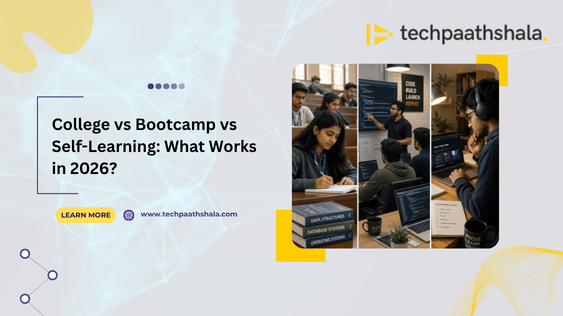
Let’s compare college, Bootcamp and self-learning What works in 2026?
The Changing Tech Education Landscape
A few years back, a college degree was basically non-negotiable.
That's not the case anymore. Companies across India and globally have shifted their focus from certificates to capabilities. They want people who can build things, solve real problems, and get started on day one.
This development has made way for bootcamps and self-learners in a major way.
However, every route still has its pros and cons. Let us discuss that.
Option 1: Traditional College Education
College education is always the most chosen option after class 12.
B.Tech, BCA, B.Sc IT, and computer science streams will give you a good platform and good knowledge base that cannot be achieved on your own.
Benefits of College
- Recognised qualification, widely
- Strong theoretical foundation built
- Campus placements often available
- Faculty, labs, peer learning
- Long-term networking opportunities
Challenges of College
- The curriculum often becomes outdated
- Limited real-world project focus
- Higher cost overall
- Fixed, inflexible learning pace
Some colleges are still teaching technologies that barely anyone uses in production anymore. Students frequently need extra training just to become job-ready, which kind of defeats the point.
Who Should Choose College?
College is right for you if:
- You want an recognized degree
- You plan on studying further
- You like learning through structure
- You require placement assistance
Option 2: Coding Bootcamps
Boot camps have become increasingly popular in India over the past few years for a very obvious reason.
The boot camp training is entirely focused on making you employment-ready by teaching only relevant skills that matter to your career.
Popular bootcamp training programs in India are machine learning, data science, AI, full-stack development, cloud, and cybersecurity.
Advantages of Bootcamp
- Fast learning as compared to traditional classroom learning
- Curriculum that is oriented towards practical aspects of the industries
- Practical Projects & Learning Using Real Tools
- Placement services and career counseling
- Interaction with industry experts
Taking admission to an excellent machine learning course in Mumbai via a bootcamp will assure you learn about Python, TensorFlow, Scikit-learn, and data analysis.
Challenges of Bootcamps
- There is considerable variation in quality in the providers of bootcamps
- Extremely intense curriculum and may not suit everyone
- Theoretical material is covered less deeply
- Some companies give preference to graduates
Who Should Consider a Bootcamp?
- A bootcamp is recommended if you:
- Want quick access to a tech career
- Are a graduate looking for employment-oriented training
- Are a working professional changing careers
- Value results over credentials
Option 3: Self-Learning
Self-learning has become really powerful with the internet.
Between YouTube, Coursera, fast.ai, Kaggle, and open-source communities, you can learn almost anything for free. And plenty of successful ML engineers in India built their skills exactly this way.
Benefits of Self-Learning
- Lowest Cost Learning Method
- 100% Flexible Schedule
- Total control over the learning process
- Complete freedom to learn about any technology
- Resources are abundant
Challenges of Self-Learning
- Lack of structure or a roadmap
- Lack of mentorship
- Hard to stay motivated
- Little opportunity for networking
- No certificate
The biggest trap? You watch videos for months, feel like you're making progress, and then realize you haven't actually built anything.
Who Should Choose Self-Learning?
Self-study works well for people who are:
- Highly self-motivated
- Knowledgeable about technology in general
- Enjoy working independently
- Always in search of ways to upgrade themselves
Comparing All Three Learning Paths
| Factor | College | Bootcamp | Self-Learning |
| Structure | High | Medium | Low |
| Cost | High | Medium | Low |
| Practical Skills | Medium | High | Depends |
| Industry Relevance | Medium | High | Depends |
| Networking | High | Medium | Low |
| Placement Support | Available | Often Available | Usually Not Available |
| Flexibility | Low | Medium | High |
| Learning Speed | Slow | Fast | Flexible |
What Employers Are Actually Looking for in 2026
This is what is really changing in India's tech recruitment landscape.
Companies are starting to assess:
- Projects on portfolio and GitHub
- Problem-solving in tech interview
- Assignments and case studies
- Internships or freelancing experience
- Ability to apply in real life
A candidate who successfully completed an excellent machine learning program in Mumbai and created three good AI projects would always be better than another who only knows theory, no matter from where they got it.
The Best Approach: Combine Learning Methods
The most successful tech professionals don't pick just one path. They stack them.
Step 1: Build Foundation
Learn programming basics from either your college curriculum or from any online source.
Step 2: Learn Practical Skills
Join a crash course to earn a high salary in machine learning, data science, artificial intelligence, or full stack.
Step 3: Continue Self-Learning
Technology evolves rapidly. Keep yourself updated by self-learning on an ongoing basis.
Step 4: Build Projects
Projects always have greater weightage than certificates. Develop projects. Publish them on Github. Showcase your skills.
Common Mistakes Students Make
Selection Based On Cost Alone
- Cheapest doesn’t mean the best value
- Value counts more than cost
Avoiding Practical Experience
- The need for construction, not studying
- Projects will always trump theory
Going With Trends Blindly
- Select based on your interests
- Interest trumps any fad
Expecting Immediate Outcomes
- Technology skills take steady effort
- Results build over months
Conclusion
There's no universal answer, and anyone who tells you otherwise is selling something.
College builds depth. Bootcamps build speed. Self-learning builds flexibility. The professionals who actually break through tend to combine all three, strategically.
If your goal is a real career in AI or data science, starting with a quality machine learning course in Mumbai while building projects and staying curious is one of the smartest moves you can make in 2026.
Ready to stop overthinking and start building? Check out Techpaathshala and explore programs designed around what the industry actually needs, not what was relevant five years ago.
FAQs
1. Do college degrees still matter in 2026?
Yes, it still has credibility and good fundamentals. However, most of the businesses value skills and even probably more.
2. Can a coding bootcamp replace a college degree?
It will make you job-ready faster but there are some companies, especially if they are looking for senior researchers, that still prefer degree holders.
3. Will self-study enough for a technology-based job?
Maybe, but this is possible if you stick to it and create some concrete projects.
4. Why should one choose a machine learning course in Mumbai?
A structured machine learning course in Mumbai will provide me with industry exposure and mentorship along with practical projects that would fulfill all the needs of the current market.
5. What option gives the quickest way to get a job?
Bootcamps, particularly those supplemented by solid projects, an effective mentor, and personal study at the same time.